

REVIEW · MADRID TUK TUK TOURS
Tour of Castizo Madrid with a private guide in a yellow Tuk-Tuk
Madrid in motion feels different.
This private yellow tuk-tuk tour gives you a fast, first-day feel for Castizo Madrid, bouncing between royal, religious, food, literary, and civic highlights. I love the English-speaking guide/driver approach (you get real answers, not just signs), and I also like that the tuk-tuk can slip into areas big buses can’t. The main drawback is simple: it’s mostly driving, and in heavier traffic the pace can feel more like a city loop than a stop-and-stroll.
You’ll spend about 1 hour to 1 hour 15 minutes seeing major sights and key streets/squares that define central Madrid. It’s priced at $37.95 per person, and that can be good value if you use the time to decide where you want to return later on foot. One more consideration: a tuk-tuk ride can feel a bit exposed, and the experience is more about viewpoints through the streets than lingering inside museums.
If you want an efficient overview without getting stuck in long bus lines or missing the narrow lanes, this is a smart way to start. Just go in expecting a drive-heavy tour, then follow up with museum time on your own schedule.
In This Review
- Key highlights to know before you ride
- The big idea: why Madrid works so well from a tuk-tuk
- Price and time: is $37.95 a smart deal?
- Plaza de Isabel II: starting in the right pocket of the city
- Royal Palace of Madrid: seeing power before you learn it
- Madrid Cathedral: the inside story with big ceiling energy
- Puerta de Alcalá: one gate, five royal gates worth knowing
- Mercado de San Miguel: Spanish food culture in one central stop
- Cervantes connection: stepping into the literary Madrid mood
- The Castizo street-and-square loop: where the city explains itself
- Congress of Deputies: history that still works
- Museo del Prado area: setting up the museum day you’ll want
- Modern Madrid in a historic wrapper: the luxury icon pass-by
- Plaza de Santa Ana: a shaped square since 1810
- Gran Vía: the early 20th-century “main street” feeling
- Guides that can make or break the ride (and how to choose wisely)
- What to expect during the drive: comfort, photos, and pacing
- Should you book this Castizo Madrid tuk-tuk tour?
- FAQ
- How long is the Castizo Madrid tuk-tuk tour?
- What does the $37.95 per person price include?
- Is this tour private?
- Where does the tour start?
- What language is the tour offered in?
- Can I cancel for a full refund?
Key highlights to know before you ride
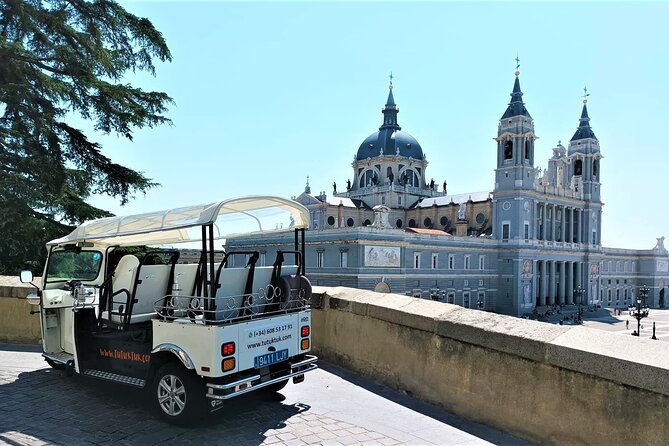
- Private tuk-tuk for just your group, so you can ask questions and move at your comfort level
- Major sights plus the street map of central Madrid, including Puerta del Sol, Ópera, and La Latina areas
- Photo-friendly route through historic gates, plazas, and classic façades
- English offered, with guides who have strong communication skills (and names like Pepe, Miguel, and José show up in the best experiences)
- Entrances not included, so plan on exterior views and learn-first, tickets-second
Buzz the old centre by tuk tuk
- Madrid: Private City Tour by Eco Tuk Tuk★ 4.9 · 3,465 reviews
- Madrid Historical Tour with Local Guide in Eco Tuk Tuk Private★ 5.0 · 876 reviews
- Madrid Express Tour with Local Guide in Eco Tuk Tuk Private★ 5.0 · 413 reviews
- Madrid: Highlights City Tour by Electric Tuk Tuk★ 4.7 · 346 reviews
The big idea: why Madrid works so well from a tuk-tuk
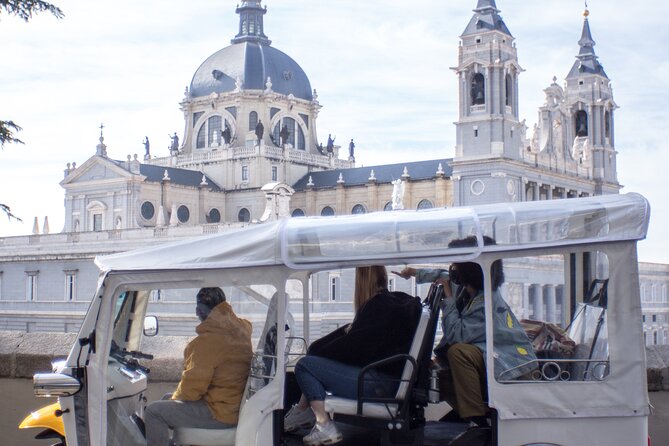
Madrid is one of those cities where “where” matters as much as “what.” You can see the Royal Palace and the Prado from a distance, sure—but the real payoff is connecting them to the streets that stitch the city together: Mayor, Arenal, Segovia, Carrera de San Francisco, Bailén, and Toledo, plus squares like Cebada, de la Paja, Mayor, Puerta del Sol, and de Oriente.
A tuk-tuk fits this mission because it’s quick and flexible. You’re not locked into a big bus route. And since this is a private tour, the guide can pace the stops around your timing—helpful if you’re arriving with jet lag or want a clean overview before committing to a museum ticket.
For your comfort: expect the ride to spend time on wider corridors and around busy areas. One review noted the ride can feel a little scary with traffic, which is believable in a vehicle like this. If you’re sensitive to bumps or close passes, bring calm breathing and keep your expectations realistic: this is a moving viewpoint platform.
Price and time: is $37.95 a smart deal?
At $37.95 per person for about 1 to 1 hour 15 minutes, you’re paying for three things:
1) private transport in a small vehicle, 2) a professional guide/driver, and 3) an organized route that hits many anchor points fast.
What’s not included: entrance fees to monuments and museums. That’s normal for a tour like this, and it actually helps you budget. You’ll get the story and context up front, then decide which places are worth paying for later.
This is usually best when you use the tour like a map. Do it early—then plan your next day around the stops that hooked you. More than one guide experience specifically praised how the tour made it easier to know what to focus on afterward.
A practical value check: if you’re a first-timer and you don’t want to spend your first day stuck figuring out distances, this price can make sense. If you already have museum tickets lined up and you only care about one interior visit, you might be better off with a walking-focused or museum-only plan.
Plaza de Isabel II: starting in the right pocket of the city

The tour starts at Plaza de Isabel II (Centro). That location matters because it puts you close to the core grid of central Madrid and makes it easier to connect later to other areas on foot.
You’ll also end back at the same meeting point. That sounds minor, but it reduces stress on your last hour. You don’t need to hunt for transit or negotiate a finish point. Just build your day around that clean loop.
Royal Palace of Madrid: seeing power before you learn it
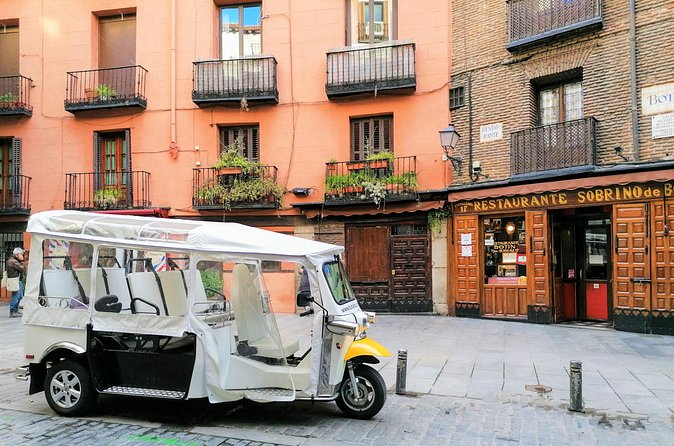
The Royal Palace of Madrid is the big visual anchor: the largest in Western Europe and among the largest worldwide by space, with 135,000+ square meters and 3,418 rooms. That number alone is mind-bending, but the guide context is what makes it land. This isn’t a dead monument—it’s one of the few official residences for heads of state open to the public.
From the outside, you’ll get a sense of scale. In a tuk-tuk, you can take in the façade and surroundings without spending your whole time in a line. The tradeoff is that you won’t be doing the full interior tour here. Entrance fees aren’t included, so treat this as a “set the scene” moment.
Practical tip: if you’re the type who loves rooms, return later with a museum plan. If you love architecture and symbolism, the exterior stop plus the guide explanation is already a payoff.
Private and unhurried, just your party




Madrid Cathedral: the inside story with big ceiling energy
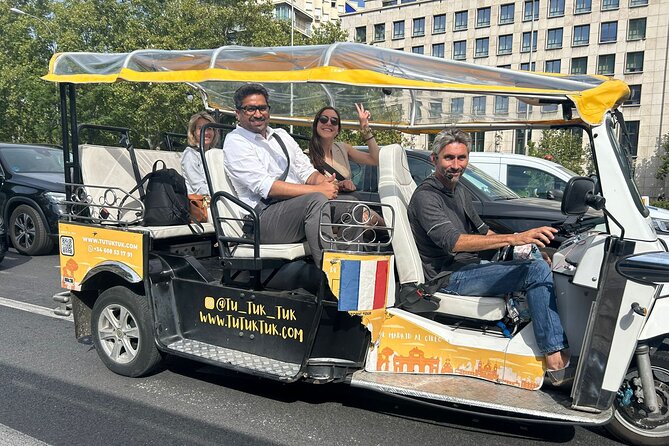
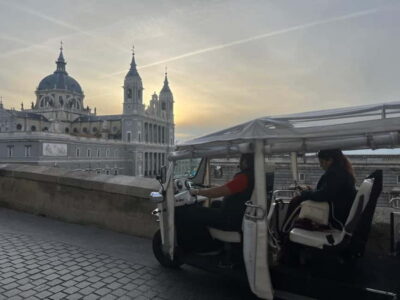
Next comes the Madrid Cathedral, a project that took shape in phases. The first stone was laid in 1883, and in 1885 Pope Leo XIII issued the bull creating the bishopric, shifting the project into what became the cathedral.
The key detail worth knowing is the contrast in interior design: the ceiling paintings and the overall style differ from other churches from the same period. That’s why this stop matters even if you only see it from the street—you’ll understand what you’re looking for when you do come back.
Because entrance fees aren’t included, your view will likely be exterior-focused during the drive-by. Still, the guide framing helps you spot what to watch for later: ceiling artwork, stylistic differences, and the cathedral’s transformation timeline.
Puerta de Alcalá: one gate, five royal gates worth knowing
The Puerta de Alcalá is one of the five old royal gates that once controlled access into Madrid. If you’re used to modern cities where streets feel “open,” gates can be a surprise. They remind you Madrid was once walled and managed like a system.
This is also a great photo stop because the structure gives you strong lines and depth. In a tuk-tuk loop, it’s easy to pull in for a quick look and move on without committing to a long visit.
Mercado de San Miguel: Spanish food culture in one central stop

Then you hit Mercado de San Miguel, often described as a meeting point for gastronomy lovers. It’s in the heart of Madrid, and even if you don’t eat right then, it’s worth seeing because it shows how food culture is embedded in everyday city life—not just as a tourist activity.
What you can do here depends on timing. Since entrance into specific stalls or food sampling isn’t described as included, treat this as a “see it, learn it, maybe snack if it fits your day” moment. This stop works especially well if you want ideas for later meals from the guide.
One review specifically highlighted that the guide offered restaurant recommendations, which is exactly where a market stop pays off. You can use what you learn—food style, neighborhood vibe, what’s popular—and then pick where you want to go next.
Cervantes connection: stepping into the literary Madrid mood
You’ll pass by the former residence of Miguel de Cervantes, author of Don Quixote. This is the kind of stop that feels small on paper but matters for the atmosphere.
Madrid’s identity isn’t just royal or governmental. It also has a writing spine. Even a quick view can help you connect streets to stories—then when you later read or watch adaptations, the city has a face in your mind.
If you’re a literature fan, this is a highlight. If you’re not, it still gives variety and keeps the tour from feeling like only “stone and politics.”
The Castizo street-and-square loop: where the city explains itself
A big part of the experience is the drive through the areas of influence around classic Madrid streets and plazas. You’ll cover:
- Streets: Mayor, Arenal, Segovia, Carrera de San Francisco, Bailén, Toledo
- Squares: Cebada, de la Paja, Mayor, Puerta del Sol, de Oriente
- Neighborhoods referenced along the way: La Latina, Ópera, Las Vistillas
What makes this valuable is the mental map you build. You start to understand why people talk about central Madrid as a set of overlapping districts rather than one simple “downtown.”
This is also where the historic layers click. The guide points out monumental complexes built in the 16th and 17th centuries when the Habsburg dynasty reigned, plus notable earlier and later structures. You’ll see examples like the medieval churches of San Nicolás de los Servitas and San Pedro el Viejo, with the Royal Palace also referenced in this broader historical frame.
Potential drawback: because this is driven/seen from a moving route, you won’t get long, close-up time at every church or façade. But you do get the big picture. If any of these churches pull you in, that’s your cue to plan a later walk when you have time.
Congress of Deputies: history that still works
You’ll pass the Congress of Deputies, the lower house of the Cortes Generales, Spain’s constitutional body representing the Spanish people.
This stop can be surprisingly interesting if you pay attention to what the building symbolizes. It’s not just architecture; it’s a living institution. A guide explanation can help you see the building as a key part of modern Spain, not only a backdrop for tourists taking photos.
Again, entrances aren’t mentioned as included. So expect to learn as you look outward.
Museo del Prado area: setting up the museum day you’ll want
The tour reaches the Museo Nacional del Prado, one of the most important art museums in the world and among the most visited. It’s also described as the most important cultural institution in Spain.
In the time window of this tour, you won’t get full museum coverage. But that’s the point. You’ll see it in context, learn what it represents, and then decide whether you’re going to buy tickets for an interior visit.
If you’re serious about art, I’d treat the tuk-tuk stop as pre-game. You want to come into the Prado with a plan—favorite periods, favorite artists, and a sense of where you want to focus once inside.
Modern Madrid in a historic wrapper: the luxury icon pass-by
There’s also a pass-by of a newer luxury icon described as involving seven historic buildings in the center of Madrid. The tour frames it as a flagship built from older structures—old fabric repurposed for a modern identity.
This is a helpful contrast point after all the royal and civic stops. Madrid doesn’t only preserve; it adapts. You’ll get a quick visual sense of that shift, without needing extra time-consuming stops.
Plaza de Santa Ana: a shaped square since 1810
Next is Plaza de Santa Ana, in the Cortes neighborhood. It dates to 1810 and has gone through multiple urbanization processes that changed its appearance over time. That detail matters because squares aren’t just empty space in Madrid; they’re social infrastructure.
In a tuk-tuk, you’ll likely appreciate it as a view and orientation point, not a long sit-down. Still, it’s a great place to clock the neighborhood energy and decide later if you want to spend your evening nearby.
Gran Vía: the early 20th-century “main street” feeling
Finally, you reach Gran Vía, one of Madrid’s main streets. It’s an important landmark since its construction in the beginning of the 20th century, and it’s tied to commerce, tourism, and leisure.
This is where the tour can feel more like Madrid as a living city rather than a museum of façades. From a vehicle, you get long lines and perspective, which is perfect for photos and for understanding how the city opens up beyond the older lanes.
If you want to do one last walk on your own, Gran Vía is a decent candidate because it’s built for strolling and people-watching—without needing you to guess where you are.
Guides that can make or break the ride (and how to choose wisely)
This kind of tour lives or dies on the guide/driver’s personality and how they manage driving time versus story time. The best guide experiences you’ll see emphasize practical context, clear English, and photo-friendly pacing.
Names that came up with standout experiences include:
- Pepe, praised for being friendly and knowledgeable and speaking fluent English
- Magel, specifically recommended for excellent English
- Miguel, praised for smiles, laughter, and strong monument guidance
- Frédéric, described as multilingual, fun, and very engaging
- José and David, noted for strong Madrid history framing and good restaurant recommendations
You can’t always request a specific person, but you can use the same strategy: ask your guide early what the tour will focus on, and tell them what you want most—more history talk, more photo stops, or faster overview to set your next day plans.
Also: weather matters. One experience pointed out that even light rain can change the mood. If conditions look iffy, ask how they handle it, and plan to keep layers handy.
What to expect during the drive: comfort, photos, and pacing
Here’s the real-life expectation to set correctly:
- Lots of driving, not lots of walking. You’ll see many sights, but you won’t treat this like a walking tour with extended time at each monument.
- Traffic will shape the timing. If you’re sensitive to stress, choose a day with calmer congestion and give yourself extra time afterward.
- Photo opportunities are built in. Multiple guide experiences highlighted good photo moments. Keep your camera ready, especially at gates, plazas, and museum exteriors.
- The vehicle is part of the fun. People like this because it feels closer to the streets and can access narrower lanes.
If you want the best overall result, plan your next day as an extension: pick one or two interior visits (like a museum you care about) and add a long walk in the neighborhood that excited you on the tuk-tuk route.
Should you book this Castizo Madrid tuk-tuk tour?
Book it if:
- You’re arriving for the first time and want a high-efficiency overview
- You prefer seeing central Madrid from the street, including historic lanes you might miss on foot
- You want an English guide who can connect sights to street-level context, then point you toward what to do next
Skip it (or switch style) if:
- You only care about one major interior visit and don’t want an overview
- You get uncomfortable in moving traffic and open-air vehicles
- You’re hoping for long, slow stops at every monument (this route is designed to move)
My bottom line: this is a smart, good-value start for Madrid. You’ll come away with a clearer map of central neighborhoods, plus the stories behind major landmarks like the Royal Palace, Madrid Cathedral, Puerta de Alcalá, the Prado, and Gran Vía. Then you can build the rest of your trip around the parts that grabbed you most.
FAQ
How long is the Castizo Madrid tuk-tuk tour?
It runs about 1 hour to 1 hour 15 minutes.
What does the $37.95 per person price include?
The price includes private transportation and a professional guide/driver. Entrance fees to monuments and museums and tips are not included.
Is this tour private?
Yes. It’s a private tour/activity, meaning only your group participates.
Where does the tour start?
It starts at Plaza de Isabel II, Centro, 28013 Madrid, Spain and ends back at the meeting point.
What language is the tour offered in?
It’s offered in English.
Can I cancel for a full refund?
Yes. You can cancel up to 24 hours in advance for a full refund.
More Tour Reviews in Madrid
- Madrid: Tour Bernabéu Entry Ticket
★ 4.5 · 21,573 reviews - Madrid: Prado Museum Entry Ticket
★ 4.6 · 20,699 reviews - Madrid: “Emociones” Live Flamenco Performance
★ 4.8 · 12,866 reviews - Madrid: Panoramic Route City Tour
★ 4.1 · 12,259 reviews - Madrid: Live Flamenco Show with Food and Drinks Options
★ 4.5 · 9,901 reviews - Avila & Segovia Tour with Tickets to Monuments from Madrid
★ 5.0 · 9,762 reviews
Private Days in the Capital
- Madrid: Private City Tour by Eco Tuk Tuk
★ 4.9 · 3,465 reviews - Madrid Welcome Tour with Local Guide in Eco Tuk Tuk Private
★ 5.0 · 2,936 reviews - Madrid Historical Tour with Local Guide in Eco Tuk Tuk Private
★ 5.0 · 876 reviews - Toledo Private Tour with Licensed Guide and Driver from Madrid
★ 5.0 · 637 reviews - Madrid Private Segway tour. Retiro Park – Centro Historico
★ 4.9 · 636 reviews - Madrid Express Tour with Local Guide in Eco Tuk Tuk Private
★ 5.0 · 413 reviews
Tuk Tuk Around the Middle
- Madrid: Private City Tour by Eco Tuk Tuk
★ 4.9 · 3,465 reviews - Madrid Welcome Tour with Local Guide in Eco Tuk Tuk Private
★ 5.0 · 2,936 reviews - Madrid Historical Tour with Local Guide in Eco Tuk Tuk Private
★ 5.0 · 876 reviews - Madrid Express Tour with Local Guide in Eco Tuk Tuk Private
★ 5.0 · 413 reviews - Madrid: Highlights City Tour by Electric Tuk Tuk
★ 4.7 · 346 reviews - Madrid: City Highlights Tuk Tuk Tour
★ 4.4 · 334 reviews
Just Added: New Madrid Tour Reviews




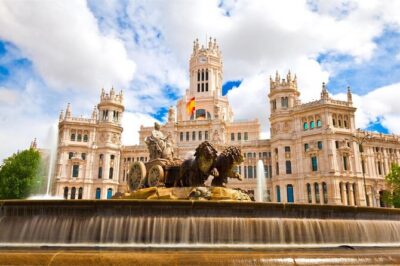
Madrid Tuk Tuk Tours, compared.
 ★ 4.9Private City Tour by Eco Tuk TukFrom $283,465 reviews
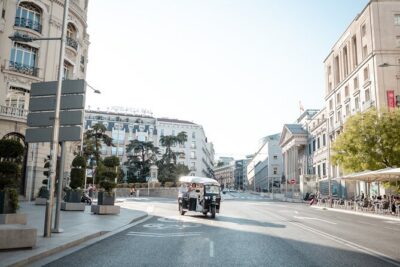 ★ 5.0Madrid Welcome Tour with Local Guide in Eco Tuk Tuk PrivateFrom $282,936 reviews
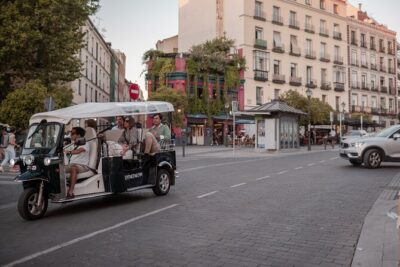 ★ 5.0Madrid Historical Tour with Local Guide in Eco Tuk Tuk PrivateFrom $28876 reviews
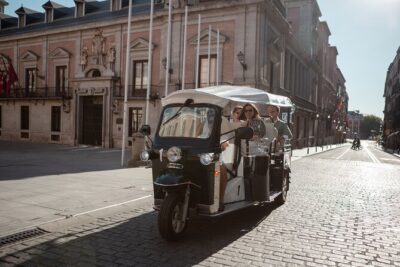 ★ 5.0Madrid Express Tour with Local Guide in Eco Tuk Tuk PrivateFrom $28413 reviews
 ★ 4.7Highlights City Tour by Electric Tuk TukFrom $28346 reviews
 ★ 4.4City Highlights Tuk Tuk TourFrom $94334 reviews
 ★ 4.4Tour Guiado En Tuk Tuk Recorre Avila De La Forma Mas ComodaFrom $10235 reviews
 ★ 4.6City Tours – 6 seats private ecological tuk tukFrom $53230 reviews
Browse the lists this tour appears in