
REVIEW · MADRID TUK TUK TOURS
Madrid Express Tour with Local Guide in Eco Tuk Tuk Private
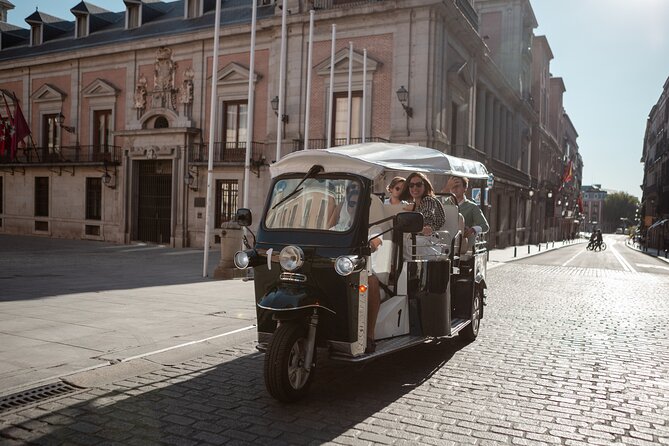
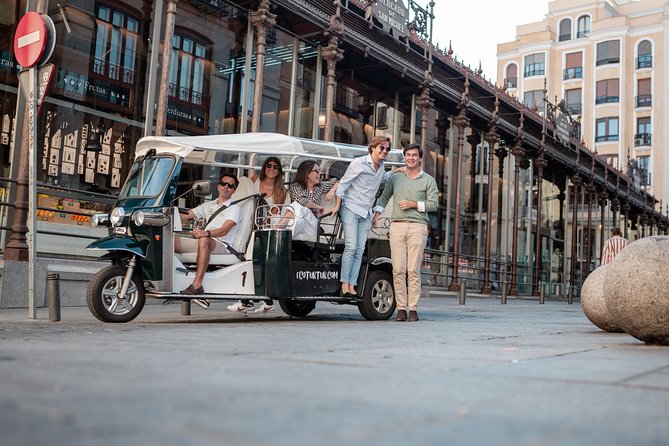
Madrid in fast, fun motion. This express ride is a smart way to see big sights quickly while a local guide keeps the story straight. I love that it’s a private eco tuk tuk experience (not a crowded bus), and I love that the route includes key photo stops plus zero queue time. One drawback to plan for: the tuk tuk’s roof can make it harder to look up at tall facades, especially in hot or bright sun.
In winter, they provide blankets and protective layers against rain and wind, so the tour doesn’t turn into a cold shuffle. You also get a mobile ticket and a driver-guide who builds the tour around what you’ll actually want to remember later.
This works best if you like a guided snapshot—fast, focused, and human-paced—rather than a long museum day or a DIY sprint through traffic.
In This Review
- Quick Hits Before You Book
- Getting Oriented Fast in Madrid’s Center
- The Express Route: What You’ll See and Why It’s Worth the Time
- Atocha Station: Rail Power and City Energy
- The Palacio de las Cortes: Spain’s Political Face (and the Lions at the Entrance)
- Cibeles and Neptune: The City’s Sports Rivalry in Stone
- The Prado Museum Stop: How to Look at European Painting Without Getting Lost
- San Jerónimo el Real (Los Jerónimos): Royal Power Meets Late Gothic Detail
- Puerta de Alcalá: A Neoclassical Arc With Five Openings
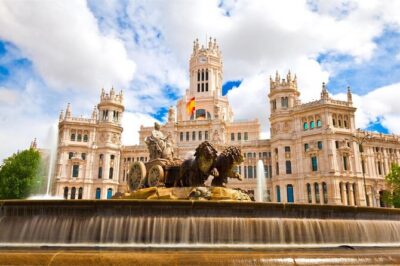
- Cibeles Fountain: Roman Symbol, Real Madrid Icon
- Banco de España Area: A Major Monument You Usually Can’t Tour Inside
- Plaza de Santa Ana: A Central Open Space With a Long Urban Past
- Almudena Cathedral: Big Faith, Modern Consecration
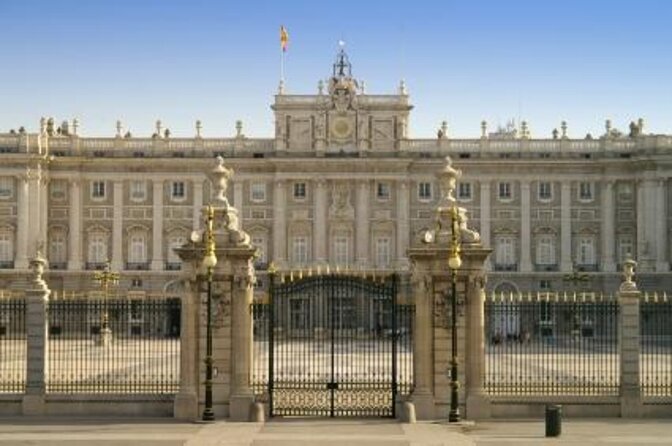
- Palacio de Oriente (Royal Palace): Why It Sits Where It Does
- Comfort and Style: How to Ride Without Hating the Weather
- Who This Tour Fits Best (and Who Might Want Something Else)
- Value for Money: Why a Low Hour Price Can Still Feel Worth It
- Should You Book This Madrid Express Eco Tuk Tuk Tour?
- FAQ
- How long is the Madrid Express Tour?
- Is this tour private?
- What language is the tour offered in?
- Is it really electric?
- What is included to keep you warm or dry?
- Where is the meeting point?
- How many people can ride in each tuk tuk?
- What are the minimum age and weight rules?
- Are pets allowed?
- Can I cancel for a full refund?
Quick Hits Before You Book
- Private tuk tuk for your group (legal max 4 passengers per tuk-tuk)
- Electric and sustainable ride that still feels fun and flexible
- Blankets and wind/rain protection make cooler months practical
- No queues or waiting at the start, so your time stays yours
- Photo-ready stops at major landmarks, with route designed for quick orientation
- Small-group feel where you can ask questions and get real answers
Buzz the old centre by tuk tuk
- Madrid: Private City Tour by Eco Tuk Tuk★ 4.9 · 3,465 reviews
- Madrid Historical Tour with Local Guide in Eco Tuk Tuk Private★ 5.0 · 876 reviews
- Madrid Express Tour with Local Guide in Eco Tuk Tuk Private★ 5.0 · 413 reviews
- Madrid: Highlights City Tour by Electric Tuk Tuk★ 4.7 · 346 reviews
Getting Oriented Fast in Madrid’s Center

This tour is built for the first-day question: Where do I go next, and what matters most? In a city as visually layered as Madrid, a short guided loop helps you learn the logic—major squares, museum cluster, royal axis—without doing homework all day.
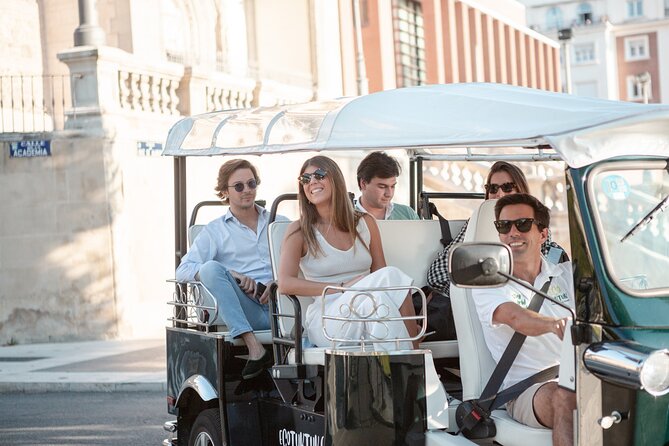
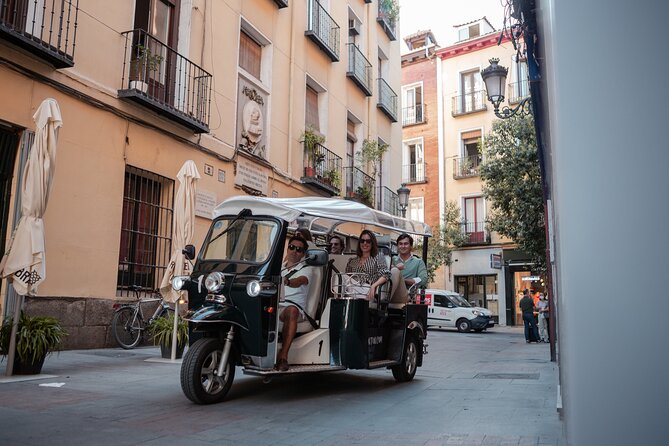
The eco electric tuk tuk matters more than you might think. You move through central streets with less friction than walking in circles, and you get closer to the details that make Madrid feel like Madrid. One big reason I’d pick this style over a standard bus is that you’re in your own bubble. If you want to ask something specific—architecture, neighborhoods, even food ideas—the guide can answer as you go.
There’s also a practical comfort angle. The vehicles run in rain or heat, and the company arms you with blankets and protective layers. That’s how you keep an express tour from falling apart when Madrid weather does what it does.
The Express Route: What You’ll See and Why It’s Worth the Time
Even though the tour can run from about 1 to 4 hours, the goal stays the same: get you “parked” in the right mental map of Madrid. The route includes major landmarks across history—from old market culture to Spain’s political heart, then straight into museums, royal sites, and the grand public squares.
Stops are pre-selected for photography, and you won’t be swapping in random detours. That’s intentional. This is an efficient route, not a free-for-all.
Also note a real-world detail: street closures and demonstrations can shift things. If you’re on a tight schedule, that’s still usually fine—Madrid is full of alternatives—but it’s good to keep the day flexible.
Atocha Station: Rail Power and City Energy
One of the first stops is Atocha, the huge railway complex near Plaza del Emperador Carlos V. It’s Madrid’s busiest station in Spain and one of the busiest in Europe, so even seeing it from the road gives you a sense of how the city connects.
I like this stop early because it anchors your orientation. Madrid’s major neighborhoods and day trips radiate from transportation nodes. When you later spot trains and stations around town, you’ll recognize the scale and role of Atocha.
The Palacio de las Cortes: Spain’s Political Face (and the Lions at the Entrance)
Next comes the Palace of the Spanish Courts, built on the old convent of the Holy Spirit, which served as the seat of Congress from 1834 to 1841. The building is neoclassical in spirit, but the facade has lots of sharp details worth stopping for.
A few things you’ll notice here:
- Six tall Corinthian columns rise to a triangular pediment.
- The entrance is flanked by emblematic lions, made from iron associated with cannons captured in the war in Africa.
- The bronze door is normally not open to the public, but it can open on very marked occasions.
The guide’s commentary is key because this is one of those places where the facade alone is interesting, but the meaning is deeper. Ask questions here and you’ll understand how Spain’s political story sits in stone and symbolism.
Private and unhurried, just your party


Cibeles and Neptune: The City’s Sports Rivalry in Stone
Then you roll past one of Madrid’s most recognizable civic ideas: the rivalry between Cibeles and Neptune. In Greek myth, these gods occupy different ranks, and in Madrid the squares become sports territory—Real Madrid celebrates by Cibeles, while Atlético de Madrid celebrates near Neptune.
If you visit Madrid in match season (or just around match vibes), this stop becomes extra fun. It’s public art fused with local identity, and you can see how a city turns mythology into lived culture.
The fountain origins matter too. Both sources were part of the Ventura Rodríguez project and went through restructuring and relocation in the late 19th century to end up at the central squares you see today.
The Prado Museum Stop: How to Look at European Painting Without Getting Lost
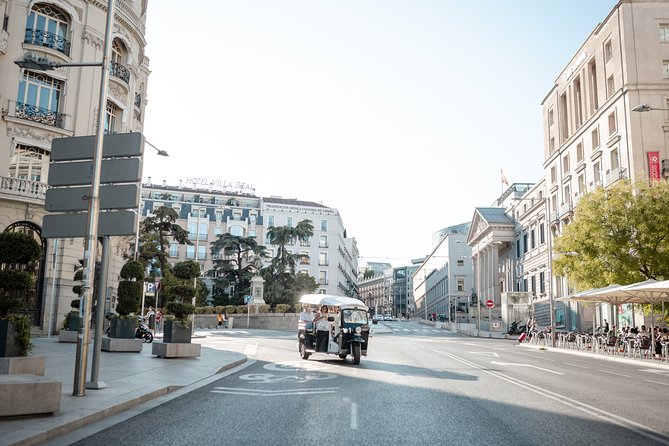
The route includes a stop tied to the Prado Museum—one of the strongest reasons people pick guided sightseeing in Madrid. This museum is famous for European painting from the 16th to the 19th centuries, and it’s especially known for the big names: Velázquez, El Greco, Goya, Tiziano, Rubens, and El Bosco.
Even if you’re not going inside on this particular express tour, this stop helps you make sense of Madrid’s art emphasis. You’ll learn who the museum highlights and what to look for when you plan your next visit.
It’s also a smart moment to ask your guide for a simple starting point: if you only care about one artist, who should you prioritize first? Your guide can point you toward the best next step after this tuk tuk loop.
San Jerónimo el Real (Los Jerónimos): Royal Power Meets Late Gothic Detail
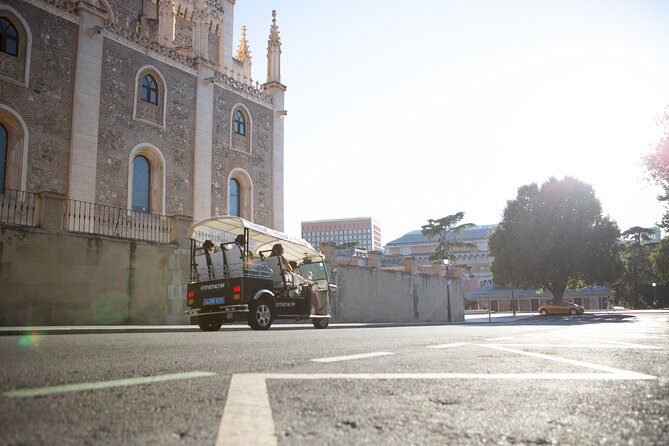
Next up is Los Jerónimos, formally the Parish Church of San Jerónimo el Real. The late Gothic look with Renaissance influences gives you a different visual texture than the nearby grand civic buildings.
Why this church is a standout stop:
- It has been remodeled and restored many times, so the final look reflects centuries, not just one construction phase.
- Its name connects to its special relationship with Spanish kings.
- Built by order of the Catholic Monarchs, it became a spiritual retreat for monarchs.
- It also hosted royal investitures because Madrid lacked a cathedral for a long time.
- Alfonso XIII’s wedding took place here, and the grand stairway leading to the door was built in 1906.
Even if you’re only stopping briefly, this is a great place to slow down mentally. This is Madrid as ceremony and continuity.
Puerta de Alcalá: A Neoclassical Arc With Five Openings
Puerta de Alcalá is a neoclassical triumphal arch designed by Francesco Sabatini. It’s a granite arc of triumph, designed as a major gateway and described as the first built in Europe after the fall of the Roman Empire.
Two details make it especially photogenic:
- It has five openings, which is unusual since many arches you’ll see have the more common three.
- The inner face is easier to approach visually, with four virtues represented: Prudence, Justice, Temperance, and Fortress.
The outer side is more decorated, so you’ll get a different impression depending where you stand. The guide can help you pick the spot for your camera angle.
Cibeles Fountain: Roman Symbol, Real Madrid Icon
Then you hit Cibeles itself. The fountain represents the Roman goddess Cibeles, linked to land, agriculture, and fertility. She’s shown on a car pulled by two lions, with mythological figures connected to the story behind the scene.
You’ll also notice the art-world fingerprints:
- The goddess sculpture is credited to Francisco Gutiérrez.
- The lions were sculpted by Roberto Michel.
- The rest of the structure uses stone.
This stop is fun because it’s art you can relate to immediately. The Cibeles fountain is an icon for Real Madrid celebrations, and it’s not subtle about it—major titles and Spanish football successes are marked here.
Banco de España Area: A Major Monument You Usually Can’t Tour Inside
The route also passes the building built to house Spain’s National Bank, designed for functions tied to coin and bill issuance across Spanish territory. The interior is not generally open to casual visits.
As stated in the tour info, the interior can only be visited by groups from educational centers and universities, and exceptionally by non-profit cultural and associative entities.
That makes this stop more about context than tickets. Still, it’s worth seeing the building’s place in the city’s grand civic layout—especially with the surrounding palaces and the palace-office cluster nearby.
Plaza de Santa Ana: A Central Open Space With a Long Urban Past
Plaza de Santa Ana sits in the Cortes neighborhood in the Centro district, dating back to 1810. What’s interesting here is not one architectural moment, but the way the square has changed through multiple urbanization processes over time.
This is a good break-point in the ride. You’re not just sprinting from landmark to landmark—you’re also seeing how public space shapes daily Madrid life.
Almudena Cathedral: Big Faith, Modern Consecration
The route includes Almudena Cathedral, described as the most important religious building in Madrid. A major fact here is that it was consecrated on June 15, 1993 by Pope John Paul II, becoming the first consecrated cathedral outside Rome.
There’s also a museum component tied to the diocese of Madrid, with dozens of objects across multiple rooms. The museum covers items like mosaics and episcopal shields and ornaments, which helps you understand the cathedral beyond the exterior.
Even if your time is short, this stop is an easy way to connect modern Madrid identity to long-standing religious and civic traditions.
Palacio de Oriente (Royal Palace): Why It Sits Where It Does
The tour’s grand closing energy is Palacio de Oriente, also called the Royal Palace. The kings of Spain live in the Palacio de la Zarzuela, so this palace is used for receptions, ceremonies, and official events.
Construction started in 1738 and lasted seventeen years. After completion, Carlos III established his habitual residence there in 1764. The site also matters: it replaced the Palace of the Austrias, which was destroyed by fire on Christmas Eve in 1734.
You’ll also get the palace’s garden framing:
- Campo del Moro gardens to the west, with roots in the Middle Ages.
- Sabatini gardens to the north, created in the 20th century.
Campo del Moro can be visited during the day, which gives you an easy next-day idea if you want more outdoor time.
Comfort and Style: How to Ride Without Hating the Weather
This is a practical point, because tuk tuks are fun—but they’re also open-air. The tour includes blankets and protective layers against rain and wind, and it runs in rain or heat with those protections in mind.
Still, two realities can affect comfort:
- The roof and the tuk tuk shape can limit how high you can look up at tall buildings.
- On very hot days, it can feel less comfortable than you’d want.
If you know you’ll be in Madrid on a scorcher day, consider:
- choosing a seat that gives you the easiest upward angle
- planning to rely on your guide for face-level details (columns, doors, fountains), not just sky-high views
If it’s cold or wet, lean into the provided blankets. They’re not an afterthought; they’re part of how this express tour stays enjoyable.
Who This Tour Fits Best (and Who Might Want Something Else)
This Madrid Express setup is ideal if:
- it’s your first time in Madrid and you want your bearings fast
- you’re short on time but still want real context for major landmarks
- you want a private ride where you can ask questions without feeling rushed
It’s also a solid choice for families, based on how the tour has worked for groups including kids (minimum age is two, babies not allowed, and a minimum weight requirement of 9 kg applies).
If you’re the type who loves long museum immersion or wants deep interior touring of major sites, you’ll probably want to pair this with separate visits. Think of this tuk tuk ride as the map-making day, not the finishing day.
Value for Money: Why a Low Hour Price Can Still Feel Worth It
At $28.67 per person, the value hinges on what you get: private transport, a local guide, and a route that hits multiple headline sights without you spending hours coordinating between neighborhoods.
Also, because it’s booked about 21 days in advance on average, the company clearly has steady demand for this exact “orientation tour” concept. That’s usually a sign it works for what it sells.
The price is easier to justify if you treat this as:
- your first-day orientation
- your plan-for-later guide
- your way to reduce decision fatigue
If you’re already completely confident about where everything is and you’re only looking for one or two places, then the value drops. But for most first timers, you’re buying time, context, and a smooth ride through the center.
Should You Book This Madrid Express Eco Tuk Tuk Tour?
I’d book it if you want a friendly, efficient introduction to Madrid’s core landmarks—especially if you like the idea of a private electric tuk tuk and a guide who can answer questions as you roll.
Skip it or consider an alternative if:
- you need tons of inside access to museums and palaces on the same day
- you’re very sensitive to heat or find roofed-looking viewpoints annoying for photos
- you want total freedom to redesign the route on the spot
If your goal is to get oriented, learn what to prioritize next, and have a fun ride doing it, this tour is a strong fit for your first hours in Madrid.
FAQ
How long is the Madrid Express Tour?
The duration is approximately 1 to 4 hours, depending on the option you book and the day’s conditions.
Is this tour private?
Yes. It’s a private activity for your group only.
What language is the tour offered in?
The tour is offered in English.
Is it really electric?
Yes. The vehicles are 100% electric and sustainable.
What is included to keep you warm or dry?
You’ll get blankets and protective layers against rain and wind to avoid cold weather.
Where is the meeting point?
Meet at C. de Bailén, 4, Centro, 28013 Madrid. The pickup point is in the underground bus station near Plaza de Oriente by the Royal Palace, by the Puerta del Príncipe entrance. Google Maps can help you find it via Calle Bailén 4 or Puerta del Príncipe.
How many people can ride in each tuk tuk?
Each tuk-tuk has a legal maximum of 4 passengers. Larger groups use more tuk-tuks.
What are the minimum age and weight rules?
The minimum age is two years old (babies are not allowed). There is also a minimum weight requirement of 9 kg.
Are pets allowed?
No, pets are not allowed for security reasons.
Can I cancel for a full refund?
Free cancellation is available up to 24 hours in advance for a full refund. If you cancel less than 24 hours before the start time, the amount paid is not refunded.
More Tour Reviews in Madrid
- Madrid: Tour Bernabéu Entry Ticket
★ 4.5 · 21,573 reviews - Madrid: Prado Museum Entry Ticket
★ 4.6 · 20,699 reviews - Madrid: “Emociones” Live Flamenco Performance
★ 4.8 · 12,866 reviews - Madrid: Panoramic Route City Tour
★ 4.1 · 12,259 reviews - Madrid: Live Flamenco Show with Food and Drinks Options
★ 4.5 · 9,901 reviews - Avila & Segovia Tour with Tickets to Monuments from Madrid
★ 5.0 · 9,762 reviews
Private Days in the Capital
- Madrid: Private City Tour by Eco Tuk Tuk
★ 4.9 · 3,465 reviews - Madrid Welcome Tour with Local Guide in Eco Tuk Tuk Private
★ 5.0 · 2,936 reviews - Madrid Historical Tour with Local Guide in Eco Tuk Tuk Private
★ 5.0 · 876 reviews - Toledo Private Tour with Licensed Guide and Driver from Madrid
★ 5.0 · 637 reviews - Madrid Private Segway tour. Retiro Park – Centro Historico
★ 4.9 · 636 reviews - Madrid Barajas Airport Private Transfer To Madrid City
★ 4.5 · 342 reviews
Tuk Tuk Around the Middle
- Madrid: Private City Tour by Eco Tuk Tuk
★ 4.9 · 3,465 reviews - Madrid Welcome Tour with Local Guide in Eco Tuk Tuk Private
★ 5.0 · 2,936 reviews - Madrid Historical Tour with Local Guide in Eco Tuk Tuk Private
★ 5.0 · 876 reviews - Madrid: Highlights City Tour by Electric Tuk Tuk
★ 4.7 · 346 reviews - Madrid: City Highlights Tuk Tuk Tour
★ 4.4 · 334 reviews - Madrid: City Tours – 6 seats private ecological tuk tuk
★ 4.6 · 230 reviews
Just Added: New Madrid Tour Reviews


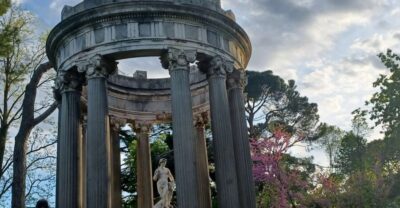
Madrid Tuk Tuk Tours, compared.
 ★ 4.9Private City Tour by Eco Tuk TukFrom $283,465 reviews
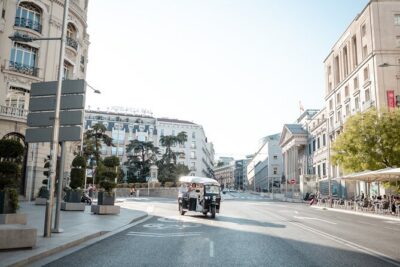 ★ 5.0Madrid Welcome Tour with Local Guide in Eco Tuk Tuk PrivateFrom $282,936 reviews
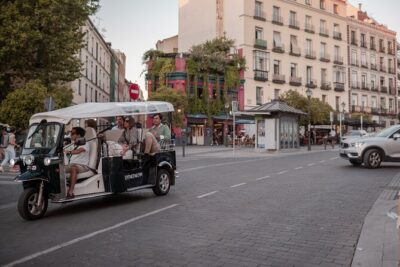 ★ 5.0Madrid Historical Tour with Local Guide in Eco Tuk Tuk PrivateFrom $28876 reviews
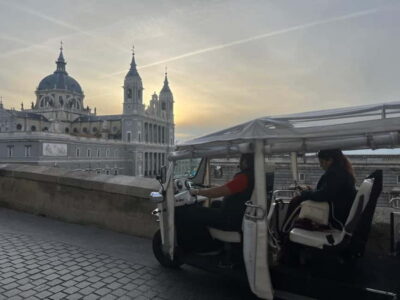 ★ 4.7Highlights City Tour by Electric Tuk TukFrom $28346 reviews
 ★ 4.4City Highlights Tuk Tuk TourFrom $94334 reviews
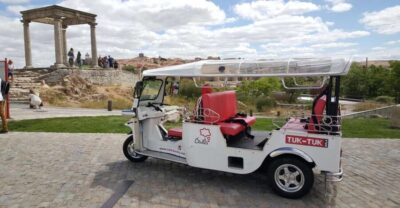 ★ 4.4Tour Guiado En Tuk Tuk Recorre Avila De La Forma Mas ComodaFrom $10235 reviews
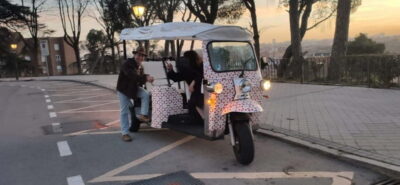 ★ 4.6City Tours – 6 seats private ecological tuk tukFrom $53230 reviews
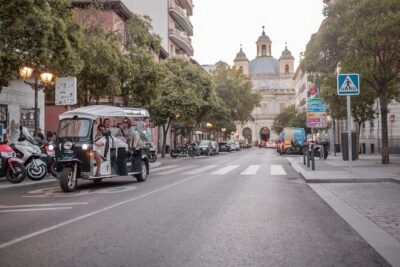 ★ 5.0Madrid Expert Tour with Local Guide in Eco Tuk Tuk PrivateFrom $28220 reviews
Browse the lists this tour appears in