
Madrid can feel like one long story—this tour helps you read it. You’ll start in the city’s symbolic center and get a guided path through Hapsburg Madrid and major plazas. What I love is how it connects architecture to power, and then rewards your walking with 360° rooftop views that make the whole layout click.
You’ll like the sites that most people see but rarely understand: Plaza Mayor, Plaza de la Villa, the Royal Palace area, and the Teatro Real. A fair heads-up: this is a mostly on-foot route, so if you’re short on stamina, plan for some concentrated walking in one block of time.
In This Review
- Key Points You’ll Care About
- Getting Oriented: Puerta del Sol to the Center of Power
- Hapsburg Madrid on Plaza Mayor and Plaza de la Villa
- Market of San Miguel: A Quick Taste of Street-Level Madrid
- Calle Mayor and the Clue Beneath the Royal Route
- Almudena Cathedral: A Strategic Pause Near the Royals
- The Royal Palace Area and Teatro Real: Where Madrid Performs
- Rooftop Finale at Riu Plaza España: 360° Views That Actually Help
- Guides Make the Difference: The Tanya and Javier Factor
- Price and Value: Is $224 Worth It for a Private 2.5-Hour Tour?
- Who Should Book (and Who Might Want a Different Option)
- Should You Book This Madrid Old Town Private Tour?
- FAQ
- How long is the Madrid Old Town Private Tour?
- Where does the tour meet?
- What’s included in the price?
- Is the tour wheelchair accessible?
- What languages are offered?
- Does the tour include lunch?
- What should I bring?
Key Points You’ll Care About
- Puerta del Sol orientation that explains why this spot mattered from the 15th century onward
- Hapsburg-era Madrid framed through the plazas you’ll actually stand in
- Royal Palace approach that includes a pass by a 9th-century Muslim wall
- Teatro Real and Almudena Cathedral timing so the Royal area feels coherent, not random
- Riu Plaza España rooftop included, with 27th-floor views over 100 meters up
Sol, the arches and the tangle of old streets
- Madrid Essential: Historic Center, Plaza Mayor & Royal Palace★ 5.0 · 6,416 reviews
- Madrid Walking Tour from Puerta del Sol to Retiro Park★ 5.0 · 2,285 reviews
- Madrid Old Town & Royal Palace Walking Tour Skip the Line Ticket★ 4.5 · 1,829 reviews
- Madrid Historic Centre Food Tour with Authentic Tapas & Wines★ 5.0 · 814 reviews
Getting Oriented: Puerta del Sol to the Center of Power
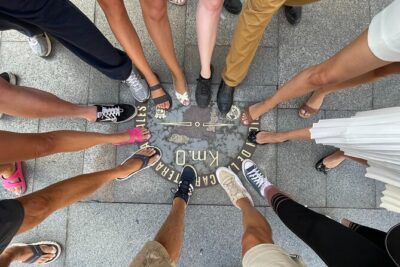
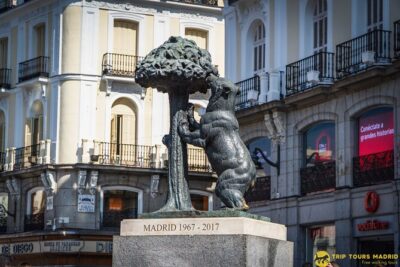
Most Madrid walks start with a pretty street scene. This one starts with a reason: you meet at Puerta del Sol, right by the statue of the Bear and the Strawberry Tree. Your guide uses this exact location to explain how Madrid grew into a capital, including the fact that Puerta del Sol connects to an old gate system from the 15th century.
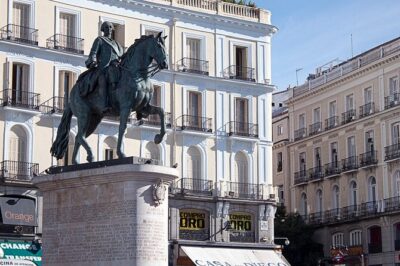
From there, you’ll move through the symbolism of kingship and politics. You’ll get time at Puerta del Sol and you’ll see the statue of King Carlos III, a name tied to major chapters in Madrid’s story. Your guide also ties Spain’s rise in the 16th and 17th centuries to the practical drivers: overseas empire, trade routes, and wealth flowing from the Americas. The effect is simple: you stop treating history like a list and start treating it like a cause-and-effect map.
This opening is useful because it sets your mental “north.” After 20 minutes here, the rest of the walk isn’t just sightseeing. It becomes a guided line from the city’s turning points to the buildings you’ll actually photograph.
Hapsburg Madrid on Plaza Mayor and Plaza de la Villa
Plaza Mayor is the postcard square, yes. But the value on this tour is what your guide teaches you to notice while you’re standing there—especially in the way the space reflects power under the Hapsburgs.
You’ll spend time at Plaza Mayor, and you’ll also visit Plaza de la Villa. These two plazas sit close enough that you can compare them in real time, but they feel different in tone and architecture. Your guide highlights the Baroque style and explains how these public spaces were shaped by the political and social needs of the time. You’ll walk away seeing the facades as political theater, not just pretty stone.
One of the smartest parts of the pacing is that the stops are short but story-heavy. Instead of getting trapped in one place for ages, you get a tight interpretation, then you move on while the ideas are still fresh.
If you’re the kind of person who likes architecture, this is where you’ll feel the tour do its job. The plazas become reference points you’ll recognize later—even if you go back on your own.
Market of San Miguel: A Quick Taste of Street-Level Madrid
Between the big squares, the tour stops at the Market of San Miguel area. This is where Madrid shows you its everyday side: the city isn’t only royal palaces and grand theaters. It also lives in markets, food culture, and the kind of bustle that locals use for daily life.
The time here is brief, so don’t expect a full food crawl. But it’s a strong moment to recalibrate. By the time you reach the Royal area later, you’ll feel the contrast more clearly.
Practical note: if you want to pause for a snack or drink, you’ll need to manage it quickly around the group pace. Wear shoes you’re comfortable with, since most of the time is spent walking between stops.
Calle Mayor and the Clue Beneath the Royal Route
The walk to the Royal Palace area includes a key historical “breadcrumb”: you pass the 9th-century Muslim wall. That detail matters because it reframes Madrid as layered. You’re not just seeing one era at a time—you’re crossing a route where older boundaries shaped later development.
Then you reach Calle Mayor, a street that feels like Madrid’s classic spine. It’s one of those places where you can sense how people moved, traded, and gathered over centuries. Your guide keeps the focus on why the route makes sense historically, not just aesthetically.
If you like connecting the dots—where walls were, why buildings got built where they did—this portion delivers. It also helps the Royal Palace stop feel more grounded. You’ll arrive with context instead of treating the palace as an isolated monument.
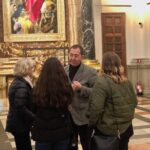
Private and unhurried, just your party




Almudena Cathedral: A Strategic Pause Near the Royals
You’ll stop to admire Almudena Cathedral on the way into the Royal zone. Even if you don’t go inside, this stop is useful because it gives you a visual “bridge” between public monarchy and religious symbolism.
The guide’s approach here is practical. You get just enough time to read the building’s presence in the square-like space around it, and to understand why it belongs in the Royal area narrative you’re building. It breaks up the walk so you’re not sprinting from plaza to palace without breathing room.
If you’re someone who likes to see how a city’s institutions stack—church, theater, monarchy—this stop clicks.
The Royal Palace Area and Teatro Real: Where Madrid Performs
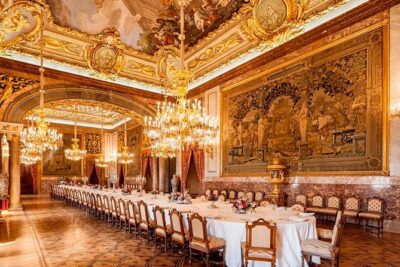
No walking tour of old Madrid feels complete without the Royal Palace area, and this one makes it feel coherent. You’ll go to the Royal Palace of Madrid, and you’ll also get a stop at Teatro Real, the Royal Theater, right in front of the palace.
The pairing is smart. The palace is the obvious political symbol, but Teatro Real adds the cultural power angle. Your guide helps connect the idea that Madrid didn’t just govern—it also staged prestige through art and public spectacle.
You get time here to look closely and to understand the context. That 15-minute palace window works well for most people because you’re not left wandering with no direction. The group stays moving, but you still get enough attention to the key points in the area.
Two practical tips for this segment:
- Bring your camera. This is one of the better photo zones for the classic Royal-ensemble look.
- Expect more crowds at peak times. Your guide’s timing keeps you from feeling stuck.
Rooftop Finale at Riu Plaza España: 360° Views That Actually Help
The best payoff on this tour is saved for last. You finish at the spectacular rooftop terrace of the Riu Plaza España Hotel, where you can enjoy 360° views from the 27th floor—over 100 meters above the ground. And the rooftop viewpoint tickets are included.
This final stop is more than a view. It’s where the tour “clicks” into place. From up here, you can see how the Royal area, the plazas, and the older city structure relate to each other. Even if you’ve visited Madrid before, the rooftop perspective helps you rebuild your mental map.
The elevation also changes your photo game. Instead of only flat street shots, you get skyline angles and the big-picture feeling that tells you where you’re standing in the city.
If you want a simple souvenir of the day, this is it. It’s the moment where your walking effort feels like it translated into understanding.
Guides Make the Difference: The Tanya and Javier Factor
This tour tends to succeed because the guide is the product. In recent bookings, I’ve seen guides like Tanya (and a Tatiana referenced in another booking) described as fully integrated in local mindset, living in Madrid for years, and able to connect history to everyday city life. One guide also communicated in multiple languages, which can be a comfort if you want the story told clearly.
Another guide, Javier, is mentioned as engaging and making the walk feel short because the pacing stays friendly and easy to follow. That matters more than people expect. At 2.5 hours, a tour can either feel like an efficient introduction—or like a rushed checklist. These reports lean toward the first option.
And here’s a sweet practical tip pulled from real experience: ask your guide if there’s a chocolate surprise or churros with chocolate moment at the end. It’s not guaranteed in the general description, but it shows up in guide-style storytelling, and it can make the final stretch feel extra satisfying.
Price and Value: Is $224 Worth It for a Private 2.5-Hour Tour?
At $224 per group for up to 2 people, you’re paying for two things: a private guide and included rooftop access. That’s not the cheapest way to see old Madrid, so the value depends on how you like to travel.
For two people, the math usually makes sense if you care about context. You’re getting time at Puerta del Sol, Plaza Mayor, Plaza de la Villa, the market area, the Royal Palace zone, Teatro Real, Almudena Cathedral, and then a viewpoint that many independent travelers have to research and plan separately. The included rooftop ticket is a tangible add-on.
The private format is also a big deal. You can ask questions as you go, slow down at a detail you care about, or adjust based on how your feet feel that day. And if you’re traveling as a pair, you avoid the “single pace for a whole group” problem that kills good tours.
If you’re traveling solo on a tight budget, you may want to compare with group tours. But if you want a guided story with major sights plus city-view payoff, this private setup is a fair trade.
Who Should Book (and Who Might Want a Different Option)
This tour is a great fit if you:
- Want a first-time orientation to Madrid’s center and don’t want to piece it together yourself
- Like history tied to the places you walk past
- Care about architectural details in plazas and the Royal area
- Would enjoy a private guide who can tailor explanations to your pace
It may not be ideal if you:
- Have limited walking tolerance. It’s designed as a walking tour through the old town highlights.
- Expect a long sit-down museum style visit. The time at each stop is intentionally tight.
Also, this tour runs in all weather conditions, so plan your outfit like you’re dressing for the day, not for an ideal forecast. Comfortable shoes are essential, and a camera helps because the rooftop viewpoint rewards photos in a big way.
Should You Book This Madrid Old Town Private Tour?
I’d book it if you want your first Madrid old-town day to feel organized and meaningful, not random. The blend of Hapsburg-era context, major landmarks near each other, a pass by a 9th-century Muslim wall, and an included rooftop finish gives you both story and payoff.
I’d skip or reconsider if you mainly want free-form wandering. This tour is structured for learning and flow, not for long unhurried drifting.
If you do book, do two things to get more out of it: wear shoes you can stand in for a while, and bring water (and if you’re like me, a little hand sanitizer for the day’s constant touchpoints).
FAQ
How long is the Madrid Old Town Private Tour?
It lasts 2.5 hours.
Where does the tour meet?
You meet your guide at Puerta del Sol, at the Statue of the Bear and the Strawberry Tree.
What’s included in the price?
A private guide is included, plus tickets for the Riu Plaza España Hotel rooftop viewpoint.
Is the tour wheelchair accessible?
Yes, it’s wheelchair accessible.
What languages are offered?
The live tour guide is available in English and Spanish.
Does the tour include lunch?
No, lunch is not included.
What should I bring?
Comfortable shoes and a camera are recommended.
If you want, tell me your travel dates and whether you’re visiting in the morning or afternoon, and I can suggest how to pair this with the rest of your Madrid day so you keep the walking smart.
More Tour Reviews in Madrid
- Madrid: Tour Bernabéu Entry Ticket
★ 4.5 · 21,573 reviews - Madrid: Prado Museum Entry Ticket
★ 4.6 · 20,699 reviews - Madrid: “Emociones” Live Flamenco Performance
★ 4.8 · 12,866 reviews - Madrid: Panoramic Route City Tour
★ 4.1 · 12,259 reviews - Madrid: Live Flamenco Show with Food and Drinks Options
★ 4.5 · 9,901 reviews - Avila & Segovia Tour with Tickets to Monuments from Madrid
★ 5.0 · 9,762 reviews
Private Days in the Capital
- Madrid: Private City Tour by Eco Tuk Tuk
★ 4.9 · 3,465 reviews - Madrid Welcome Tour with Local Guide in Eco Tuk Tuk Private
★ 5.0 · 2,936 reviews - Madrid Historical Tour with Local Guide in Eco Tuk Tuk Private
★ 5.0 · 876 reviews - Toledo Private Tour with Licensed Guide and Driver from Madrid
★ 5.0 · 637 reviews - Madrid Private Segway tour. Retiro Park – Centro Historico
★ 4.9 · 636 reviews - Madrid Express Tour with Local Guide in Eco Tuk Tuk Private
★ 5.0 · 413 reviews
Old Madrid on Foot
- Madrid Essential: Historic Center, Plaza Mayor & Royal Palace
★ 5.0 · 6,416 reviews - Madrid Walking Tour from Puerta del Sol to Retiro Park
★ 5.0 · 2,285 reviews - Madrid Old Town & Royal Palace Walking Tour Skip the Line Ticket
★ 4.5 · 1,829 reviews - Madrid Historic Centre Food Tour with Authentic Tapas & Wines
★ 5.0 · 814 reviews - Madrid in a Day Tour:Royal Palace, Historic Center & Prado Museum
★ 5.0 · 628 reviews - Guided Tour of Madrid of the Austrias and the Historic Center
★ 5.0 · 520 reviews
Just Added: New Madrid Tour Reviews



Plaza Mayor & Old Town Tours, compared.
 ★ 5.0Madrid Essential: Historic Center, Plaza Mayor & Royal PalaceFrom $36,416 reviews
 ★ 5.0Madrid Walking Tour from Puerta del Sol to Retiro ParkFrom $32,285 reviews
 ★ 4.5Madrid Old Town & Royal Palace Walking Tour Skip the Line TicketFrom $401,829 reviews
 ★ 5.0Madrid Historic Centre Food Tour with Authentic Tapas & WinesFrom $78814 reviews
 ★ 5.0Madrid in a Day Tour:Royal Palace, Historic Center & Prado MuseumFrom $119628 reviews
 ★ 5.0Guided Tour of Madrid of the Austrias and the Historic CenterFrom $2520 reviews
 ★ 5.0Old Madrid Tapas and Fine Wine Small Group TourFrom $101415 reviews
 ★ 4.2From Madrid: Old Town Toledo Tour with Optional ActivitiesFrom $32403 reviews
Browse the lists this tour appears in