
REVIEW · MADRID TUK TUK TOURS
Madrid Expert Plus Tour with Local Guide in Eco Tuk Tuk Private
Madrid makes sense fast on three wheels.
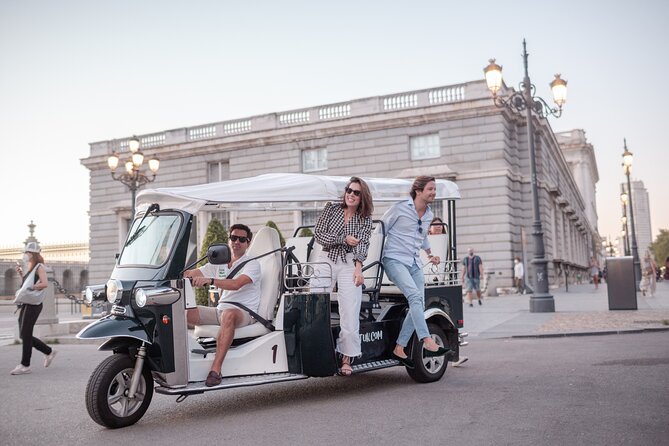
This private Eco Tuk Tuk tour gives you a guided sweep across central Madrid’s big landmarks and classic neighborhoods, with stops that work for photos and explanations that turn monuments into stories.
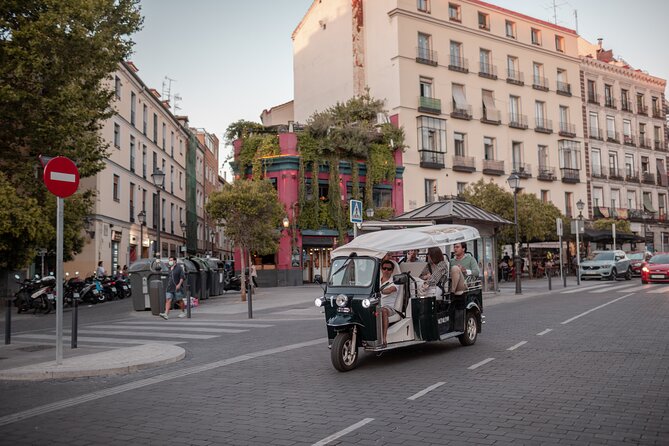
I especially love the practical feel: the ride is 100% electric, and you’re offered winter blankets and protective layers so the day stays comfortable. I also like that you begin the experience without queues or waiting, which matters when you only have a few hours in the city.
One drawback to keep in mind: the route can shift when streets are closed or crowded, and if you’re delayed too long, the tour may shorten or be canceled with no refund.
In This Review
- Key points to know before you ride
- Why a private electric Eco Tuk Tuk feels right for Madrid
- Price and value: what $28.67 buys you in real time
- Covered Market, Atocha station, and the seats of power you can actually see
- Neptune Fountain, Prado-area art focus, and San Jerónimo el Real
- Royal Palace area, Campo del Moro gardens, and Templo de Debod views
- Puerta de Alcalá, Columbus Square, and the big plaza icons (Neoclassical to football)
- Las Ventas, Barrio Salamanca streets, and seeing Madrid’s style shifts in one ride
- Cibeles, Plaza de Santa Ana, and the city’s storytelling through squares
- Almudena Cathedral and San Francisco el Grande: two ways Madrid worships
- How long to choose: 2, 3, or 4 hours when you want to see it all
- Should you book this Madrid Eco Tuk Tuk tour?
- FAQ
- Is the Eco Tuk Tuk tour private?
- How long is the tour?
- What’s included in the tour price?
- Does the tour run in English?
- Where does the tour meet and start?
- Can I cancel for a full refund?
Key points to know before you ride
- Private Tuk Tuk for your group with a legal max of 4 passengers per vehicle
- No-queue start plus pre-selected photo stops at the right locations
- Winter comfort: blankets and protective layers against wind and rain
- A guide who makes Madrid click fast, with real city color (I’ve seen guides like Christian, Lucia, Juan, and Laura praised for pacing and stories)
- A “see a lot” format that’s great when walking has already worn you out
Buzz the old centre by tuk tuk
- Madrid: Private City Tour by Eco Tuk Tuk★ 4.9 · 3,465 reviews
- Madrid Historical Tour with Local Guide in Eco Tuk Tuk Private★ 5.0 · 876 reviews
- Madrid Express Tour with Local Guide in Eco Tuk Tuk Private★ 5.0 · 413 reviews
- Madrid: Highlights City Tour by Electric Tuk Tuk★ 4.7 · 346 reviews
Why a private electric Eco Tuk Tuk feels right for Madrid
Madrid is spread out, and a lot of the best sights sit in areas where traffic, pedestrians, and long walking routes can eat up your day. That’s why this kind of private electric tuk tuk approach works so well. You’re not stuck in a slow bus crawl, and you also avoid the “we can’t get everywhere” limits of a pure walking plan.
The best part is how the ride supports the guide’s storytelling. A local can point out what you’re seeing in context: what a building was for, why a square was designed the way it was, and how the city grew from royal power to everyday life. In the reviews, names like Christian, Lucia, Juan, Enrique, and Camilo come up repeatedly, and the common thread is clear: the drive becomes a real orientation tool, not just transportation.
You’ll also get a sense of Madrid’s variety in one stretch. In a single outing you can go from food and rail life to grand neoclassical monuments, then to art, cathedrals, and even football-and-bullfighting landmarks.
Price and value: what $28.67 buys you in real time
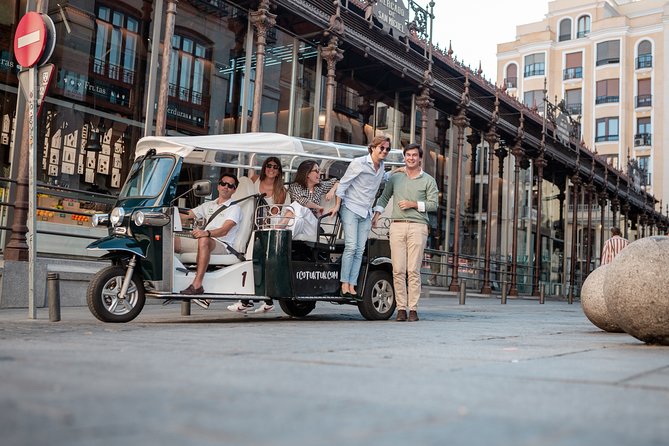
At about $28.67 per person for a 2 to 4 hour private-format tour, the value comes from the combo: guidance + routing + time savings. “Budget” tours often mean long waits, rushed stops, or you standing around while someone flips through a script. Here, the tour is designed to start without queues or waiting, and it uses pre-selected photography stops, so you spend your time looking at Madrid instead of figuring out logistics.
You’re also not just paying for a driver. The experience includes an Expert Companion Guide plus a vehicle that’s 100% electric and sustainable. That’s a nice moral bonus, but the practical bonus is smoother, quieter city driving—less stress when you’re trying to take in streets and squares quickly.
One more detail that affects value: the tour is built to run in real weather. You’ll get blankets and protective layers in winter and the vehicle design helps keep you covered when it’s cold or rainy. That can turn a “meh” sightseeing day into a comfortable one, which is worth something when you’re paying out of a limited travel calendar.
Covered Market, Atocha station, and the seats of power you can actually see
Your route begins in the area around a classic Madrid food stop: a covered market dating from around 1916, known for local food, delicatessen, and events in an elegant setting. Even if you don’t have time to snack, this kind of stop is useful because it grounds the city. Madrid isn’t only palaces and museums—there’s a daily rhythm, and markets are where you see it.
Then you head toward Atocha station, which is more than a train hub. It’s one of the country’s busiest stations and a major European rail complex. Standing near or passing through Atocha gives you a quick picture of Madrid as a connector—where commuters, travelers, and long-distance routes all mix.
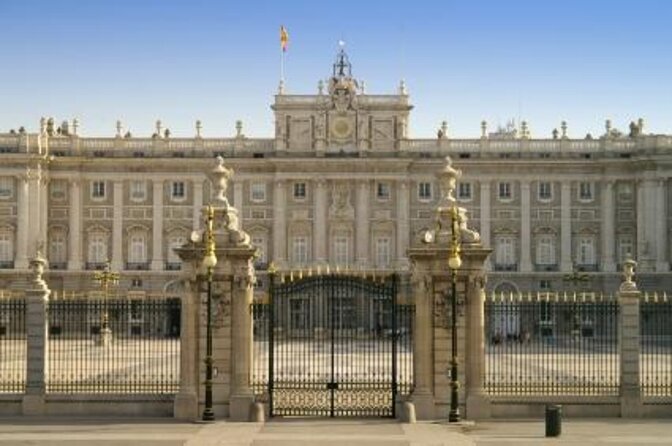
From there, you shift to politics and architecture with a stop at the Palace of the Spanish Courts. This building has a lot going on visually: neoclassical elements, a monumental facade, and symbolic details like the lions flanking the entrance (cast from iron connected to historic captured cannons). For me, this is the kind of stop where a guide’s explanations matter, because the exterior can look “just official” until someone connects the design to the story of what the site replaced and how power operated here.
If you’re short on time, these three stops do a smart job. They give you texture: food life, transport life, and government life—before you go full tourist-mode with the big landmarks.
Neptune Fountain, Prado-area art focus, and San Jerónimo el Real
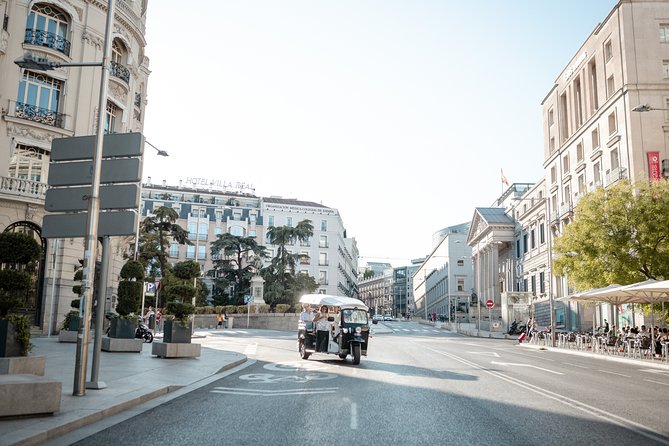
After the more functional sights, the tour moves into Madrid’s monument language. A key moment is the Fountain of Neptune at Plaza de Cánovas del Castillo. It’s a classic neoclassical statement in the middle of a roundabout—meaning you see it from street level, not from a museum pedestal. The guide can help you interpret the style and timing: the fountain was proposed in 1777, construction started in 1782, and it was completed in 1786. That kind of timeline turns the view into something you can place.
Next, you’ll be in the zone of the Prado Museum. This stop is especially strong if you like art but don’t want to commit hours inside. The focus here is on what makes the Prado a heavyweight in European painting—big names like Velázquez, El Greco, Goya, and a deep lineup beyond them. Even if you already plan to return on your own, having a guide point out the main strengths helps you choose what to see later without getting lost.
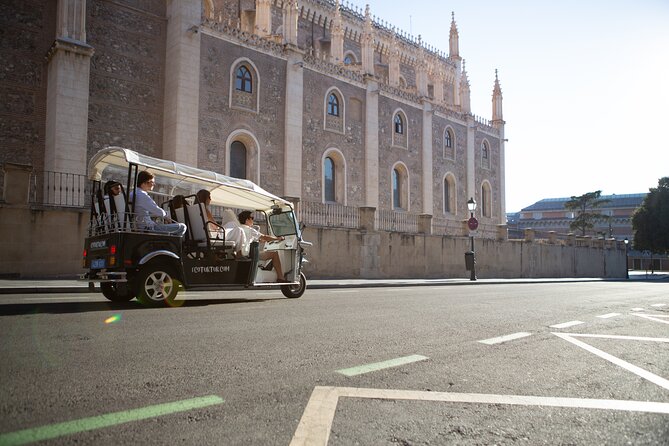
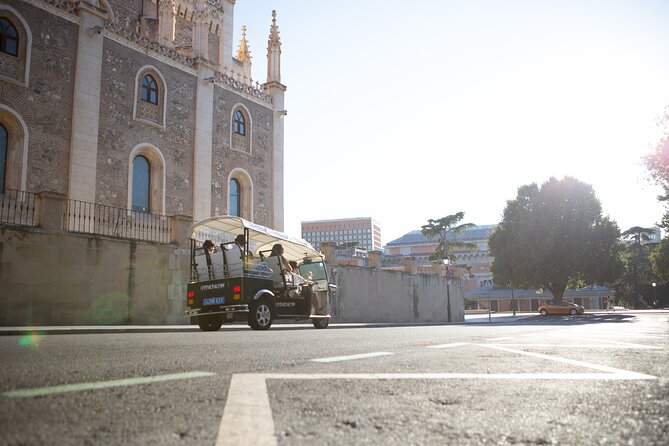
Then comes San Jerónimo el Real, often nicknamed Los Jerónimos. It sits next to the Prado area and has late Gothic roots with Renaissance influence. You’ll also learn how it ties to Spanish royalty—built by royal order, used for spiritual retreat, and tied to major royal events. The reason this matters on a tuk tuk tour: it explains why the area feels important beyond art galleries. It’s also a religious and ceremonial zone.
One small expectation check: you’re not getting a deep “tour of every chapel.” This is more like a guided spotlight. If you want long interior time, you’ll likely plan a separate visit later.
Private and unhurried, just your party



Royal Palace area, Campo del Moro gardens, and Templo de Debod views
No Madrid orientation tour feels complete without the royal core. The route includes the area around the Royal Palace (Palacio de Oriente), where construction began in 1738 and lasted about 17 years. You’ll also hear how royal residence patterns shifted here after Carlos III established habitual residence in 1764, turning the palace into the political heart in practice—even if today it’s used mostly for receptions and official ceremonies.
Right by it is Campo del Moro, a garden area declared of historical-artistic interest and stretching roughly 20 hectares, running from the western facade of the Royal Palace toward the promenade of the Virgin of the Port. Even if your tuk tuk stop is short, it helps to see the green edge of power. Madrid isn’t only stone; it’s also controlled space and designed scenery.
Then the tour heads toward one of Madrid’s most unusual surprises: Templo de Debod. This is an ancient Egyptian temple placed in Madrid, and it’s located west of Plaza de España on a hill area near the Mountain Barracks. The stop is listed as about 15 minutes, and admission is free—so it’s a quick hit that adds a “how is this here?” moment to your day.
If you want practical advice: for Debod and the royal-palace area, don’t rush your photos. The views change with the angle and light, and a guide can help you position yourselves for better shots without losing time.
Puerta de Alcalá, Columbus Square, and the big plaza icons (Neoclassical to football)
Madrid loves grand entrances. You’ll pass near Puerta de Alcalá, a neoclassical triumphal arch designed by Francesco Sabatini. It replaced an earlier 16th-century version, was inaugurated in 1778, and is known for having five openings instead of the more typical three. It’s also a rare chance to see an “arch vocabulary” that feels connected to older European ideas—long before the modern theme parks and souvenir lines.
Another “look up” stop is the area of the Christopher Columbus monument in the middle of a square, with neo-Gothic style and a white marble sculpture on a stone pedestal. The monument was built in 1885 for a wedding celebration, and the plaza layout makes it easy to frame in photos even while you’re moving.
Nearby, you’ll also get the idea of Madrid’s public-space layering through the Gardens of Discovery, opened in 1970, where you can admire sculptures connected to themes like the discovery of America. If you’re the kind of visitor who likes symbolism in city planning, this stop hits.
Then the route shifts into modern Madrid fame with the Santiago Bernabéu stadium approach along the Paseo de la Castellana. Even if you aren’t going inside, the stadium presence changes the mood. It’s where royal-era grandeur gets a contemporary rival: mass culture, sports, and city identity.
Las Ventas, Barrio Salamanca streets, and seeing Madrid’s style shifts in one ride
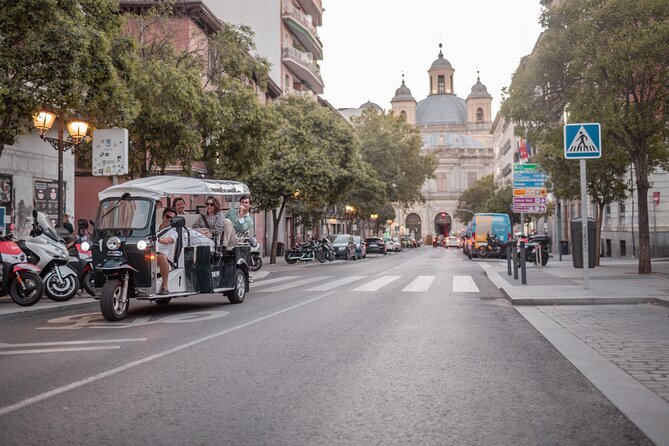
From monuments and art to spectacle: the tour includes Las Ventas, Madrid’s famous bullring. It’s described as the biggest bullfighting venue in Spain, with capacity listed at 81,044, inaugurated in 1947. That number alone helps you understand why it’s treated as a landmark. It’s not a niche arena; it’s a massive civic presence.
Then you move into Barrio Salamanca, one of Madrid’s upscale shopping and street-life zones, with streets like Velázquez, Ortega y Gasset, and Serrano. This part of the tour works even if you’re not shopping. The streets themselves tell you a lot: width, building style, and the way neighborhoods communicate class and architecture.
After that, you’re again on the Castellana corridor, linking the Salamanca elegance to the stadium area. In a single ride, you feel Madrid’s shifts—from traditional spectacle to modern celebrity and commerce—without having to plan separate transport days.
Cibeles, Plaza de Santa Ana, and the city’s storytelling through squares
The route passes by Plaza de Santa Ana in the Cortes neighborhood, dating from 1810 with a history of urban changes that altered its appearance across time. Seeing a plaza like this is a good reminder that Madrid’s center isn’t frozen in an old-photo moment. The city keeps changing, even when it’s “classic.”
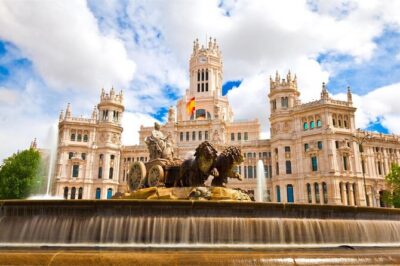
Then comes one of the most photo-friendly icons: Cibeles. The fountain represents the Roman goddess Cibeles, linked to land, agriculture, and fertility, riding a car pulled by lions. The guide context matters here because Cibeles isn’t only mythology; it’s also a real fan symbol tied to celebrations for Real Madrid. If football is part of your travel vibe, this stop will make sense immediately.
You may also encounter the Bank of Spain building area. The outside design and symbolism are treated as important, though interior visits are not described as generally available—so expect the value to be in the exterior sighting and context, not a full museum-style entrance.
This section is where the guide’s timing helps you most. Squares and fountains are easiest to understand when you’re not sprinting between them. The tuk tuk format keeps you moving, but you still get the chance to look up, breathe, and take a few composed photos.
Almudena Cathedral and San Francisco el Grande: two ways Madrid worships
Madrid’s religious architecture can feel like it comes in two modes: old-world gravity and official-state ceremony. The tour includes both.
First, Almudena Cathedral, described as Madrid’s most important religious building. It was consecrated in 1993 by Pope John Paul II, with a cathedral museum that holds objects telling the story of the diocese. Even if you don’t have time for a long museum visit, your guide can point out what those collections usually focus on: mosaics, episcopal shields, and ornaments.
Then there’s the Royal Basilica of San Francisco el Grande (Basilica of Our Lady of the Angels), located in the Palacio neighborhood. This stop adds contrast. If Almudena reads as modern ceremonial importance, San Francisco el Grande tends to feel like deep Madrid faith tied to the city’s historic core.
The value of including both in one half-day is simple: you can feel the range of Madrid’s sacred design without booking separate tours.
How long to choose: 2, 3, or 4 hours when you want to see it all
The tour runs 2 to 4 hours, and choosing the right length is the difference between a satisfying overview and an ending that feels rushed.
A 2-hour option is great when you’re arriving into town and want quick orientation, or when your legs are already tired from other walking plans. It’s also ideal if you just want the “main hits” and a guide to point you toward where you should spend your next day.
A 3-hour outing is the sweet spot for many visitors because it usually allows enough time for multiple neighborhood shifts and at least a few focused stops where the guide can explain meaning, not just location.
If you’re on a first visit and want the most relaxed pace, the 4-hour tour is the better call. The trade-off: if the weather is rough or crowds block certain routes, you might still feel the schedule pressure. One review note that matters here: the ride can become a little “stop-and-go,” and a longer day can feel tiring if you’re already mentally worn out from earlier sightseeing.
My practical suggestion: if you’re planning museum time on another day (like Prado), consider choosing 2 or 3 hours here so you don’t overstuff your calendar.
Should you book this Madrid Eco Tuk Tuk tour?
I’d book this if you want an efficient, comfortable way to get your bearings, especially on a first trip or when you only have a short window in Madrid. The combo of private electric tuk tuk, expert guidance, and no-queue start is the main reason it feels like real value rather than just a fun ride.
I’d think twice if you’re arriving with high uncertainty (tight flight changes or a schedule that can collapse). The tour can shorten if you’re late, and the route may vary due to real-world street conditions like closures and demonstrations. This is a well-run experience, but it’s still Madrid out there, not a studio set.
If your travel style is “see a lot, learn enough to choose better later,” this is a strong fit.
FAQ
Is the Eco Tuk Tuk tour private?
Yes. It’s a private tour/activity, and your group participates only.
How long is the tour?
The duration is approximately 2 to 4 hours.
What’s included in the tour price?
It includes an expert companion guide, a driver, a private electric vehicle for your group, a start without queues or waiting, pre-selected photo stops, and blankets/protective layers for cold or rainy weather.
Does the tour run in English?
Yes, the tour is offered in English.
Where does the tour meet and start?
The start point is C. de Bailén, 4, Centro, 28013 Madrid, and the pickup is near the bus station (underground) of Plaza de Oriente, next to the Royal Palace. You can find the exact location using Puerta del Príncipe on Google Maps.
Can I cancel for a full refund?
You can cancel up to 24 hours in advance for a full refund. If you cancel less than 24 hours before the start time, the amount paid is not refunded.
More Tour Reviews in Madrid
- Madrid: Tour Bernabéu Entry Ticket
★ 4.5 · 21,573 reviews - Madrid: Prado Museum Entry Ticket
★ 4.6 · 20,699 reviews - Madrid: “Emociones” Live Flamenco Performance
★ 4.8 · 12,866 reviews - Madrid: Panoramic Route City Tour
★ 4.1 · 12,259 reviews - Madrid: Live Flamenco Show with Food and Drinks Options
★ 4.5 · 9,901 reviews - Avila & Segovia Tour with Tickets to Monuments from Madrid
★ 5.0 · 9,762 reviews
Private Days in the Capital
- Madrid: Private City Tour by Eco Tuk Tuk
★ 4.9 · 3,465 reviews - Madrid Welcome Tour with Local Guide in Eco Tuk Tuk Private
★ 5.0 · 2,936 reviews - Madrid Historical Tour with Local Guide in Eco Tuk Tuk Private
★ 5.0 · 876 reviews - Toledo Private Tour with Licensed Guide and Driver from Madrid
★ 5.0 · 637 reviews - Madrid Private Segway tour. Retiro Park – Centro Historico
★ 4.9 · 636 reviews - Madrid Express Tour with Local Guide in Eco Tuk Tuk Private
★ 5.0 · 413 reviews
Tuk Tuk Around the Middle
- Madrid: Private City Tour by Eco Tuk Tuk
★ 4.9 · 3,465 reviews - Madrid Welcome Tour with Local Guide in Eco Tuk Tuk Private
★ 5.0 · 2,936 reviews - Madrid Historical Tour with Local Guide in Eco Tuk Tuk Private
★ 5.0 · 876 reviews - Madrid Express Tour with Local Guide in Eco Tuk Tuk Private
★ 5.0 · 413 reviews - Madrid: Highlights City Tour by Electric Tuk Tuk
★ 4.7 · 346 reviews - Madrid: City Highlights Tuk Tuk Tour
★ 4.4 · 334 reviews
Just Added: New Madrid Tour Reviews




Madrid Tuk Tuk Tours, compared.
 ★ 4.9Private City Tour by Eco Tuk TukFrom $283,465 reviews
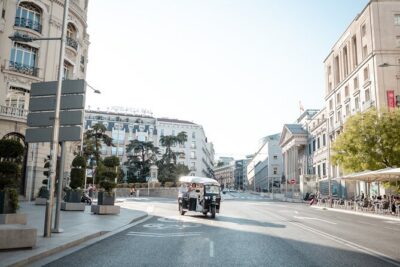 ★ 5.0Madrid Welcome Tour with Local Guide in Eco Tuk Tuk PrivateFrom $282,936 reviews
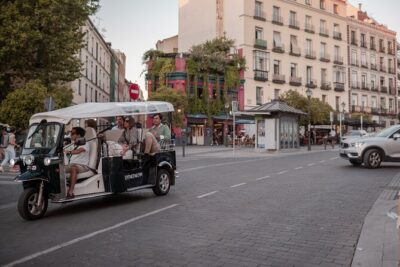 ★ 5.0Madrid Historical Tour with Local Guide in Eco Tuk Tuk PrivateFrom $28876 reviews
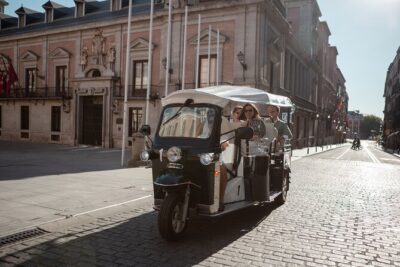 ★ 5.0Madrid Express Tour with Local Guide in Eco Tuk Tuk PrivateFrom $28413 reviews
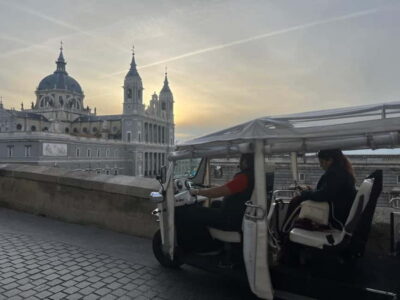 ★ 4.7Highlights City Tour by Electric Tuk TukFrom $28346 reviews
 ★ 4.4City Highlights Tuk Tuk TourFrom $94334 reviews
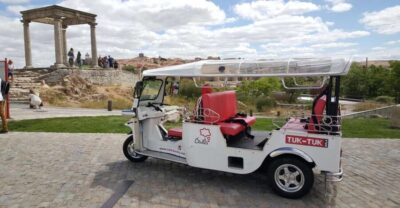 ★ 4.4Tour Guiado En Tuk Tuk Recorre Avila De La Forma Mas ComodaFrom $10235 reviews
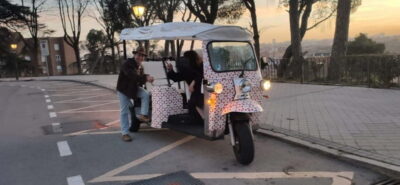 ★ 4.6City Tours – 6 seats private ecological tuk tukFrom $53230 reviews
Browse the lists this tour appears in