
REVIEW · MADRID TUK TUK TOURS
Tour en tuk-tuk electrico por MADRID MODERNO
Madrid in motion, and you don’t suffer for it. This electric tuk-tuk tour strings together big Madrid hits like the Royal Palace area, Almudena Cathedral, Neptune and Cibeles, plus the Atocha-to-Prado corridor, with a guide keeping each stop moving. I love the fast overview for first-time visitors (you cover more than you could on foot), and I like the short photo pauses that let you decide what you want to study later. The one drawback: it’s mostly exterior viewing and brief context, so it’s not a substitute for full museum visits.
The route also feels smart for people who want variety without chaos. In about 1 hour 30 minutes you’ll pass religious landmarks, royal gates, major squares, and even the bullring zone, then end up in neighborhoods that make planning your next walk easy.
Price is $131.54 per group (up to 4), so it can be a good deal when shared, and you get bottled water plus an English-speaking guide/driver. If you’re expecting lots of inside time, you’ll need to pair this with separate tickets for the places that matter most to you.
In This Review
- Key highlights I’d plan around
- Tuk-tuk Modern Madrid: how the 90 minutes really works
- Royal Palace, Almudena Cathedral, and San Francisco el Grande
- Puerta de Toledo and the Neptune Fountain stop-the-clock sights
- Atocha station and the Reina Sofía art corridor
- Jerónimos, Casón del Buen Retiro, and the Prado zone planning boost
- Las Ventas, Salamanca, Columbus, and the long shots on Gran Vía
- What I think makes the guides work (and what can trip you up)
- Price and value: $131.54 per group can make sense
- Who this tour fits best
- Should you book Madrid MODERNO by electric tuk-tuk?
- FAQ
- How long is the tour?
- How much is it, and how many people are included?
- What language is the tour offered in?
- Where do we meet, and what time does it start?
- What’s included in the price?
- Are attraction tickets included?
- What’s the cancellation situation?
Key highlights I’d plan around
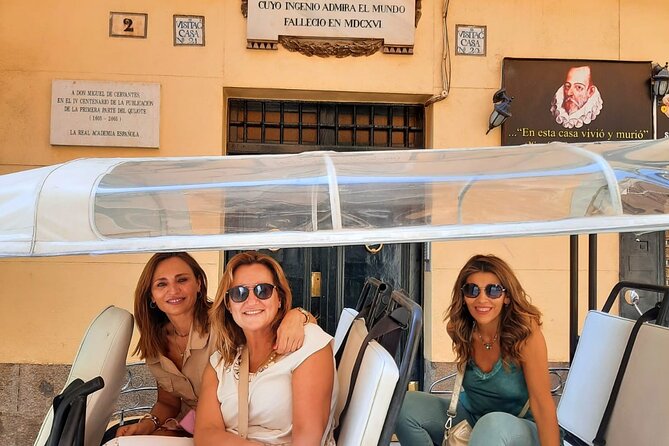
- Electric tuk-tuk comfort: you move between far-apart sights with minimal walking stress.
- Photo-stop flexibility: you can pause, shoot a few pics, and still get a quick history hit.
- Madrid’s art corridor in one sweep: Atocha, Reina Sofía area, and the Prado zone show up on the same route.
- Architecture variety: palace views, cathedrals, gates, and major fountains in one compact loop.
- English guide support: guides like Juan, Jimena, and Javier are singled out for clear explanations.
- Small-group feel: it’s private for your group, not a mixed crowd shuffle.
Buzz the old centre by tuk tuk
- Madrid: Private City Tour by Eco Tuk Tuk★ 4.9 · 3,465 reviews
- Madrid Historical Tour with Local Guide in Eco Tuk Tuk Private★ 5.0 · 876 reviews
- Madrid Express Tour with Local Guide in Eco Tuk Tuk Private★ 5.0 · 413 reviews
- Madrid: Highlights City Tour by Electric Tuk Tuk★ 4.7 · 346 reviews
Tuk-tuk Modern Madrid: how the 90 minutes really works
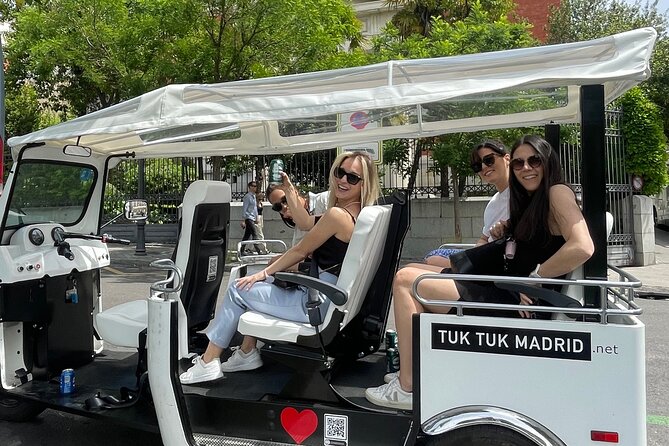
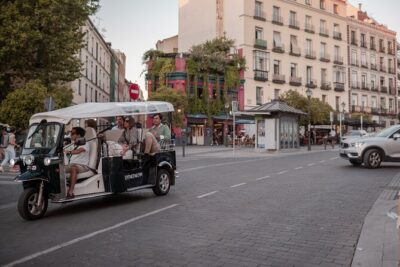
This is a private, up-to-4-person tour run in an electric tuk-tuk, aimed at giving you a clean overview of central Madrid quickly. The experience runs about 1 hour 30 minutes, and it finishes back at the meeting spot. You’ll start at C. de Vergara, 1 (Centro, 28013) at 9:00am, so build your morning around being there on time (Madrid can be slow to cross, even when you feel like you’re close).
You’ll use a mobile ticket, and bottled water is included. That sounds small, but in practice it helps: you’re moving through plazas and roundabouts, and you don’t want to spend your tour time hunting for a drink. Your guide (and driver) do the heavy lifting: they point out what you’re seeing and give short, usable context so the city stops being just a blur of buildings.
One more thing that matters: this kind of tour is weather-dependent. If conditions are rough, the tour can be canceled and rebooked or refunded, so have a backup day in mind for your Madrid sightseeing.
Royal Palace, Almudena Cathedral, and San Francisco el Grande

The early stretch sets the tone with Madrid’s “power and faith” landmarks, seen from the best city-view angles you can manage in a short ride.
Royal Palace (Palacio Real de Madrid)
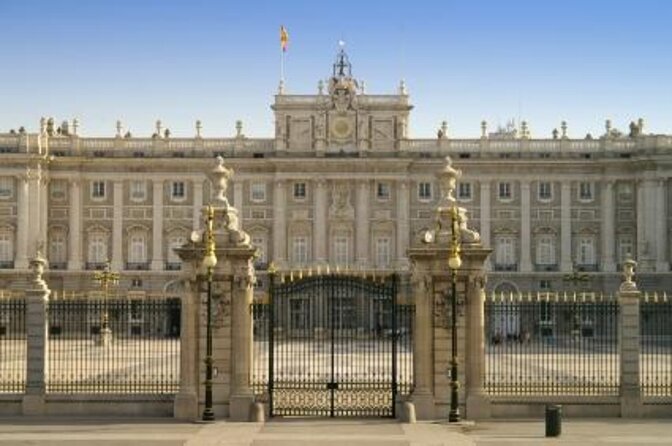
Madrid’s Royal Palace is huge—about 135,000 m² with 3,418 rooms—and it’s often described as Western Europe’s largest royal palace. On a tuk-tuk tour you won’t be doing a full interior visit. What you get instead is the quick payoff: exterior details plus guide context that helps you recognize what you’re looking at before you ever buy tickets later.
Almudena Cathedral
Almudena Catedral Metropolitana de Santa María la Real is dedicated to the Virgin Mary under the invocation of Almudena, and it’s the Catholic seat of Madrid’s archbishop. The guide’s explanation about its site being built where an old mosque once stood is the kind of detail that sticks. The name comes from the Arabic al-mudayna, meaning citadel, and the cathedral’s “timeline” shows up in its mix of styles: Neoclassical outside, Neo-Gothic inside, and Neo-Romanesque in the crypt.
San Francisco el Grande (Basilica of Our Lady of the Angels)
This basilica sits in the Palacio neighborhood near Plaza de San Francisco. You’ll see it as a landmark presiding over the square where streets intersect, but you also get the story: it’s tied to the Franciscan convent of Jesus and Mary, founded in the early 13th century.
Practical tip: these stops are ideal for photos that include the surrounding streets, not just close-ups. Roundabouts and squares frame Madrid’s monuments well—use the tuk-tuk as your moving “tripod.”
Puerta de Toledo and the Neptune Fountain stop-the-clock sights
After the palace-and-church start, the tour moves into Madrid’s monumental “city gateways and showpieces,” where the guide’s details help you notice what’s otherwise easy to miss.
Puerta de Toledo
This is one of Madrid’s access gates, and the current structure dates from the first third of the 19th century. It was designed by architect Antonio Aguado and shaped like a triumphal arch. It was erected to honor King Ferdinand VII and commemorate Spanish independence after the French occupation. The best part of a quick stop here is learning what the monument is celebrating, so you’re not just taking a photo of an arch.
Neptune Fountain (Plaza de Cánovas del Castillo)
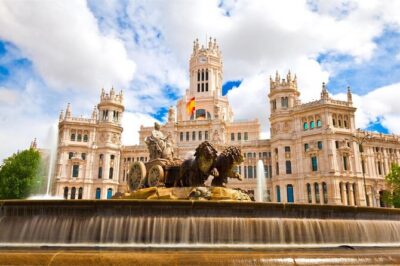
Neptune is a neoclassical fountain set in the middle of its roundabout. The plan was proposed in 1777, construction started in 1782, and it wrapped up in 1786. The tour’s neat detail: it was originally located at the descent of the San Jerónimo race, facing the Cibeles fountain, before being moved to this square in 1898. That “move” matters because it explains why Neptune feels like it belongs to this particular plaza.
If you hate wasting time in traffic jams, these city-center photo stops are actually efficient. You get a history note, shoot your picture, and keep rolling.
Atocha station and the Reina Sofía art corridor
One of the most useful parts of this route is how it tackles Madrid’s transport hub and its major art museum zone close together.
Atocha station
Atocha is described as Madrid’s rail junction and the station with the highest passenger traffic in Spain. It grew from a simple halt inaugurated in 1851 to become the Midi station inaugurated in 1892. Even if you’re not riding trains that day, it’s a great point on the map. The guide’s context makes Atocha feel like a key piece of Madrid’s modern story.
Reina Sofía area (Museo Nacional Centro de Arte Reina Sofía, MNCARS)
Reina Sofía is tied to a striking setting: it’s housed in the old General Hospital of Madrid, a neoclassical 18th-century building. The building is known as the Sabatini building, after Italian architect Francesco Sabatini. The museum opened in 1992, and it expanded in 2005 with the opening of the Nouvel building.
Even if you don’t go inside during this quick tour stop, you’ll understand why people use Reina Sofía as a reason to come to this neighborhood. It helps you plan the next day: walkable streets, major transit, and a museum that’s easy to return to.



Jerónimos, Casón del Buen Retiro, and the Prado zone planning boost
This is where the tour starts connecting Madrid’s royals-to-art story in a way that’s genuinely helpful. You see multiple landmarks linked to the old Buen Retiro Palace complex and the museum world that grew from it.
San Jerónimo el Real (Los Jerónimos)
This old monastery, popularly called Los Jerónimos, was one of Madrid’s most important monasteries, originally ruled by the Order of San Jerónimo. The stop is short (about 5 minutes), and it’s marked as admission ticket free, so if you want a quick look you may be able to step in briefly depending on conditions.
Casón del Buen Retiro
One of only two buildings surviving from the Buen Retiro Palace destruction, the Casón was built by Alonso Carbonel in 1637 as a court ballroom space under Felipe IV. Since 1971 it has been part of the Prado Museum system. The tour context matters here because it explains connections you might otherwise miss, like how Guernica ended up at Reina Sofía in 1992 and how Casón’s role shifted again after later renovations (reopened as a Museum Study Center in 2009).
Salón de Reinos (the old great ceremonial room)
This room was built between 1630 and 1635 as the representative axis of the old Buen Retiro Palace. It earned the name from the painted coats of arms of the 24 kingdoms of the Hispanic Monarchy under Philip IV. A very practical modern detail: it’s often called the Army Museum because it housed that institution between 1841 and 2005, before collections moved toward the Alcázar of Toledo.
Real Academia Española (RAE)
This stop is about the Spanish language as an institution. The Royal Spanish Academy was founded in 1713 on the initiative of Juan Manuel Fernández Pacheco, the VIII Marquis of Villena and Duke of Escalona, modeled after the French Academy. King Felipe V approved the constitution the next year, and the academy’s first statutes were approved in 1715. This is marked as admission ticket not included, so treat it as an orientation stop unless your guide offers options.
Museo del Prado area
The Prado Museum stop is also short (about 5 minutes) and marked admission ticket free. You’ll get the quick pitch on why it’s famous: major European painters from the 15th to 18th centuries, and an especially strong concentration of Spanish art. The guide points out giants like Velázquez, El Greco, Goya, Titian, Rubens, and Bosco.
Puerta de Alcalá
This monument is one of Madrid’s old royal gates. It sits at the roundabout in Plaza de la Independencia, at the crossroads of several streets. It’s an easy win photo moment because you can capture it with traffic patterns and street lines in the background.
This “museum zone” portion is the part I’d recommend for anyone arriving with limited time. You leave with enough context to decide what to see in depth later.
Las Ventas, Salamanca, Columbus, and the long shots on Gran Vía
After the art-and-palace stretch, you get Madrid’s big-city personality: shopping streets, civic institutions, and iconic “you have to walk this at least once” boulevards.
Las Ventas bullring
This is the largest bullring in Spain, with a capacity listed at 23,798 (third largest in the world). It’s the second largest by ring diameter at 61.5 m. You’ll see it as a landmark with real scale, not just a sign on a map.
Barrio de Salamanca
This upscale district is tied to 19th-century development promoted by builder José de Salamanca y Mayol. It’s known for high-end shopping, especially around Serrano, Claudio Coello, and Ortega y Gasset. The stop runs about 20 minutes and is marked admission ticket free, so you can take your time with street views.
Plaza de Colón and the Columbus monument
This public square is where major streets converge: Goya, Génova, Paseo de la Castellana, and Recoletos. The name is from Christopher Columbus, and the monument is neo-Gothic, erected between 1881 and 1885.
National Library of Spain (BNE)
The BNE is described as the autonomous body responsible for Spain’s bibliographic and documentary heritage. It guards around 30 million publications—books, magazines, maps, engravings, drawings, scores, and brochures—covering materials produced since the beginning of the 18th century.
Bank of Spain + Cibeles
You’ll pass the Bank of Spain headquarters, built between 1884 and 1891, facing Plaza de Cibeles. Then you’ll reach La Cibeles, the monumental fountain in the same square. The fountain was part of 18th-century urban remodeling initiated by King Carlos III, meant to beautify Madrid in a neoclassical style. The guide’s explanation that locals once called the area the Salón del Prado helps you understand why this square feels like a social center, not just a landmark.
Gran Vía
Your route ends with Madrid’s signature street energy. Gran Vía runs from Calle de Alcalá to Plaza de España and is known for its early-1900s commercial and tourist role. The section between Plaza de Callao and Plaza de España is nicknamed Madrid’s Broadway due to theater and cinemas. You’ll get a quick look, about 10 minutes, and it’s a handy final orientation point before you go exploring on your own.
What I think makes the guides work (and what can trip you up)
This tour lives or dies by communication, and the data you’re given points to a consistent win: the guides are comfortable with English and able to explain big monuments in clear chunks. Names that come up for standout guiding include Juan, Jimena, Javier, and a pair of drivers often mentioned with praise: José and Javier. I’d treat that as a strong sign that narration is a core part of the experience, not an afterthought.
Still, there’s one practical friction point you should plan for: Madrid traffic noise. One note from the experience is that the guide voice can get covered by street sounds, even when there’s an audio setup. If you’re sensitive to loud environments, consider bringing earplugs just in case, and don’t assume every stop will be equally quiet for listening.
Price and value: $131.54 per group can make sense
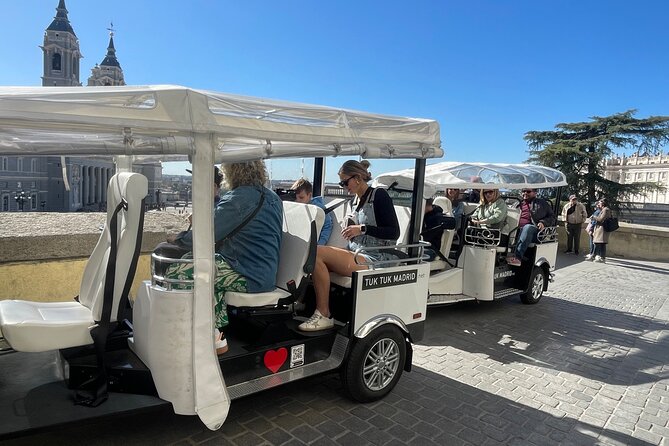
At $131.54 per group (up to 4) for about 90 minutes, the math works best for couples with another pair, small families, or friend groups that can share. For four people, the per-person cost comes out to roughly $33 each, which is often less than what you’d pay in rides plus paying for the time cost of getting around on your own.
The value is also about what’s included. You get bottled water and a guide/driver, and you don’t have to spend time plotting the order of sights. The trade-off is also clear: because the tour is short and private, you’re not doing a deep, ticket-heavy museum day. Think of this as a smart “first pass” to help you build a second day plan.
Who this tour fits best
This is ideal if you:
- want a first-timer’s overview of central Madrid
- prefer less walking while still seeing major landmarks
- like having a guide explain what you’re looking at, then using that to plan your own next steps
It’s less ideal if you:
- want long museum time at Reina Sofía or the Prado
- expect nonstop access inside buildings (most stops are brief)
- are traveling with strict time windows that can’t handle a short photo stop and repositioning
If you’re flexible and use the tour to decide what to revisit, it works well.
Should you book Madrid MODERNO by electric tuk-tuk?
I’d book it if you want a practical way to get your bearings fast. You’ll see royalty buildings, cathedrals, gates, fountains like Neptune and Cibeles, and key art-zone landmarks around Atocha and the Prado corridor—without turning your day into a long hike.
I’d hesitate only if you need lots of inside time, or if your schedule is fragile. This kind of tour is short by design, and good weather helps the experience run smoothly. If that fits your style, it’s a solid way to start your Madrid days and then branch out from there.
FAQ
How long is the tour?
It runs about 1 hour 30 minutes.
How much is it, and how many people are included?
It costs $131.54 per group, and the group size is up to 4.
What language is the tour offered in?
The tour is offered in English.
Where do we meet, and what time does it start?
The meeting point is C. de Vergara, 1, Centro, 28013 Madrid. The start time is 9:00am, and the tour ends back at the meeting point.
What’s included in the price?
Bottled water and a guide/driver are included. You’ll also receive a mobile ticket.
Are attraction tickets included?
Some stops are marked free (like Jerónimos and the Prado area), while the Royal Spanish Academy (RAE) stop is marked as admission not included. Other stops aren’t specifically labeled as included.
What’s the cancellation situation?
Free cancellation is available up to 24 hours in advance for a full refund, and the tour requires good weather. If it’s canceled due to poor weather, you’ll be offered a different date or a full refund.
More Tours in Madrid
- Madrid: Tour Bernabéu Entry Ticket
★ 4.5 · 21,573 reviews - Madrid: Panoramic Route City Tour
★ 4.1 · 12,259 reviews - Avila & Segovia Tour with Tickets to Monuments from Madrid
★ 5.0 · 9,762 reviews - Madrid: Royal Palace Expert Guided Tour with Skip-the-Line
★ 4.7 · 8,407 reviews - Madrid: Segovia and Toledo Tour, Alcazar, and Cathedral
★ 4.7 · 7,797 reviews - Toledo Tour from Madrid: Cathedral, Synagogue & St. Tome’s Church
★ 5.0 · 6,784 reviews
More Tour Reviews in Madrid
- Madrid: Tour Bernabéu Entry Ticket
★ 4.5 · 21,573 reviews - Madrid: Prado Museum Entry Ticket
★ 4.6 · 20,699 reviews - Madrid: “Emociones” Live Flamenco Performance
★ 4.8 · 12,866 reviews - Madrid: Panoramic Route City Tour
★ 4.1 · 12,259 reviews - Madrid: Live Flamenco Show with Food and Drinks Options
★ 4.5 · 9,901 reviews - Avila & Segovia Tour with Tickets to Monuments from Madrid
★ 5.0 · 9,762 reviews
Tuk Tuk Around the Middle
- Madrid: Private City Tour by Eco Tuk Tuk
★ 4.9 · 3,465 reviews - Madrid Welcome Tour with Local Guide in Eco Tuk Tuk Private
★ 5.0 · 2,936 reviews - Madrid Historical Tour with Local Guide in Eco Tuk Tuk Private
★ 5.0 · 876 reviews - Madrid Express Tour with Local Guide in Eco Tuk Tuk Private
★ 5.0 · 413 reviews - Madrid: Highlights City Tour by Electric Tuk Tuk
★ 4.7 · 346 reviews - Madrid: City Highlights Tuk Tuk Tour
★ 4.4 · 334 reviews
Just Added: New Madrid Tour Reviews



Madrid Tuk Tuk Tours, compared.
 ★ 4.9Private City Tour by Eco Tuk TukFrom $283,465 reviews
 ★ 5.0Madrid Welcome Tour with Local Guide in Eco Tuk Tuk PrivateFrom $282,936 reviews
 ★ 5.0Madrid Historical Tour with Local Guide in Eco Tuk Tuk PrivateFrom $28876 reviews
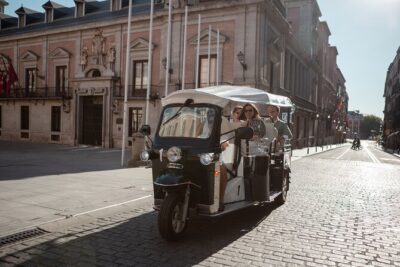 ★ 5.0Madrid Express Tour with Local Guide in Eco Tuk Tuk PrivateFrom $28413 reviews
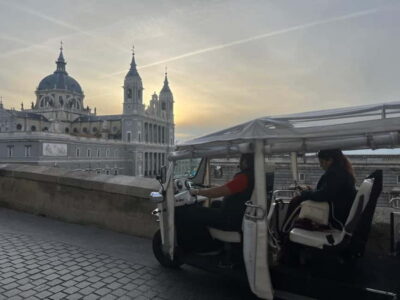 ★ 4.7Highlights City Tour by Electric Tuk TukFrom $28346 reviews
 ★ 4.4City Highlights Tuk Tuk TourFrom $94334 reviews
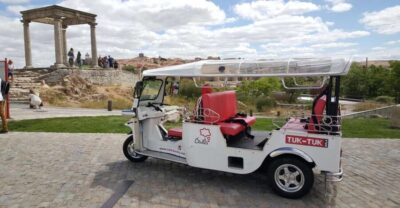 ★ 4.4Tour Guiado En Tuk Tuk Recorre Avila De La Forma Mas ComodaFrom $10235 reviews
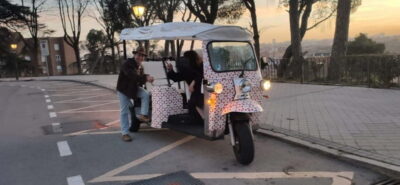 ★ 4.6City Tours – 6 seats private ecological tuk tukFrom $53230 reviews
Browse the lists this tour appears in