
REVIEW · MADRID TUK TUK TOURS
Madrid Tuk Tuk & Olé Experience – Private 1.5h Cultural Tour
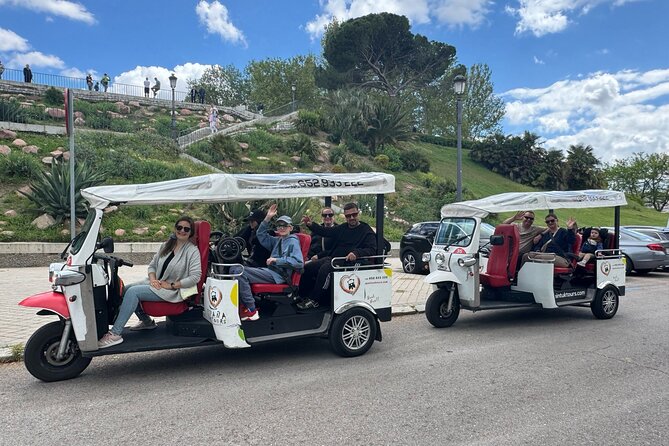
Madrid looks different from a tuk tuk. This private 1.5-hour ride strings together royal sights, cathedrals, and big art landmarks with a friendly guide such as Sebastian, Pedro, Pablo, or Simon calling out what matters. You also get the kind of pacing that works when you want highlights without burning a whole day on buses and lines.
Two things I really like here are the private group setup (up to 4 people, so questions don’t get lost in the crowd) and the way the stops are chosen for fast context. Even the art museums and historic buildings feel connected, so you start seeing Madrid as one story instead of 18 separate attractions. One practical consideration: with many stops packed into 1.5 hours, you’ll get a taste at each location, not a long, slow wander.
In This Review
- Key Highlights Worth Waking Up For
- A Tuk Tuk Sprint Through Madrid’s Big Names
- The 1.5-Hour Reality: What You Will See (and What You Won’t)
- Royal Palace and Almudena: Where Madrid Shows Its Official Face
- San Francisco el Grande and the Toledo Gate: Faith and Power at Street Level
- Neptune Fountain and Plaza Cánovas: Small Stops, Big Orientation
- Atocha to Reina Sofía: Modern Art in an Old Hospital
- Jerónimos and Buen Retiro Remains: The Royal Retreat After the Palace
- Royal Spanish Academy and the Prado: Language and Painting as National Identity
- Gates, Boulevards, and the City’s Different Faces
- Gran Vía: The “Madrid Broadway” Section You’ll Recognize Instantly
- Pricing and Value: When $167.02 Makes Sense
- Who This Tuk Tuk Tour Fits Best
- Final Call: Should You Book It?
- FAQ
- How long is the Madrid Tuk Tuk & Olé experience?
- What is the price, and how many people can join?
- Is this tour private?
- What language is the tour offered in?
- Where does the tour start, and where does it end?
- Are admission tickets included for the stops?
- What is included in the price?
- Is lunch or dinner included?
- What if I need to cancel?
Key Highlights Worth Waking Up For
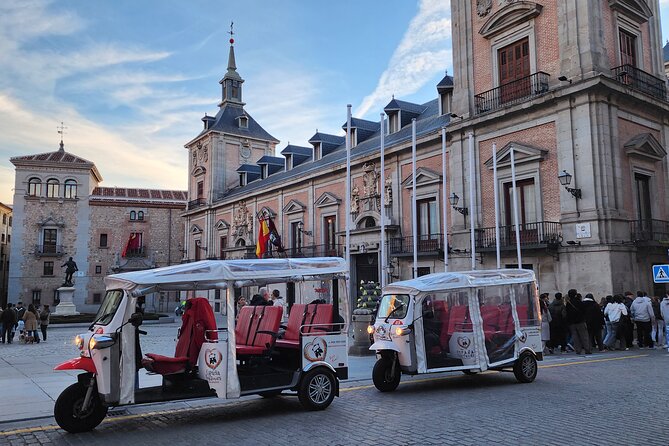
- Private tuk tuk format for up to 4 people, so you can ask questions and adjust on the fly.
- Free admission is built into the plan at each featured stop, which helps value when you add up museum entry.
- Guides who teach the city with anecdotes and route tips; names you may hear include Sebastian, Pedro, Pablo, Charlie, and Simon.
- Start early to stay fast since traffic can slow a tuk tuk day as time passes.
- Atocha to Reina Sofía to Prado gives you art in two moments: 20th-century modern plus classic masterworks.
Buzz the old centre by tuk tuk
- Madrid: Private City Tour by Eco Tuk Tuk★ 4.9 · 3,465 reviews
- Madrid Historical Tour with Local Guide in Eco Tuk Tuk Private★ 5.0 · 876 reviews
- Madrid Express Tour with Local Guide in Eco Tuk Tuk Private★ 5.0 · 413 reviews
- Madrid: Highlights City Tour by Electric Tuk Tuk★ 4.7 · 346 reviews
A Tuk Tuk Sprint Through Madrid’s Big Names
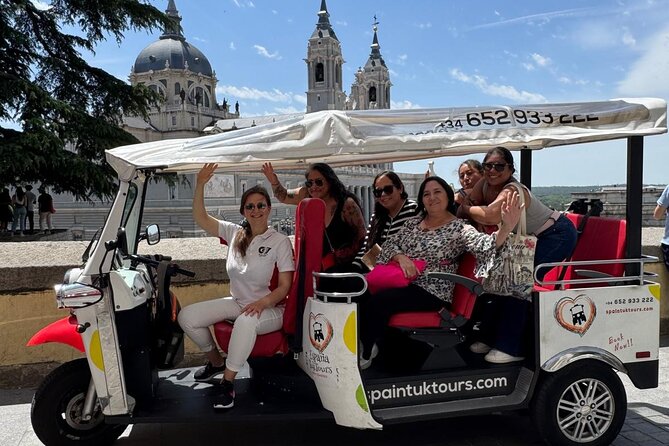
This isn’t a random sightseeing loop. It’s a compact cultural route that moves through Madrid’s power centers: monarchy, church authority, royal retreats, national institutions, and the art Madrid is famous for. You’ll spend your time where Madrid’s identity is visible in stone—palace facades, landmark gates, museum clusters, and civic buildings—without waiting around for your next metro connection.
The tuk tuk matters here. Walking everywhere in a short window can turn into a leg-budget problem fast. On a tuk tuk, you get a cleaner line of sight to buildings and plazas as your guide narrates what you’re looking at. That’s especially useful for the “read the city” moments: why a gate looks the way it does, why a fountain is where it is, and why these institutions ended up here.
The 1.5-Hour Reality: What You Will See (and What You Won’t)
At 1 hour 30 minutes, this tour is best thought of as a highlight sampler with built-in context. You’ll stop at major landmarks across the city, but the timing won’t allow for a long, detailed museum day at every site. The payoff is that you’ll leave with clear mental snapshots and a sense of what to return for later.
Also, it’s private and focused. Because it’s only your group, you’re more likely to get answers that match your interests—history, architecture, art, or just practical “what’s the deal with this building” explanations. If you’re the kind of person who likes to know what you’re looking at while you’re looking at it, this format clicks.
Royal Palace and Almudena: Where Madrid Shows Its Official Face
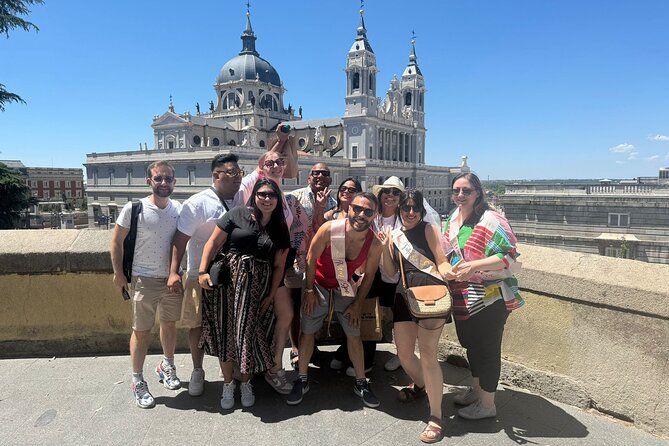
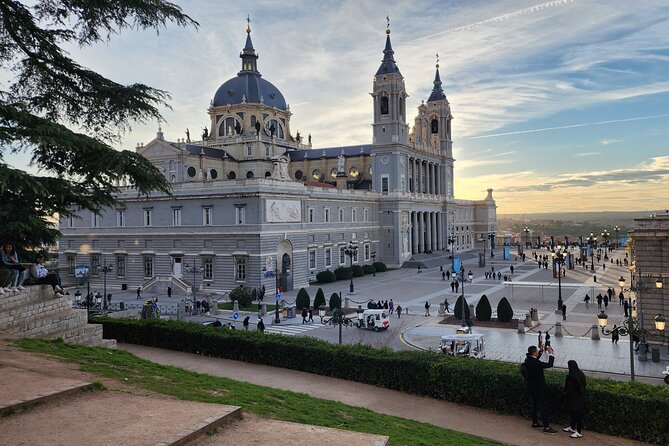
The route starts with the Royal Palace of Madrid, described as the official residence of Spain’s king and noted as the largest royal palace in Western Europe. Even if you don’t go deep into every room, this stop sets the tone: Madrid’s monarchy isn’t hidden away. It’s meant to be seen, read, and remembered.
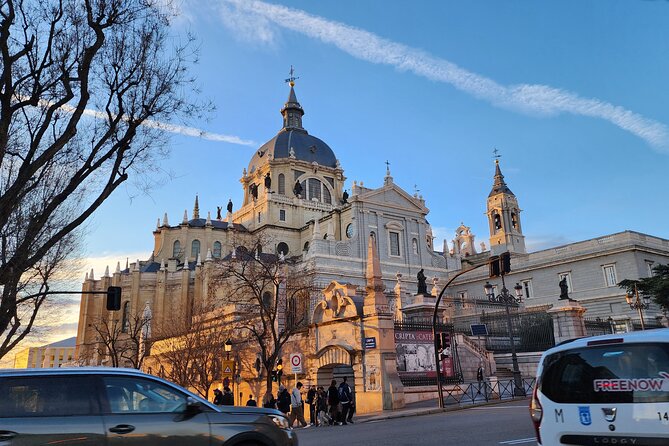
Next is Almudena Cathedral, a cathedral dedicated to the Virgin Mary under the invocation of Almudena, and it sits right in Madrid’s historic center. What makes this stop interesting is the layered build: it’s on the site of an old mosque, and the design shifts styles—neoclassical outside, neo-gothic inside, plus a neo-romanesque crypt. In a short tour, you’ll usually get the “why it looks the way it looks” version of architecture, which is exactly what you need to make a first visit feel meaningful.
A nice bonus in this plan is that admission is marked as free for these stops. That changes the math. You’re less likely to skip due to ticket price, and you can treat the route like a cultural sampler instead of a paid buffet where only some stops feel worth it.
San Francisco el Grande and the Toledo Gate: Faith and Power at Street Level
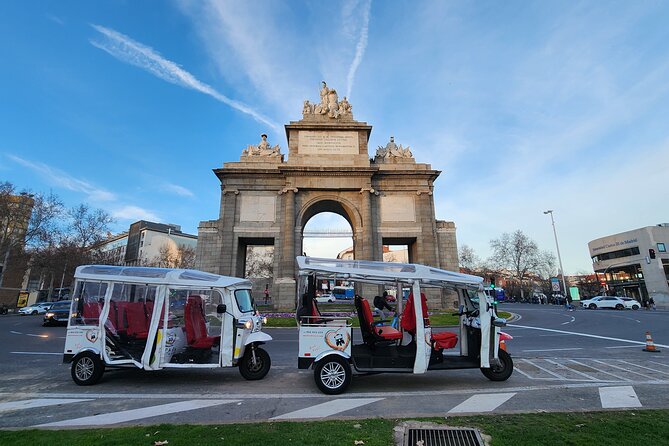
After the cathedral stop, you’ll head to Real Basilica de San Francisco el Grande, part of the Franciscan complex and tied to a convent history that goes back to the early 1200s. This is one of those places where a short visit can still make sense, because churches are built to communicate—through scale, materials, and spatial drama. Even without a long sit-down, you’ll usually come away with a clearer feel for Madrid’s religious footprint.
Then comes Puerta de Toledo, a triumphal-arch style gate honoring King Ferdinand VII and Spanish independence after the French occupation. What I like about pairing a cathedral with a gate is contrast: one is devotion and ritual; the other is nationhood and commemoration. You start to see how Madrid marks authority in different ways.
Private and unhurried, just your party




Neptune Fountain and Plaza Cánovas: Small Stops, Big Orientation
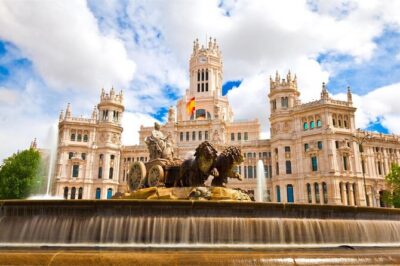
The tour includes Plaza de Cánovas del Castillo and the Neptune Fountain at its center. This isn’t just a pretty photo stop. The details help you orient yourself around Madrid’s plaza culture: the fountain was proposed in 1777, construction started in 1782, finished in 1786, and the fountain was later moved to the square center in 1898. That kind of “where it used to be” context is exactly what your guide is for.
This is also where a private tuk tuk shines. You can pause, look, and immediately connect the plaza to nearby routes. It’s the fast way to learn city geography—useful later when you’re walking on your own.
Atocha to Reina Sofía: Modern Art in an Old Hospital
From gates and plazas, the tour turns toward Estación de Atocha, a major railway junction and Madrid’s busiest passenger station in Spain. Even if you’re not taking trains, Atocha works as a visual landmark. It’s a reminder that Madrid is a city of movement, not just monuments.
Then you move to Museo Reina Sofía, housed in the old General Hospital of Madrid. The building’s architectural lineage matters here: the earlier design is credited to José de Hermosilla, with later work by Francesco Sabatini. The museum opened in 1992, and later expanded with a second building designed by Jean Nouvel. In a short tour, you won’t leave as an expert on museum architecture, but you will understand what kind of building this is and why that setting fits modern and contemporary art.
This is also where your guide’s style can make the difference. Some guides are more story-driven, others more detail-driven. Either way, the key is that the route ties the city’s 20th-century creative identity to a physical space that used to serve healthcare—again, contrast, purpose, and reuse.
Jerónimos and Buen Retiro Remains: The Royal Retreat After the Palace
The tour then goes to Jerónimos (San Jerónimo el Real), an old monastery associated with the Order of San Jerónimo. It sits near the story of royal residences too—because by the time of Felipe IV, an adjacent Royal Room expanded into what became part of the Buen Retiro Palace era. This is one of those connections that’s hard to notice if you’re only reading plaques. With a guide, it becomes a line you can follow.
From there, you’ll see two remaining pieces of the Buen Retiro palace complex:
- El Casón del Buen Retiro, built in 1637 as a court ballroom space for Felipe IV, and later linked to the Prado Museum.
- Salón de Reinos del Palacio del Buen Retiro, built between 1630 and 1635 and originally decorated with coats of arms connected to the Hispanic monarchy of Philip IV’s time. It later became known as the Army Museum before collections moved elsewhere.
Here’s the practical value: even though these buildings survived when much of the palace did not, they still let you grasp what kind of royal space Buen Retiro was. If you plan to visit the Prado or spend more time in the Retiro area later, this stop gives you the “anchor points” so you don’t feel lost.
Royal Spanish Academy and the Prado: Language and Painting as National Identity
Next up is the Real Academia Española (RAE). It’s a publicly funded institution for the Spanish language, founded in 1713 and shaped with royal approval. In a city tour, this might sound abstract—but it’s a strong cultural pivot. Madrid doesn’t just govern; it codifies ideas.
Then comes Museo Nacional del Prado, one of the world’s best-known art museums, with a particular emphasis on Spanish and European painters from the 15th to the 18th centuries. The Prado is especially associated with major artists such as Velázquez, El Greco, and Goya, plus figures like Titian, Rubens, and Bosch. Again, you’ll likely get a “where to start” perspective rather than a full museum plan, but that can be hugely helpful. It’s a fast way to decide which painter or era you should prioritize on a return trip.
This is also where the tour’s timing matters. If you’re going early, the vibe is calmer and the route can stay moving. One guide tip shared in past experiences is that traffic can slow things later in the day—so if you want the tour to feel smooth, choose an earlier start when you can.
Gates, Boulevards, and the City’s Different Faces
After the big art and language stops, the tour swings back into street-level Madrid with Puerta de Alcalá. This is one of Madrid’s historic royal gates, located at the roundabout in Plaza de la Independencia, where multiple major streets intersect. In other words: it’s a city compass point. Seeing it during a ride helps you mentally map where the city expands from the historic center.
Then you head toward Las Ventas bullring, described as the largest bullring in Spain. It’s also a huge capacity venue, with the seating count cited as 23,798. Even if bullfighting isn’t your focus, it’s part of modern Madrid’s public architecture and cultural history.
From there, you reach Barrio de Salamanca, a district strongly tied to 19th-century development and now known for high-end shopping around Serrano, Claudio Coello, and Ortega y Gasset streets. This works well in a short tour because it shows Madrid’s economic layer, not just its cultural monuments.
You also pass by Biblioteca Nacional de España (Spain’s national library), with an emphasis on preservation and cataloging of Spain’s documentary heritage, and the Banco de España, Spain’s central bank. Both stops are more than quick exteriors. They remind you Madrid is also an administrative capital, with institutions built to last.
Gran Vía: The “Madrid Broadway” Section You’ll Recognize Instantly
The final stretch includes Gran Vía, one of Madrid’s main streets. The tour notes that Gran Vía begins at Calle de Alcalá and ends at Plaza de España, with the famous cinema corridor often compared to Madrid’s Broadway. One practical point: Gran Vía is the kind of street you’ll keep seeing on future walks, so getting an easy orientation view from the tuk tuk helps.
Even if you later want quiet side streets, Gran Vía is a helpful baseline map. When you know where it runs, you can navigate the city faster on your own.
Pricing and Value: When $167.02 Makes Sense
The price is $167.02 per group for up to 4 people, for about 1 hour 30 minutes. That’s the key: you aren’t paying per person, you’re paying per tuk tuk group.
Here’s the value math. If you fill the group with 4 people, the effective cost is roughly $42 per person. That can be a strong deal when the tour plan indicates free admission at a long list of stops. If it’s just 2 people, you’re closer to $84 per person, which still may feel fair if you’re planning to enter major sites anyway, but it becomes less of a bargain if your priorities are just quick exterior photos.
So I’d use this rule: book it if you want a guided route that saves time and helps you pick what to do next. Skip it if you already have your own tightly planned neighborhood-by-neighborhood checklist and you’d rather move at your own speed.
Who This Tuk Tuk Tour Fits Best
This tour is a great fit if you:
- Want to get your bearings fast across multiple Madrid districts.
- Like art and architecture but don’t want to schedule separate museum trips immediately.
- Prefer a private guide who can explain what you’re seeing in real time.
- Are traveling with a small group (up to 4), where the per-group pricing pays off.
It might not be the best choice if you expect a slow, museum-deep visit at each stop. In 1.5 hours, the goal is momentum plus context, not hours inside every venue.
Final Call: Should You Book It?
If your Madrid plan is short and you want the major threads—palaces, cathedrals, royal retreats, national institutions, and big art—this is an efficient way to build a mental map. The free admission aspect also helps the value feel practical, not just “fun transportation.”
I’d book it early in your trip if you can. It’s the kind of experience that gives you follow-up targets. After this, you’ll usually know which areas are worth more time and which ones you’ve already “met” enough to move on.
FAQ
How long is the Madrid Tuk Tuk & Olé experience?
It runs about 1 hour 30 minutes (approx.).
What is the price, and how many people can join?
It costs $167.02 per group and accommodates up to 4 people.
Is this tour private?
Yes. It’s a private tour/activity, and only your group participates.
What language is the tour offered in?
The tour is offered in English.
Where does the tour start, and where does it end?
It starts at Pl. de la Lealtad, 1, Retiro, 28014 Madrid, Spain, and ends back at the meeting point.
Are admission tickets included for the stops?
The experience lists admission ticket free for the included stops.
What is included in the price?
All fees and taxes are included.
Is lunch or dinner included?
No, dinner and lunch are not included.
What if I need to cancel?
You can cancel for a full refund if you cancel up to 24 hours in advance of the experience start time.
More Tour Reviews in Madrid
- Madrid: Tour Bernabéu Entry Ticket
★ 4.5 · 21,573 reviews - Madrid: Prado Museum Entry Ticket
★ 4.6 · 20,699 reviews - Madrid: “Emociones” Live Flamenco Performance
★ 4.8 · 12,866 reviews - Madrid: Panoramic Route City Tour
★ 4.1 · 12,259 reviews - Madrid: Live Flamenco Show with Food and Drinks Options
★ 4.5 · 9,901 reviews - Avila & Segovia Tour with Tickets to Monuments from Madrid
★ 5.0 · 9,762 reviews
Private Days in the Capital
- Madrid: Private City Tour by Eco Tuk Tuk
★ 4.9 · 3,465 reviews - Madrid Welcome Tour with Local Guide in Eco Tuk Tuk Private
★ 5.0 · 2,936 reviews - Madrid Historical Tour with Local Guide in Eco Tuk Tuk Private
★ 5.0 · 876 reviews - Toledo Private Tour with Licensed Guide and Driver from Madrid
★ 5.0 · 637 reviews - Madrid Private Segway tour. Retiro Park – Centro Historico
★ 4.9 · 636 reviews - Madrid Express Tour with Local Guide in Eco Tuk Tuk Private
★ 5.0 · 413 reviews
Tuk Tuk Around the Middle
- Madrid: Private City Tour by Eco Tuk Tuk
★ 4.9 · 3,465 reviews - Madrid Welcome Tour with Local Guide in Eco Tuk Tuk Private
★ 5.0 · 2,936 reviews - Madrid Historical Tour with Local Guide in Eco Tuk Tuk Private
★ 5.0 · 876 reviews - Madrid Express Tour with Local Guide in Eco Tuk Tuk Private
★ 5.0 · 413 reviews - Madrid: Highlights City Tour by Electric Tuk Tuk
★ 4.7 · 346 reviews - Madrid: City Highlights Tuk Tuk Tour
★ 4.4 · 334 reviews
Just Added: New Madrid Tour Reviews


Madrid Tuk Tuk Tours, compared.
 ★ 4.9Private City Tour by Eco Tuk TukFrom $283,465 reviews
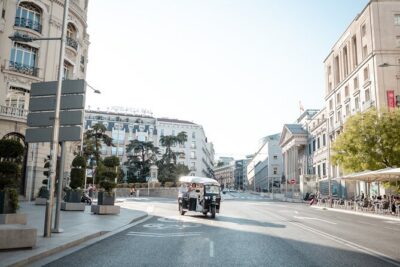 ★ 5.0Madrid Welcome Tour with Local Guide in Eco Tuk Tuk PrivateFrom $282,936 reviews
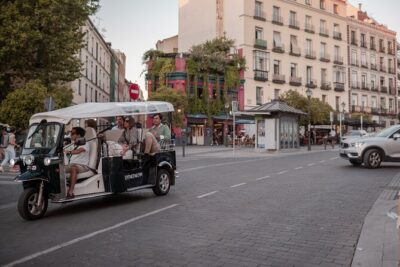 ★ 5.0Madrid Historical Tour with Local Guide in Eco Tuk Tuk PrivateFrom $28876 reviews
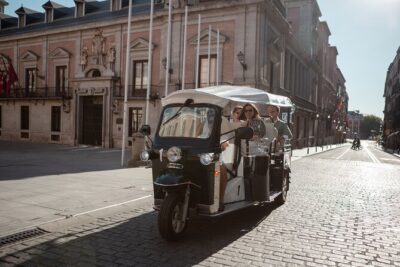 ★ 5.0Madrid Express Tour with Local Guide in Eco Tuk Tuk PrivateFrom $28413 reviews
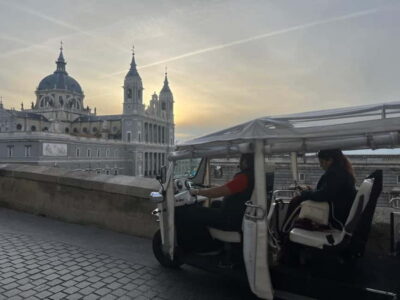 ★ 4.7Highlights City Tour by Electric Tuk TukFrom $28346 reviews
 ★ 4.4City Highlights Tuk Tuk TourFrom $94334 reviews
 ★ 4.4Tour Guiado En Tuk Tuk Recorre Avila De La Forma Mas ComodaFrom $10235 reviews
 ★ 4.6City Tours – 6 seats private ecological tuk tukFrom $53230 reviews
Browse the lists this tour appears in