

REVIEW · MADRID TUK TUK TOURS
Madrid Sightseeing Tuk Tuk Tours
Madrid is big; this tuk tuk keeps you moving. What makes this ride fun is the tight, guided loop that strings together major landmarks, classic neighborhoods, and big views in about 1–3 hours. I love the fast orientation it gives you on a first day, and I also like the stop-and-walk breaks that turn key sights into more than just drive-bys. Guides like David, Offito, Alexander, Gerardo, and Cesar are repeatedly praised for keeping the city stories clear and useful.
One thing to consider: the tuk tuk’s covered design can affect sightlines. If you get a seat where you’re looking past the cover, you may feel more boxed in than you expect, so choosing your position and asking the guide where to sit can matter.
In This Review
- Key things to know before you ride
- Price and logistics: what $108.02 buys you
- How the tuk tuk experience actually feels
- Royal Palace area: from defensive roots to royal spectacle
- Almudena Cathedral and Plaza de la Villa: free stops that add meaning
- Mercado San Miguel and old-market architecture
- La Latina, San Isidro, and Las Letras: neighborhoods where you actually feel Madrid
- Paseo-style highlights: UNESCO trees, Prado area, and the “Madrid axis”
- Retiro Park, Cibeles, and Neptuno: where photos turn into a break
- Los Jerónimos and the “walkable grandeur” feeling
- Puerta de Alcalá, Toledo, and classic gates you can’t miss
- Bernabéu, the Picasso Tower, and modern Madrid contrasts
- Choosing your guide: what makes the ride better than a drive
- Who this tour is best for
- Should you book this Madrid tuk tuk sightseeing tour?
- FAQ
- How long is the Madrid Sightseeing Tuk Tuk Tour?
- What does the tour cost per person?
- Is the tour offered in English?
- Are admission tickets included for the Royal Palace or the Prado?
- Where does the tour meet?
- Is this a private tour?
- Are service animals allowed?
- Can children under 6 years old join?
- What is the cancellation policy?
Key things to know before you ride

- A 1–3 hour sightseeing loop that’s built for first-timers who want momentum
- Short walk moments at major sights like Almudena Cathedral and the food-and-architecture stop at Mercado San Miguel
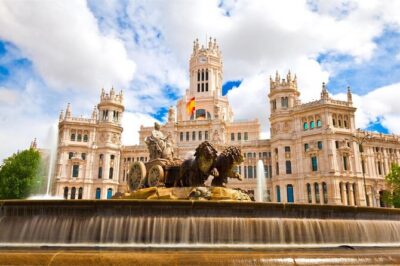
- Madrid’s classic “postcard” axis from Cibeles and Neptune fountains toward Retiro Park
- Admission tickets mostly not included, so you’ll need to plan ahead for the big indoor stops
- Rain-and-cold readiness, including reports of blankets for bad weather
- English-speaking guides who connect the dots between monuments, neighborhoods, and everyday life
Buzz the old centre by tuk tuk
- Madrid: Private City Tour by Eco Tuk Tuk★ 4.9 · 3,465 reviews
- Madrid Historical Tour with Local Guide in Eco Tuk Tuk Private★ 5.0 · 876 reviews
- Madrid Express Tour with Local Guide in Eco Tuk Tuk Private★ 5.0 · 413 reviews
- Madrid: Highlights City Tour by Electric Tuk Tuk★ 4.7 · 346 reviews
Price and logistics: what $108.02 buys you

At about $108.02 per person, this is not the cheapest way to tour Madrid. But you’re paying for a private tuk tuk experience plus an accompanying personal guide, not just transit.
The value sweet spot is time. In a short window, you get to see Royal Palace-area grandeur, the Almudena Cathedral setting, the Prado/Retiro corridor, and even west-side modern icons. That’s ideal when you’re jet-lagged, traveling with kids, or just want your bearings fast.
Two practical notes can change how good the value feels. First, several headline attractions require separate admission tickets (like the Royal Palace, the Prado, Bernabéu, the Royal Botanical Garden, and San Francisco el Grande). Second, because it’s a guided route with scheduled stopping points, you’ll want to show up ready to go on time—one late-arrival situation in the feedback turned into a missed tour.
How the tuk tuk experience actually feels
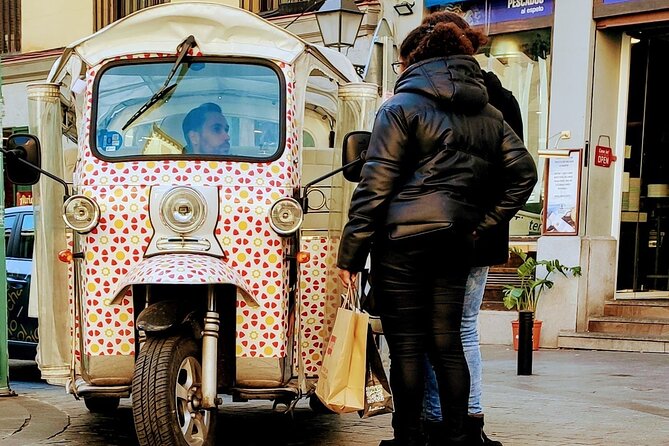
This is a private ride, so you’re not squeezed into a crowd with strangers. You’ll ride in a tuk tuk setup designed for moving through streets efficiently, and you’ll get quick photo opportunities plus moments where you can step out and walk.
It’s also the kind of vehicle that rewards good weather clothing. Madrid weather can swing fast, and the reports include blankets being offered when it got cold and rainy. If you’re sensitive to wind, bring a layer even in seasons that look mild.
And yes, there’s a trade-off with the covered design: if you end up where the cover blocks your view, you may feel like you’re fighting for angles. That’s why it pays to ask the guide where to sit so you can see street-level details, not just rooftops.
Royal Palace area: from defensive roots to royal spectacle
You start in the Royal Palace of Madrid orbit, and this isn’t just about looking at the outside. The palace story stretches back to a fortified building that goes to the 9th century, tied to Muhammad I of the Emirate of Córdoba. Over time, that fort became an alcazar, expanded by the Spanish Crown until it was the seat of the Court under Philip II.
Even if you don’t enter, you’ll get a feel for why this spot anchors so much of Madrid’s identity. The guide’s job here is to connect architecture to power—how rulers used buildings to project control and legitimacy.
If you do plan to go inside, remember that Royal Palace admission isn’t included. So treat the palace as a deliberate ticket choice, not an automatic stop.
Almudena Cathedral and Plaza de la Villa: free stops that add meaning

Right after the palace setting, the route heads to Almudena Cathedral, the major religious building in Madrid. It was consecrated on June 15, 1993 by Pope John Paul II, and it’s noted for being the first cathedral consecrated outside Rome.
What I like about this stop on a short guided loop is how it shifts the vibe. You go from royal scale to sacred atmosphere quickly, and the feedback suggests you can often step inside for a look and pictures when it’s open.
The tour then slides toward Plaza de la Villa, a place tied to Madrid’s civic story. The area once held a church, and later the plaza took its current name in the 15th century, connected to Madrid receiving a title from King Henry IV of Castile. It’s the kind of stop where a guide’s spoken details turn a simple square into a timeline you can feel.
Both Almudena Cathedral access (as presented) and Plaza de la Villa are free stops. The real “payoff” is context—your guide helps you notice what you’d otherwise walk past.




Mercado San Miguel and old-market architecture

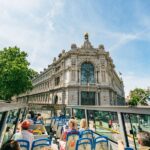
Mercado San Miguel is a quick stop with a big effect. It’s highlighted as the last example of iron architecture still standing in Madrid, with similar iron-built structures from the late 1800s already demolished.
This matters because it shows you how Madrid changed materials and industrial design, not just styles of buildings. Even if you don’t eat much there, you’ll likely enjoy the sensory shift: market noise, food smells, and a more lived-in feel than grand monuments.
If food is part of your plan, this is a good place to take a short break. If you’re on a tight schedule, treat it like a photo-and-sample stop, then get back to the ride so you don’t lose momentum.
La Latina, San Isidro, and Las Letras: neighborhoods where you actually feel Madrid
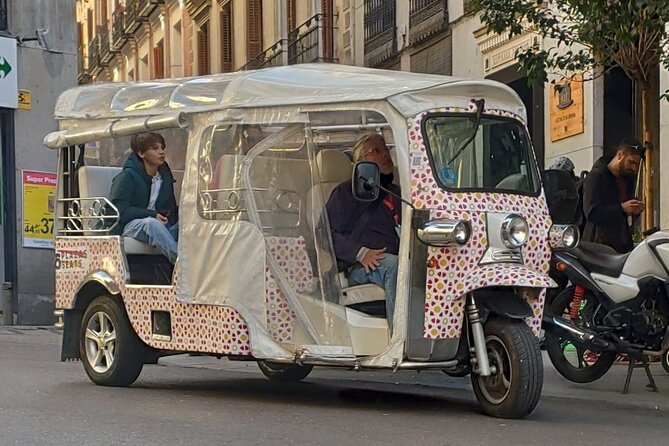
Madrid isn’t just monuments. The tour leans into that by cutting through neighborhoods with medieval street layouts and long cultural memory.
La Latina is presented as one of the city’s most traditional central areas, arranged around squares like La Cebada and La Paja. This is where your guide’s commentary helps you see the grid of streets as a historical leftover, not random lanes.
Then you move to the Church of San Isidro, a 17th-century baroque church with a Latin cross plan. It connects to the Society of Jesus through the Imperial College monastery, and it carries a dramatic chapter: a fire in 1936 destroyed much of it. Stops like this are why a guided route helps—baroque facades are pretty, but the fire history adds weight to what you see.
Barrio de Las Letras is another highlight, because it brings together writers, literature, and today’s mix of bohemian fun, shopping, and food. This is the kind of area where you’ll likely want to slow down after the tuk tuk ride, because it’s easy to keep exploring on foot once you’ve gotten your bearings.
Paseo-style highlights: UNESCO trees, Prado area, and the “Madrid axis”
One portion of the route is built around a famous tree-lined avenue stretching between Glorieta de Carlos V and Plaza de Cibeles. It’s described as the first example of an urban avenue since the 16th century, and it’s been recognized as a UNESCO World Heritage Site since 2021.
This section is ideal for getting those classic, wide Madrid views while still staying warm and dry if the weather turns. Your guide helps you read the space—how parks, museums, fountains, and monumental façades all reinforce the same city story.
From there, you hit the Prado area. The Museo Nacional del Prado is one of Madrid’s most visited attractions and houses about 8,600 paintings and more than 700 sculptures. The bicentennial was celebrated in 2019, and it has a scale that can feel intimidating if you’re going in cold. On a short tour, you’ll mainly get the exterior and the strategic “where to go next” context—Prado admission isn’t included—so you’ll need to decide if you want to turn your guided stop into an actual museum visit.
Retiro Park, Cibeles, and Neptuno: where photos turn into a break

Retiro Park is a center-of-the-city reset. It’s described as 125 hectares with more than 15,000 trees, including a reference to the Cipreste, an oldest-tree claim of around 400 years. Even if you only see a small slice, this is a relief valve compared to streets packed with traffic and people.
Then comes Plaza de Cibeles, centered on the Cibeles Fountain, designed in 1782 and tied to the goddess of nature and protector of the people. It’s one of those Madrid landmarks that feels instantly iconic once you’re standing near it—even if the details take a minute to absorb.
Fuente de Neptuno adds a different kind of drama. Neptune, trident in hand and a coiled serpent nearby, stands on a carriage pulled by seahorses, surrounded by dolphins. It’s the kind of visual story you can’t fully understand from a distance, so the guide’s framing helps you look with intention.
Los Jerónimos and the “walkable grandeur” feeling
The route includes Los Jerónimos, referring to the church of San Jeronimo el Real. It’s described as one of the two most important convents in Madrid and is classified as a National Monument in 1925.
This is a good stop for people who want architecture that feels ceremonial but not like a theme park. Again, it’s not just about stopping—it’s about understanding why this type of church/convent space mattered historically in Madrid.
From a practical angle, if you’re choosing between indoor tickets and outdoor sights on your trip, prioritizing the big-ticket museum time (like the Prado) might be the best fit. Los Jerónimos is still valuable even as a viewpoint stop, especially on a shorter tour length.
Puerta de Alcalá, Toledo, and classic gates you can’t miss
You’ll also see Puerta de Alcalá, inaugurated in 1778. It was one of five royal gates built to access the town, and your guide can point out how gates worked as city boundary markers—half architecture, half strategy.
Later the route mentions Puerta de Toledo. It’s 19 meters tall, inaugurated in 1827, and described as the last monumental gateway erected in Madrid. Construction began in 1812, and it’s noted as a reception venue for King Ferdinand VII.
Gates can feel like leftovers until you realize they’re how cities controlled movement and announced power. On this tour format, you’re close enough to feel those meanings without needing extra travel time.
Bernabéu, the Picasso Tower, and modern Madrid contrasts
Not all the route is classical. You’ll pass major modern landmarks too, which is part of the appeal for first-timers who think Madrid is only old stone and grand plazas.
Torre Picasso is included as a 157-meter-tall building that was the tallest in Madrid until the Four Towers. The Santiago Bernabéu Stadium is also part of the ride: opened in 1947 as Nuevo Estadio Chamartín, later renovated, and noted for having the highest UEFA score. It’s described as the second largest football stadium in Spain, accommodating more than 80,000 fans. Admission isn’t included, so this is more about seeing and spotting rather than entering during the tuk tuk stop.
You’ll also pass the Salamanca neighborhood and the Paseo de la Castellana corridor, including references to older palatial architecture remains near Plaza de Colón.
These stops help you understand Madrid as a city that grew outward and upward, not stuck in one era.
Choosing your guide: what makes the ride better than a drive
The biggest repeated theme in the experience feedback is the guide impact—people didn’t just like the route, they liked the way the guide explained it.
Offito is mentioned with a tour pace that worked well for adding short walks, going inside the cathedral, and spotlighting small details of history around the city. Alexander is called out for keeping small kids engaged, which is a serious selling point if you’re traveling with children who don’t love long museum lines. David is praised for personable delivery, punctuality, and city storytelling, with one note describing food recommendations too. Gerardo is singled out for excellent English and strong local connection. Cesar shows up in the feedback as a guide who worked well even in cold weather, with the enclosed cover helping keep people warm.
If you book, pay attention to your comfort needs. If you’re traveling with kids, tell the guide at the start. If it’s cold or rainy, plan layers. If you’re photo-focused, ask where to sit for the best sightlines.
Who this tour is best for
This is a great fit if you:
- Want a first-day overview that covers lots of Madrid without map stress
- Prefer guided context so monuments feel like stories, not just photos
- Want short walking breaks, especially at places like Almudena Cathedral and Mercado San Miguel
- Are traveling with kids who need active pacing (the Alexander-style approach gets mentioned)
- Would like a plan that still works when weather turns (blankets were reported)
You might not love it if you:
- Want to spend hours inside major attractions during this same window
- Get frustrated when viewpoints are affected by an enclosed cover
- Need flexible stop times for long museum browsing (because many stops are quick by design)
Should you book this Madrid tuk tuk sightseeing tour?
If you want an efficient, guide-led way to understand Madrid in a short window, I think this is a smart buy—especially at $108.02 per person when you consider you’re getting private transportation, an English-speaking guide, and a route that hits big names plus local-feeling neighborhoods.
Book it if your priority is seeing a lot and learning why it matters. Pass if your priority is long indoor time at the Royal Palace, the Prado, or stadium-level stops. My best advice: treat the tuk tuk as the day’s backbone, then build your “must-enter” tickets around the parts of Madrid that your guide turns from background scenery into something you actually want to explore.
FAQ
How long is the Madrid Sightseeing Tuk Tuk Tour?
The duration is listed as 1 to 3 hours (approximately).
What does the tour cost per person?
The price is $108.02 per person.
Is the tour offered in English?
Yes. The tour is offered in English.
Are admission tickets included for the Royal Palace or the Prado?
No. Admission fees are not included for the Royal Palace of Madrid, Museo Nacional del Prado, Santiago Bernabéu Stadium, Real Jardín Botánico, and Real Basilica de San Francisco el Grande.
Where does the tour meet?
The meeting point is C. de Vergara, 1, Centro, 28013 Madrid, Spain.
Is this a private tour?
Yes. It is a private tour/activity, and only your group will participate.
Are service animals allowed?
Yes. Service animals are allowed.
Can children under 6 years old join?
No. Children under 6 years old are not allowed.
What is the cancellation policy?
You get free cancellation. You can cancel up to 24 hours in advance for a full refund.
More Tours in Madrid
- Madrid: Tour Bernabéu Entry Ticket
★ 4.5 · 21,573 reviews - Madrid: Panoramic Route City Tour
★ 4.1 · 12,259 reviews - Avila & Segovia Tour with Tickets to Monuments from Madrid
★ 5.0 · 9,762 reviews - Madrid: Royal Palace Expert Guided Tour with Skip-the-Line
★ 4.7 · 8,407 reviews - Madrid: Segovia and Toledo Tour, Alcazar, and Cathedral
★ 4.7 · 7,797 reviews - Toledo Tour from Madrid: Cathedral, Synagogue & St. Tome’s Church
★ 5.0 · 6,784 reviews
More Tour Reviews in Madrid
- Madrid: Tour Bernabéu Entry Ticket
★ 4.5 · 21,573 reviews - Madrid: Prado Museum Entry Ticket
★ 4.6 · 20,699 reviews - Madrid: “Emociones” Live Flamenco Performance
★ 4.8 · 12,866 reviews - Madrid: Panoramic Route City Tour
★ 4.1 · 12,259 reviews - Madrid: Live Flamenco Show with Food and Drinks Options
★ 4.5 · 9,901 reviews - Avila & Segovia Tour with Tickets to Monuments from Madrid
★ 5.0 · 9,762 reviews
Tuk Tuk Around the Middle
- Madrid: Private City Tour by Eco Tuk Tuk
★ 4.9 · 3,465 reviews - Madrid Welcome Tour with Local Guide in Eco Tuk Tuk Private
★ 5.0 · 2,936 reviews - Madrid Historical Tour with Local Guide in Eco Tuk Tuk Private
★ 5.0 · 876 reviews - Madrid Express Tour with Local Guide in Eco Tuk Tuk Private
★ 5.0 · 413 reviews - Madrid: Highlights City Tour by Electric Tuk Tuk
★ 4.7 · 346 reviews - Madrid: City Highlights Tuk Tuk Tour
★ 4.4 · 334 reviews
Just Added: New Madrid Tour Reviews




Madrid Tuk Tuk Tours, compared.
 ★ 4.9Private City Tour by Eco Tuk TukFrom $283,465 reviews
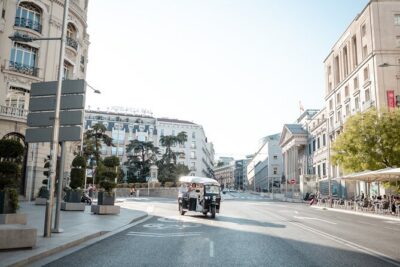 ★ 5.0Madrid Welcome Tour with Local Guide in Eco Tuk Tuk PrivateFrom $282,936 reviews
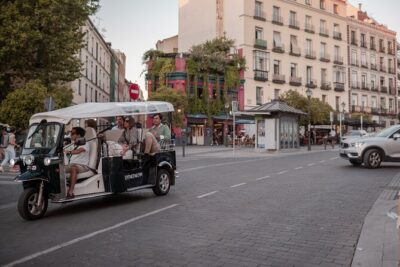 ★ 5.0Madrid Historical Tour with Local Guide in Eco Tuk Tuk PrivateFrom $28876 reviews
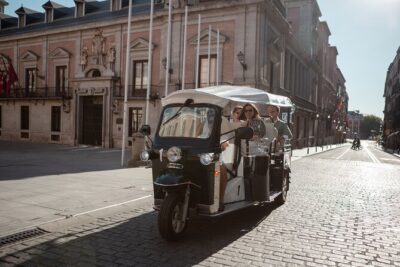 ★ 5.0Madrid Express Tour with Local Guide in Eco Tuk Tuk PrivateFrom $28413 reviews
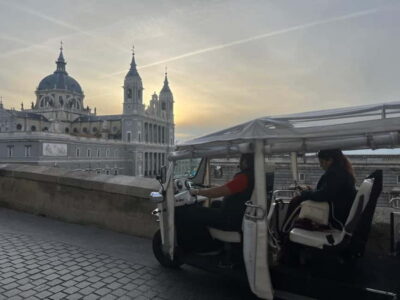 ★ 4.7Highlights City Tour by Electric Tuk TukFrom $28346 reviews
 ★ 4.4City Highlights Tuk Tuk TourFrom $94334 reviews
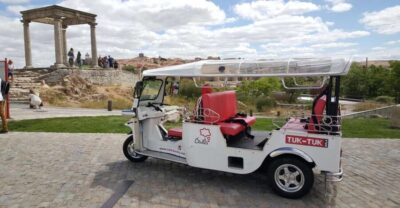 ★ 4.4Tour Guiado En Tuk Tuk Recorre Avila De La Forma Mas ComodaFrom $10235 reviews
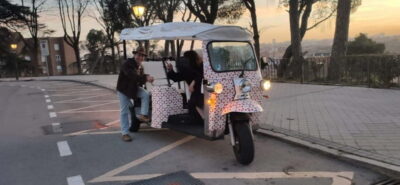 ★ 4.6City Tours – 6 seats private ecological tuk tukFrom $53230 reviews
Browse the lists this tour appears in