
Ávila and Segovia in one shot? This private 11-hour route strings together UNESCO highlights with a guided walk in El Escorial. I like that you get real context, not just photos: your guide connects Roman engineering, medieval fortification, and royal Spanish architecture in the same day.
What I like most: the guided inside visit of El Escorial Monastery (with the royal palace complex, basilica, pantheon, library, school, and monastery all explained), and the way Segovia’s sights come alive through the story of the Roman aqueduct and the jump from cathedral streets to the Alcázar.
One possible drawback: the schedule is tight and the day can feel a bit rushed, especially if you want long, unhurried hangs in Avila or Segovia.
In This Review
- Key Points That Matter Before You Go
- Why This Trip Works for a One-Day Spain Fix
- Morning Departure: Starting Early from Madrid
- Ávila’s Viewpoint Stop and the Walls-First Mood
- Ávila Cathedral and the Reality of Limited Free Roaming
- Segovia: From Roman Aqueduct Explanations to Old Town Streets
- Segovia Free Time: Eat Well, Shop Light, Stay On Schedule
- The Alcázar of Segovia: Why This Castle Feels Like a National Symbol
- El Escorial: Inside the Monastery Complex (Not Just the Facade)
- Transportation, Timing, and the “Follow the Guide” Factor
- Price and Value: What $2,038 Per Person Buys You
- Who This Tour Suits Best (and Who Should Skip It)
- Should You Book This Ávila–Segovia–El Escorial Private Tour?
- FAQ
- FAQ
- What locations does this private tour cover?
- How long is the tour?
- Is the tour guided?
- What’s included in the price?
- What is not included?
- Do I get free time in Segovia?
- Where do I meet if my hotel pickup isn’t available?
- Is this tour suitable for people with mobility impairments?
- Are large bags or luggage allowed?
- Can I cancel and get a full refund?
Key Points That Matter Before You Go
- El Escorial inside access: You’re not just driving by. You get a guided look at the royal complex and major spaces.
- Roman aqueduct storytelling in Segovia: Expect clear explanations of how the aqueduct was created and why it still matters.
- City walls + cathedral in Avila: You’ll see the fortified mood that makes Avila feel like a living museum.
- Alcázar of Segovia as a cultural symbol: It’s more than a castle photo. Your guide frames it in Spanish art and history.
- Free time exists, but timing is strict: Plan to eat fast, shop lightly, and keep moving as instructed.
- No large luggage allowed: If you’re traveling with big bags, make alternative arrangements.
Private and unhurried, just your party
- Madrid: Private City Tour by Eco Tuk Tuk★ 4.9 · 3,465 reviews
- Madrid Welcome Tour with Local Guide in Eco Tuk Tuk Private★ 5.0 · 2,936 reviews
- Madrid Historical Tour with Local Guide in Eco Tuk Tuk Private★ 5.0 · 876 reviews
- Toledo Private Tour with Licensed Guide and Driver from Madrid★ 5.0 · 637 reviews
Why This Trip Works for a One-Day Spain Fix
This is a great choice if you want the “Castile greatest hits” without committing to a multi-day trip. In one day, you’ll hit three UNESCO-listed destinations—Ávila, Segovia, and El Escorial—while a private guide stitches the places into one coherent story.
I also like the format: you start early, do guided walks where they count, then get just enough free time to grab lunch and browse. It’s not about lingering. It’s about getting the big ideas and the key monuments in a single itinerary.
That tight pacing is also why it’s worth choosing with your expectations in check.
Morning Departure: Starting Early from Madrid
You’ll leave Madrid in the morning and ride in an air-conditioned vehicle with a private guide. The route is long enough that the early start is useful: you’re not wasting your sightseeing time sitting in traffic later.
One small practical tip: if your hotel pickup isn’t possible, the meeting point is on Julio Camba street, next to the exit of Metro Ventas. And since the day is time-critical, show up a bit ahead so you’re not scrambling.
Ávila’s Viewpoint Stop and the Walls-First Mood
Ávila is the first city on the program, and it hits fast—part scenery, part history. Before you even get into the streets, you’ll pause at the Cuatro Postes viewpoint, which sets the tone for what follows. It’s a quick chance to orient yourself and understand why Ávila is so photogenic from higher ground.
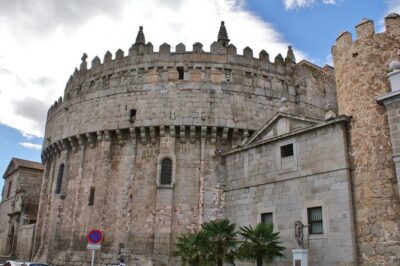
Once in town, you’ll do a walking tour that passes key landmarks: the Sanctuary of San Vicente, the cathedral, and of course the city walls. Ávila works so well on a day like this because the compact center lets you feel the medieval atmosphere without needing hours of wandering.
I especially like the fact that Avila’s walls and cathedral aren’t just checkboxes. Your guide’s job is to give you the “why,” so the stonework starts to mean something. People have praised guides like Miguel for being very informative, so if you get a similar energy, you’ll likely enjoy the walking portion even if it’s brief.
Ávila Cathedral and the Reality of Limited Free Roaming
Avila’s a walkable city center, but this tour keeps you fairly close to the planned route. If you’ve got mobility needs, there’s an important heads-up: the day includes numerous staircases and pavements, and it’s not fully accessible.
Even for able walkers, it’s not the kind of day where you can wander far from where the vehicle is parked. I’d treat Avila like a guided “greatest hits” stop, not a slow, deep exploration.
What to do: wear comfortable walking shoes and keep layers handy. Reviews mention chilly weather, so you’ll be happier if you’re prepared to adjust to morning-to-midday temperature swings.
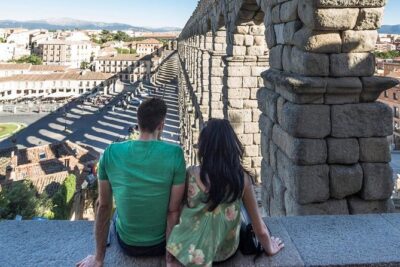
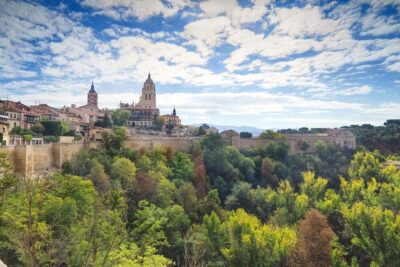
The aqueduct and the Alcazar, other Segovia days



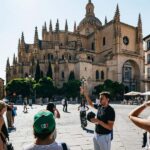
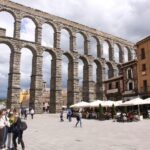
Segovia: From Roman Aqueduct Explanations to Old Town Streets
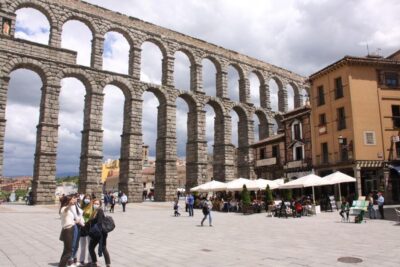
Segovia is where the day turns dramatic. You’ll arrive and get a guided look around the historic core, starting with the big theme: the Roman aqueduct and how it was created.
This is one of those monuments that people think they understand until someone explains the engineering choices behind it. In a short guided window, your guide can help you “read” the aqueduct instead of just admiring it.
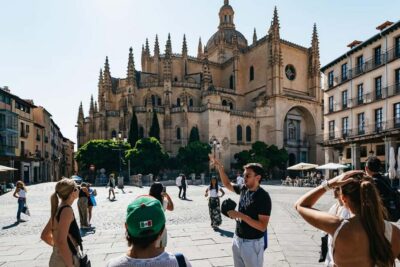
From there, you’ll keep walking through the center: you’ll pass the cathedral and move through the district of the Canonries before reaching the Alcázar. It’s a compact route, but it covers major eras, which is exactly what you want when you’re doing three cities in one day.
Segovia Free Time: Eat Well, Shop Light, Stay On Schedule
After the guided portion, you’ll have free time to handle lunch, shopping, or independent monument stops. The catch is time management. This tour is designed to move, and the schedule is described as tight.
I’d treat that free time as a sprint with a lunch reward. Reviews include very specific lunch ideas—like Candido for suckling pig and Restaurant Pasapan for a fusion lunch—so if you’re looking for a practical place to eat, those names are at least worth keeping in your mental shortlist.
Shopping can be fun in Segovia’s old streets, but don’t plan to roam without a clock. Get your bearings early, eat, then head back when the guide’s instructions say to.
The Alcázar of Segovia: Why This Castle Feels Like a National Symbol
The Alcázar is the next big payoff. It’s described as a symbol of the art and history of Spain, and that framing matters. In other words, it’s not just a castle you look at; it’s part of the story of how Spain visualizes itself—through architecture, power, and cultural memory.
You’ll reach it at the end of the guided circuit, which is smart. After you’ve walked from Roman through medieval landmarks, the Alcázar feels like the natural “royal” conclusion to the day’s historical climb.
If you want photos, this is the moment. It’s one of the places where you can easily spend an extra few minutes getting the right angles—just don’t let photo time steal from getting back to the vehicle when needed.
El Escorial: Inside the Monastery Complex (Not Just the Facade)
El Escorial is the architectural heavyweight of the day. You’ll arrive later in the afternoon and get a guided visit inside the Monastery, lasting about 105 minutes.
Here’s why this stop is so valuable: the complex isn’t a single building. It’s a whole royal-and-religious system, including a royal palace, basilica, pantheon, library, school, and monastery. A good guide makes the layout coherent, so you walk away understanding what each space was for, not just what it looks like.
Some guides have been singled out for a warm, thorough approach—like Paula—which is exactly what you want at El Escorial. It’s the kind of place where explanations help you notice details you’d miss if you were on your own.
Transportation, Timing, and the “Follow the Guide” Factor
This tour uses an air-conditioned vehicle and runs like a tight relay between cities. That’s part of its appeal (you see a lot), but it also means you need to follow instructions closely.
Two timing realities matter:
- The schedule is tight, and latecomers can’t be accommodated.
- You’ll spend enough time in transit between stops that you should treat the guided segments as the core experience.
Also note the luggage rule: no luggage or large bags. If you’re used to traveling with carry-on-sized bags, plan to travel light for this day.
For pickup, your hotel pick-up works only for central city-center locations. If you can’t do that, you’ll meet at Julio Camba street near Metro Ventas. And one practical note from the real world: the vehicle may not have a clear sign, so look for your guide holding a list and coordinating via phone rather than assuming there’s visible branding from far away.
Price and Value: What $2,038 Per Person Buys You
At $2,038 per person, this isn’t a budget day trip. So the smart question is: what are you really paying for?
You’re paying for private guiding across three stops, transportation in an air-conditioned vehicle, and entrance to the El Escorial Monastery. Those inclusions add up when you compare doing the day on your own and trying to stitch together timed entry for El Escorial plus guided context for every stop.
The trade-off is that Avila and Segovia are shorter visits than you might want if you plan to linger in cafés, museums, or viewpoints for long stretches. Reviews back up that feeling: this works best when you want a strong overview and are okay with moving briskly.
If your goal is maximum monument count with expert storytelling, the price can feel more reasonable. If your goal is slow travel, you might feel like you’re constantly checking the time.
Who This Tour Suits Best (and Who Should Skip It)
This is ideal for you if:
- You have limited time in Madrid and want major UNESCO highlights in one day.
- You like guided explanations more than independent wandering.
- You’re comfortable with brisk walking and changing locations frequently.
It’s a poor fit if:
- You have mobility concerns. The tour is not fully accessible due to staircases and pavements.
- You hate tight schedules. The day covers three cities, with strict timing and limited freedom to roam.
Also, if you’re someone who likes to sit down for a long lunch, Avila and Segovia may feel like they leave you with only a quick window. You can still eat well, but it’s not the day for a two-hour café hang.
Should You Book This Ávila–Segovia–El Escorial Private Tour?
I’d book it if you want a focused day that gives you a strong mental picture of Spain’s architectural timeline: fortified medieval Avila, Roman-to-medieval Segovia with the Alcázar payoff, then El Escorial’s royal-religious complex where a guide can really help you understand the rooms and purpose.
I wouldn’t book it if you need a relaxed pace or if you’re traveling with accessibility constraints, because the walking and surfaces are part of how you experience these cities.
If you do book, give yourself the best chance to enjoy it: wear walking shoes, travel light (no large bags), and commit to following the guide’s timing. This kind of day runs on rhythm—when you match it, the monuments land harder.
FAQ
FAQ
What locations does this private tour cover?
It covers Ávila, Segovia, and El Escorial, with a guided visit inside the El Escorial Monastery.
How long is the tour?
The total duration is 11 hours.
Is the tour guided?
Yes. You’ll have a private live tour guide with English and Spanish.
What’s included in the price?
Included items are transportation in an air-conditioned vehicle, a private guide, hotel pick-up inside the city center (when available), and entrance to the El Escorial Monastery.
What is not included?
Food and drinks are not included, and entrance fees for monuments other than El Escorial are not included.
Do I get free time in Segovia?
Yes. There is free time in Segovia for lunch, shopping, or visiting monuments on your own.
Where do I meet if my hotel pickup isn’t available?
If your hotel is not in the city center, the meeting point is Julio Camba street, next to the exit of Metro Ventas.
Is this tour suitable for people with mobility impairments?
No. It is not fully accessible due to stairs and pavements along the route.
Are large bags or luggage allowed?
No. The tour does not allow luggage or large bags.
Can I cancel and get a full refund?
Yes. Free cancellation is available up to 24 hours in advance for a full refund.
Behind the Walls of Avila
- Avila & Segovia Tour with Tickets to Monuments from Madrid
★ 5.0 · 9,762 reviews - Three Cities in One Day: Segovia, Avila and Toledo from Madrid
★ 5.0 · 8,402 reviews - Madrid: Avila and Segovia Day Trip with Tickets to Monuments
★ 4.6 · 4,568 reviews - Avila with Walls and Segovia with Alcazar from Madrid
★ 4.5 · 3,293 reviews - Full Day Tour to Avila & Segovia from Madrid
★ 5.0 · 1,133 reviews - From Madrid: Avila and Segovia Full-Day Tour
★ 4.6 · 1,052 reviews
A Day Up in Segovia
- Avila & Segovia Tour with Tickets to Monuments from Madrid
★ 5.0 · 9,762 reviews - Three Cities in One Day: Segovia, Avila and Toledo from Madrid
★ 5.0 · 8,402 reviews - Madrid: Segovia and Toledo Tour, Alcazar, and Cathedral
★ 4.7 · 7,797 reviews - Madrid: Toledo & Segovia Tour w/ Cathedral, Alcazar & Lunch
★ 4.6 · 5,846 reviews - Madrid: Avila and Segovia Day Trip with Tickets to Monuments
★ 4.6 · 4,568 reviews - Toledo & Segovia Tour with Cathedral and Alcazar Tickets & Lunch
★ 4.5 · 4,046 reviews
Private Days in the Capital
- Madrid: Private City Tour by Eco Tuk Tuk
★ 4.9 · 3,465 reviews - Madrid Welcome Tour with Local Guide in Eco Tuk Tuk Private
★ 5.0 · 2,936 reviews - Madrid Historical Tour with Local Guide in Eco Tuk Tuk Private
★ 5.0 · 876 reviews - Toledo Private Tour with Licensed Guide and Driver from Madrid
★ 5.0 · 637 reviews - Madrid Private Segway tour. Retiro Park – Centro Historico
★ 4.9 · 636 reviews - Madrid Express Tour with Local Guide in Eco Tuk Tuk Private
★ 5.0 · 413 reviews
Just Added: New Madrid Tour Reviews




Segovia Day Trips from Madrid, compared.
 ★ 5.0Avila & Segovia Tour with Tickets to Monuments from MadridFrom $819,762 reviews
 ★ 5.0Three Cities in One Day: Segovia, Avila and Toledo from MadridFrom $1268,402 reviews
 ★ 4.7Segovia and Toledo Tour, Alcazar, and CathedralFrom $487,797 reviews
 ★ 4.6Toledo & Segovia Tour w/ Cathedral, Alcazar & LunchFrom $465,846 reviews
 ★ 4.6Avila and Segovia Day Trip with Tickets to MonumentsFrom $744,568 reviews
 ★ 4.5Toledo & Segovia Tour with Cathedral and Alcazar Tickets & LunchFrom $454,046 reviews
 ★ 4.5Avila with Walls and Segovia with Alcazar from MadridFrom $603,293 reviews
 ★ 4.3From Madrid: Segovia & Avila Day Trip with Optional TicketsFrom $592,161 reviews
Browse the lists this tour appears in