

REVIEW · MADRID GHOST & LEGEND TOURS
Escape the Inquisition in Madrid Exploration Game
A city game that never herds you. This Escape the Inquisition exploration turns central Madrid into a choose-your-own adventure, with you solving clues at landmark stops and learning as you go. It’s offline-friendly, so you can keep moving even if your phone signal gets weird.
Two things I like a lot: you can start whenever you want during the day, and you can pause, take a break, then resume later. The other big win is the private, no-guide setup, meaning no waiting around for a person and no crowd herding.
One drawback to plan for: it’s truly self-guided. There’s no physical guide to meet you, so if you show up expecting a staff member at the entrance, you can end up standing around.
In This Review
- Key reasons this game is worth your time
- How Escape the Inquisition works (and what you’re actually doing)
- Price and value: $7.14 for 70 minutes of brain-and-street time
- Getting set up: start, end, and why the route matters
- The no-guide reality (the #1 thing to get right)
- Stop-by-stop: the Madrid route and what to expect at each place
- Stop 1: Calle de San Bernardo (first clue, quick start)
- Stop 2: Calle de Isabel la Católica (a second puzzle to lock in the rhythm)
- Stop 3: Tribunal del Santo Oficio de la Inquisición (the longer checkpoint)
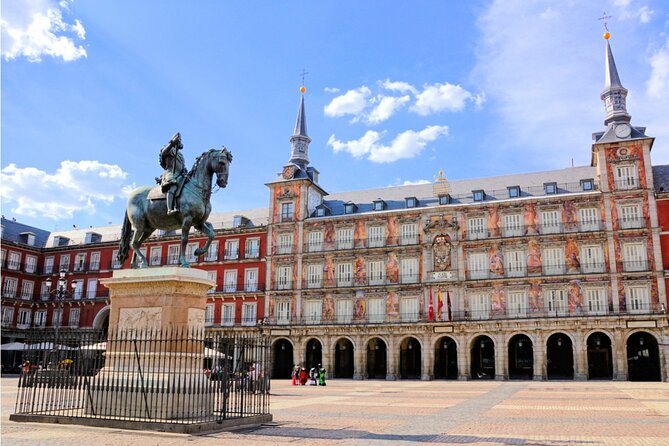
- Stop 4: Plaza Mayor (classic Madrid, game-moment lighting)
- Stop 5: Mercado San Miguel (food-market energy as a puzzle break)
- Stop 6: Plaza de la Cruz Verde (another clue in open air)
- Stop 7: Restaurante La Muralla (mid-route checkpoint with a name you’ll remember)
- Stop 8: Plaza de la Cebada (endless people-watching option)
- Stop 9: Real Basilica de San Francisco el Grande (the finish with a payoff feeling)
- Pacing and “brain fit”: why people’s experiences differ
- Who this is best for (and who should skip it)
- Common hiccups and how to avoid them
- Should you book Escape the Inquisition in Madrid?
- FAQ
- Is there a physical tour guide with Escape the Inquisition in Madrid
- Do I need an internet connection to play the game
- How long does the game take
- Can I start and pause whenever I want
- Where do I start and where does the experience end
- What language is the game offered in
- What is the cancellation policy
Key reasons this game is worth your time
- Plays offline on your phone: keep going without relying on mobile data.
- Private and no-human-contact: just your group, your pace, no crowd vibes.
- Landmark-to-landmark puzzle route: history-flavored stops across central Madrid.
- Flexible timing: you can start at your chosen hour and take breaks.
- Short checkpoints: most locations are about 5 minutes, with one longer stop.
- Puzzle difficulty varies: some players find it easy, others find it tough—bring patience.
The darker corners of old Madrid, retold
- Madrid: Spanish Inquisition and Legends Evening Walking Tour★ 4.7 · 1,396 reviews
- Madrid Oscuro: Torture, Ghosts, Crimes and Legends★ 5.0 · 1,363 reviews
- Madrid: Entry Ticket to Legends The Home of Football Museum★ 4.7 · 856 reviews
- Madrid: The Spanish Inquisition Walking Tour★ 5.0 · 399 reviews
How Escape the Inquisition works (and what you’re actually doing)

This isn’t a classic “follow a guide and listen” tour. Instead, you’re given a mobile game that guides you from one clue to the next. At each stop, you’ll solve a puzzle and then get instructions on where to go next, along with some place-specific learning.
The big practical advantage is control. You’re not stuck behind the slowest person, and you’re not pushed along by the schedule. Want to linger near a plaza view? Do it. Need a quick coffee break? Pause and come back. The game is designed so you can handle your own pace without asking anyone for directions.
You’ll also appreciate that it’s meant to work offline. That matters in Madrid because you might hop through areas where data is slower or your phone battery is already taking a hit from navigation. Offline play means fewer “loading…” moments.
It’s offered in English, and the ticket is a mobile ticket, so plan to have your phone ready the whole time. You’ll also want to keep an eye on the instruction message you receive after booking, since the entire experience runs from your device rather than a person at the meeting point.
Price and value: $7.14 for 70 minutes of brain-and-street time
At $7.14 per person, this sits in a rare category: low-cost enough that it won’t feel like a big gamble, but structured enough that it’s not just wandering around with a vague theme.
Here’s what you’re really paying for:
- Organization: the game tells you where to go next.
- Time efficiency: you’re walking a route designed for about 1 hour 10 minutes (approx.).
- A different kind of sightseeing: puzzles force you to look at places more closely than a typical photo stop.
The value gets even better if you travel with a group and you can use group discounts. Since it’s private for your group, you’re not sharing the experience with strangers. That usually keeps the whole thing calmer and easier to manage.
The one “cost” that isn’t on your receipt: you’re relying on your own problem-solving. If you hate puzzles, the experience can feel like homework instead of fun.
Getting set up: start, end, and why the route matters

The starting point is C. de San Bernardo, 1, Centro, 28013 Madrid. The game ends at Calle de la Ventosa, 21, Centro, 28005 Madrid.
That start-to-finish setup is useful because it nudges you into a loop through central Madrid. You’re not doing a “go here, return there” walk. You’re moving forward through neighborhoods and landmarks, and the end point lands you somewhere you can keep exploring on your own.
The experience is open Monday–Sunday from 5:00 AM to 9:30 PM, and you can start at any hour (within that operational window). That flexibility is great if you want to do it:
- early to beat the day’s crowds,
- midday when you need a break from sitting in cafés,
- or late afternoon when you’re in “let’s walk and see what happens” mode.
Also, because it’s near public transportation, you can fit it into a larger day without committing to a long taxi or a complicated transit plan.
The no-guide reality (the #1 thing to get right)
Here’s the part that can trip people up: there’s no physical pickup. If you arrive expecting someone with a sign or a lanyard, you might be disappointed.
The system provides guidance through your smartphone, and the instructions are sent to you via email at booking time. So do this before you go:
- Make sure you can access your email on the day of your game.
- Confirm you know what to open on your phone.
- Give your battery a fighting chance.
If you get set up before you start walking, the experience tends to run smoothly.
Set these beside it before you book anything in Madrid





Stop-by-stop: the Madrid route and what to expect at each place
The itinerary is built around quick checkpoints. Most stops are around 5 minutes, and one spot gives you about 10 minutes. At each location, you’ll get a clue, solve a puzzle, and receive guidance plus learning about the place you found.
Below is the route in order, plus my advice on how to get the most out of each stretch.
Stop 1: Calle de San Bernardo (first clue, quick start)
You begin at Calle de San Bernardo, 1. The game starts with you following a clue and then solving a puzzle to move on. This is a good “warm-up” stop.
What I like about starting here: it gets you engaged fast. You’re not walking for 20 minutes before the game asks you to do anything. Once you crack that first puzzle, the rest of the route tends to feel easier because you’ve learned how the game communicates.
If you’re traveling with kids, this first step is where you’ll learn whether they enjoy puzzle-solving or prefer to be spectators.
Stop 2: Calle de Isabel la Católica (a second puzzle to lock in the rhythm)
Next up is Calle de Isabel la Católica, again about 5 minutes. Expect another clue, another puzzle, and then instructions for where to go next.
This stop usually matters for one reason: it helps you settle into the game’s flow. If the puzzles feel too simple, it may help you decide whether you want to speed up or slow down. If they feel too hard, you’ve still got time to recover your momentum before the longer stop.
Stop 3: Tribunal del Santo Oficio de la Inquisición (the longer checkpoint)
The most time is spent at Tribunal del Santo Oficio de la Inquisición with about 10 minutes.
This is the emotional center of the theme. The game lingers here because you’re likely to spend more time reading, reasoning, and solving. It’s also where you’ll get more of the “what is this place and why does it matter” type of learning.
Practical advice: don’t rush this stop. If you blow through it, you’ll likely miss the explanation that helps the puzzle make sense. Also, if you prefer lighter puzzle pressure, this is the stop where you might want to take a breath and work as a team.
Stop 4: Plaza Mayor (classic Madrid, game-moment lighting)
You’ll move on to Plaza Mayor (about 5 minutes). This is a high-recognition location, which is great because you can anchor the game to something you can visually confirm.
Plaza Mayor is a strong “pause and look” spot. Even if you’re moving quickly, you’ll get a sense of how the game uses familiar landmarks to keep you oriented.
One consideration: plazas can be windy and crowded at popular hours. Since this is private and no-guide, your group can still control your pacing, but your comfort may depend on the time you choose.
Stop 5: Mercado San Miguel (food-market energy as a puzzle break)
Next comes Mercado San Miguel for about 5 minutes. The setting practically begs you to snack. Even if you don’t stop to eat, the place changes the mood from “walk and think” to “walk and smell something good.”
This stop can be a fun reset if your group’s brainpower is wearing out. Quick puzzles here tend to feel less like a grind and more like an in-and-out mission.
Stop 6: Plaza de la Cruz Verde (another clue in open air)
You’ll hit Plaza de la Cruz Verde for about 5 minutes. Plazas like this are often where clue instructions feel easiest to follow because you have fewer tight corners and fewer “which direction is the right one?” moments.
If you start to feel lost, this kind of open space can help you orient yourself visually while you solve.
Stop 7: Restaurante La Muralla (mid-route checkpoint with a name you’ll remember)
Then you reach Restaurante La Muralla (about 5 minutes). This stop is interesting because it’s tied to a business address rather than a grand monument. That can make the puzzle feel more “real-world” and less like you’re chasing a postcard.
It’s also a reminder of how the game works: clues can land you at any kind of place that players can find. That’s why it’s smart to keep your phone with you and avoid breaking away from the route for too long.
Stop 8: Plaza de la Cebada (endless people-watching option)
After that, it’s Plaza de la Cebada (about 5 minutes). This is a great spot for atmosphere. Even if you’re focused on the puzzle, you’ll get some of Madrid’s street-life energy.
If your group has mixed ages, this can be the stop where the adults solve while kids watch people, point out details, and keep the mood light.
Stop 9: Real Basilica de San Francisco el Grande (the finish with a payoff feeling)
Your last stop is Real Basilica de San Francisco el Grande for about 5 minutes. This ending location gives you a strong “we finished the mission” feeling because it’s a big enough landmark to feel like an actual destination, not just another random corner.
When you finish, you’ll end near Calle de la Ventosa, 21. That’s a convenient setup to continue exploring without needing to retrace your entire walk back to the start.
Pacing and “brain fit”: why people’s experiences differ

This game can feel perfect or frustrating depending on your group’s puzzle tolerance.
Here’s what to expect based on the type of feedback the experience has received:
- Some people felt the puzzles were very easy and obvious, which can make it less exciting for kids who want more of a challenge.
- Other people found parts of the game very difficult, to the point where they couldn’t finish.
- Some groups reported that the historical information included between puzzles can feel long and may interrupt the momentum, especially for kids.
- Some people felt they couldn’t complete the full route, even though the game is structured to guide you stop-to-stop.
So what should you do with that uncertainty? I’d plan your mindset like this:
- If you like solving clues, you’ll probably have fun because the route gives you constant feedback and direction.
- If your group hates puzzles, treat it as a light scavenger mission rather than a strict test.
- If you’re traveling with kids, pick a time when everyone has energy. If you start tired, any confusing puzzle can feel like a wall.
Also, because the experience is offline, your smartphone is your compass. If your device struggles, your “game skill” matters less. Keep it functional.
Who this is best for (and who should skip it)
This experience shines if you want a different sightseeing style without the logistics of a traditional tour.
It’s a great fit for:
- Adventurous travelers who like walking and solving.
- Families who enjoy games and can work as a team.
- Groups that want private time without meeting strangers.
- People who prefer self-guided flexibility, including the ability to pause.
It might be a weaker fit if:
- You need a person to explain things and keep you moving.
- Your group gets stressed by puzzles under time pressure.
- You’re expecting a classic guided “here’s what you’re seeing” format, because there’s no physical guide.
On accessibility, the data says most travelers can participate, and service animals are allowed. If you have specific mobility needs, you’ll want to choose your route time carefully and be prepared for walking between central locations.
Common hiccups and how to avoid them
Based on the most repeated failure points, there are two things you can do to protect your trip:
1) Don’t assume anyone will meet you.
Because it’s a self-guided activity with no physical pickup, your success depends on getting the phone instructions and being ready to start where the game tells you.
If you arrive at the start point and nothing happens, it doesn’t mean the tour is broken. It often means the game needs to be launched on your device, or you’re missing the email guidance.
2) Expect puzzle difficulty to be a mixed bag.
With a 3.9/5 average rating, it’s not a universal “everyone loves it” kind of experience. Some people find it too easy; others find it hard. Go in with a team attitude and plan to ask yourselves less “is this fair?” and more “how can we try another approach?”
Should you book Escape the Inquisition in Madrid?
I’d book it if you want a low-cost, offline, private way to see central Madrid while keeping your schedule flexible. The route hits major spots like Plaza Mayor, Mercado San Miguel, and ends at San Francisco el Grande, and the puzzle structure gives you a reason to actually look rather than just pass by.
Skip it if you want a guided experience with a person explaining history in real time, or if your group hates puzzles and gets upset when they don’t immediately click. In that case, you’ll likely feel like you’re paying for confusion instead of discovery.
If you do book, take the self-guided part seriously: set up your phone instructions before you start, stay patient at the harder clue moments, and treat the game as a walking mission through Madrid’s well-known corners.
FAQ
Is there a physical tour guide with Escape the Inquisition in Madrid
No. This is a private, self-guided activity with no human contact. Guidance is provided through your smartphone, using instructions sent via email.
Do I need an internet connection to play the game
No. The game is designed to work offline, so you don’t need an internet connection to play.
How long does the game take
The duration is approximately 1 hour 10 minutes.
Can I start and pause whenever I want
Yes. You have full flexibility to start at any hour, take a break at any time, and resume later.
Where do I start and where does the experience end
Start: C. de San Bernardo, 1, Centro, 28013 Madrid.
End: Calle de la Ventosa, 21, Centro, 28005 Madrid.
What language is the game offered in
The experience is offered in English.
What is the cancellation policy
Free cancellation is available. You can cancel up to 24 hours in advance for a full refund. If you cancel less than 24 hours before the start time, the amount paid is not refunded.
More Self-Guided Tours in Madrid
- Madrid: Las Ventas Bullring Tour with Audio Guide
★ 4.6 · 3,154 reviews - Madrid: Prado Museum Ticket with In-App Audio Guide
★ 3.6 · 1,154 reviews - Madrid: Royal Palace Entry with Audio Guide
★ 3.5 · 806 reviews - Audio Guided Tour of the Bullring of Las Ventas in Madrid
★ 4.5 · 290 reviews - Madrid: Reina Sofía Museum Ticket with In-App Audio Guide
★ 3.1 · 231 reviews - Madrid: El Retiro Park Self-Guided Audio Tour
★ 3.8 · 134 reviews
More Tour Reviews in Madrid
- Madrid: Tour Bernabéu Entry Ticket
★ 4.5 · 21,573 reviews - Madrid: Prado Museum Entry Ticket
★ 4.6 · 20,699 reviews - Madrid: “Emociones” Live Flamenco Performance
★ 4.8 · 12,866 reviews - Madrid: Panoramic Route City Tour
★ 4.1 · 12,259 reviews - Madrid: Live Flamenco Show with Food and Drinks Options
★ 4.5 · 9,901 reviews - Avila & Segovia Tour with Tickets to Monuments from Madrid
★ 5.0 · 9,762 reviews
The Legends and Ghosts of Madrid
- Madrid: Spanish Inquisition and Legends Evening Walking Tour
★ 4.7 · 1,396 reviews - Madrid Oscuro: Torture, Ghosts, Crimes and Legends
★ 5.0 · 1,363 reviews - Madrid: Entry Ticket to Legends The Home of Football Museum
★ 4.7 · 856 reviews - Madrid: The Spanish Inquisition Walking Tour
★ 5.0 · 399 reviews - Evening Walking Tour: Spanish Inquisition & Legends of Old Madrid
★ 4.5 · 311 reviews - Madrid: The Spanish Inquisition Walking Tour
★ 4.8 · 281 reviews
Just Added: New Madrid Tour Reviews






Madrid Ghost & Legend Tours, compared.
 ★ 4.7Spanish Inquisition and Legends Evening Walking TourFrom $231,396 reviews
 ★ 5.0Madrid Oscuro: Torture, Ghosts, Crimes and LegendsFrom $31,363 reviews
 ★ 4.7Entry Ticket to Legends The Home of Football Museum856 reviews
 ★ 5.0The Spanish Inquisition Walking TourFrom $31399 reviews
 ★ 4.5Evening Walking Tour: Spanish Inquisition & Legends of Old MadridFrom $24311 reviews
The Spanish Inquisition Walking TourFrom $31281 reviews
★ 4.5Evening Walking Tour: Spanish Inquisition & Legends of Old MadridFrom $24311 reviews
The Spanish Inquisition Walking TourFrom $31281 reviews
 ★ 4.7Toledo: Mysteries and Secrets Tour in SpanishFrom $14106 reviews
 ★ 5.0Inquisition, The Executioner, Witches, Expulsion Jews and MuslimsFrom $385 reviews
Browse the lists this tour appears in