
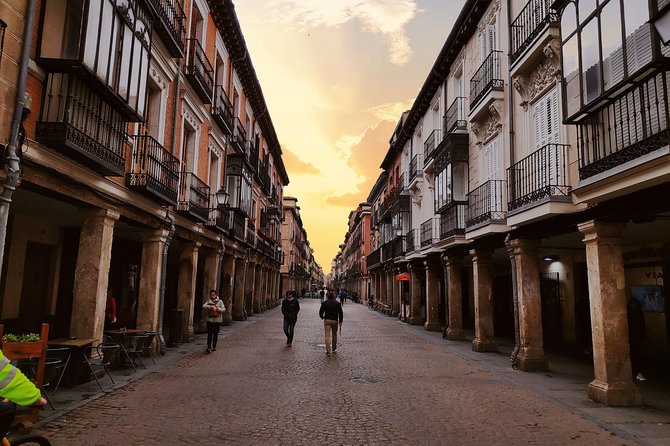
REVIEW · GUIDED
Alcala de Henares and Cervantes Guided Tour from Madrid
Cervantes starts with a short ride. This half-day tour takes you from Madrid into Alcala de Henares, where the city’s streets and university buildings help explain why Miguel de Cervantes became the kind of writer Europe couldn’t forget.
I especially like the mix of big-idea storytelling and specific stops: the University of Alcala campus and the places tied to Cervantes’s early life. A second highlight is the Museo Casa Natal de Cervantes experience, where the house and its objects do a lot more than name-drop.
One consideration: the schedule is tight and you should expect some walking and city-center movement. In other words, plan to be flexible about where you start and finish in Madrid, even if you’re booked on a smooth bus ride.
In This Review
- Key points to know before you go
- Alcala de Henares: the Cervantes detour that actually makes sense
- Timing and logistics on a 5-hour tour from Madrid
- Plaza de Cervantes: start in the square where the city names itself
- Colegio de San Ildefonso and the University of Alcala: where ideas get architecture
- Calle Mayor: medieval commerce on a street with deep layers
- Museo Casa Natal de Cervantes: the birthplace debate, now turned into a museum
- Cathedral de Alcala de Henares: a concentric-town center and early martyrs
- How the guides shape the day (and why it matters)
- Price and value: what $54.57 buys you in real terms
- Best fit: who this tour suits and who might want a different plan
- Should you book Alcala de Henares and the Cervantes tour from Madrid?
- FAQ
- How long is the Alcala de Henares and Cervantes tour?
- Is round-trip transportation from Madrid included?
- What entry tickets are included?
- Are food and drinks included?
- Do I need a face mask?
- How big is the group?
- What if I need to cancel?
Key points to know before you go
- Cervantes House Museum included so you skip the ticket hassle and get straight to the birthplace story
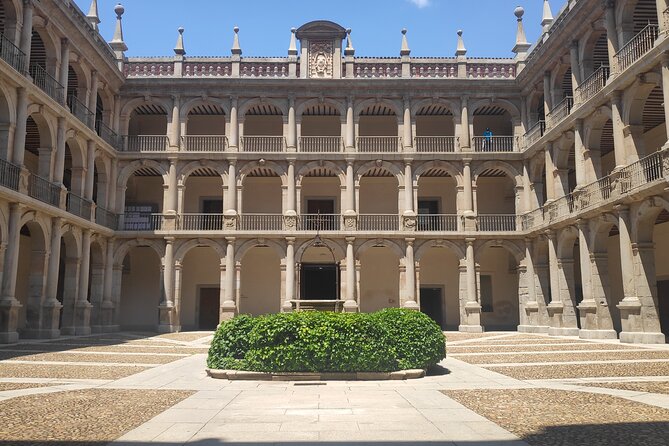
- University of Alcala stop with entry (Colegio de San Ildefonso) gives you context beyond monuments
- Guided walking through Alcala de Henares on a compact route, built for understanding fast
- Air-conditioned round-trip bus keeps the day comfortable, especially in warmer months
- Mandatory face masks, with a backup option to buy one for 1€ if you forget
- Small-group feel up to 50 people, usually easier for questions and pacing
A local guide takes the strain
- Madrid: Royal Palace Expert Guided Tour with Skip-the-Line★ 4.7 · 8,407 reviews
- From Madrid: Guided Day Trip to Toledo by Bus★ 4.1 · 5,280 reviews
- From Madrid: Toledo Guided Day Trip★ 4.3 · 3,501 reviews
- Madrid: Las Ventas Bullring Tour with Audio Guide★ 4.6 · 3,154 reviews
Alcala de Henares: the Cervantes detour that actually makes sense
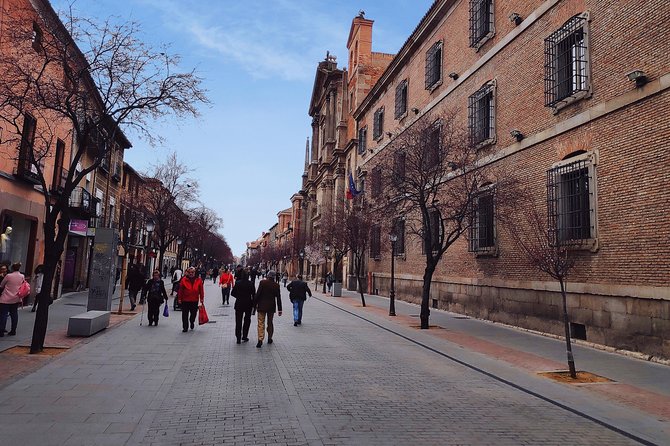
If you only know Cervantes from book spines or school syllabi, this is a great way to see how a place can shape a writer. Alcala de Henares isn’t just a name on a map. It’s a university town with old streets, big religious buildings, and a long habit of studying ideas—exactly the kind of environment that helped fuel literature.
What I like most is that the tour doesn’t treat Cervantes like a floating figure in time. It connects him to physical spots: the city square that carries his name, the house museum tied to his birth debate, and the broader setting of a university founded under Cardinal Cisneros. You end up with a clearer picture of what “Spanish Renaissance learning” looked like in real stone and street layout.
And the day has the right pacing for a half-day outing. You’re not stuck in a long museum chain. You ride, walk, and keep moving so the concepts stay connected.
Timing and logistics on a 5-hour tour from Madrid
This is about 5 hours total, with round-trip transport by air-conditioned bus and a guided walking portion in Alcala. That duration is ideal if you want Cervantes without sacrificing your entire day in Madrid.
You’ll also get a mobile ticket, which is convenient if your travel day is already packed. The tour notes that it’s near public transportation, so even if your hotel is not right next to the meeting point, you can usually find an easy way to get there.
A practical heads-up: face masks are mandatory during the tour. If you forget one, the tour offers the possibility of buying a mask for 1€. I’d still bring one in advance, just to keep things simple.
Finally, the group is capped at 50 travelers, and the guide may be multi-lingual. That usually helps with clarity, especially when you have questions about what you’re seeing.
Plaza de Cervantes: start in the square where the city names itself
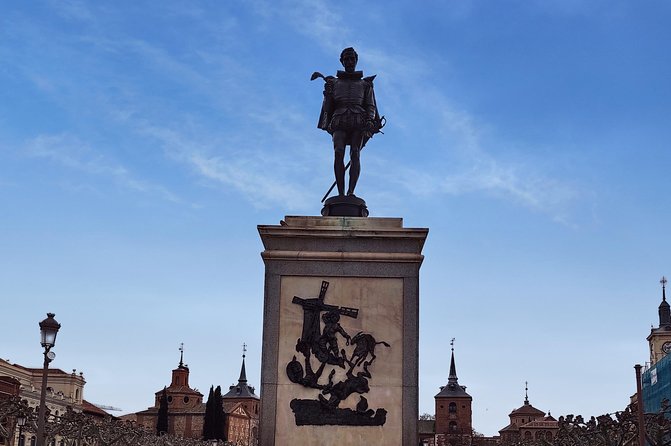
Most city squares are good for orientation. This one is more personal. Plaza de Cervantes has had several names over time, shifting from Market Square and later Constitution Square, before settling into the name it carries since 1879 in memory of Miguel de Cervantes.
It’s also the city’s main square—large, central, and easy to picture as the public “stage” where people lived their daily routines. That matters for a writer like Cervantes, who drew from the social world around him.
Plan to treat this stop as the quick mental reset before the deeper sites. You’ll get just enough context here to recognize what you’re seeing later.
Colegio de San Ildefonso and the University of Alcala: where ideas get architecture
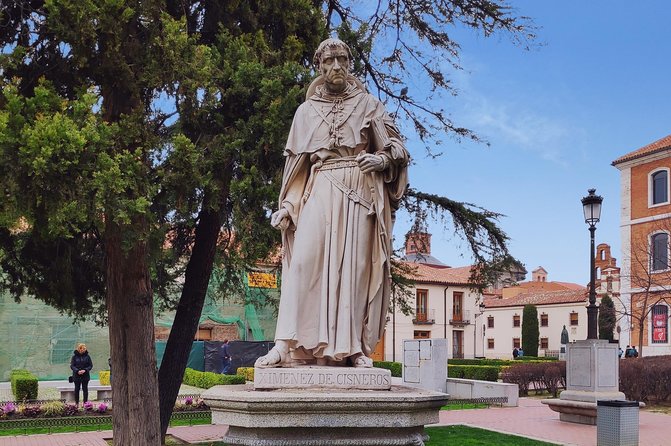
If you care about the intellectual background behind Spanish literature, this is the heart of the experience. The tour includes admission to the Colegio de San Ildefonso, part of the historic university complex—designed as a core piece of the University of Alcala under Cardinal Cisneros from 1499.
You’ll also hear about the building’s design and craftsmanship. The facade was built starting in 1537 by Rodrigo Gil de Hontañón, and the work finished in 1553 with contributions noted from Pedro de la Cotera. The description also points to major artists and carvers involved in the decorative program, including Francisco de Villalpando and Ruiz Diaz of the Corral.
One reason this stop hits so well is that it gives you more than dates. It shows you how education lived in physical spaces: courtyards, chapels, and rooms that were built for learning and for the authority of teaching.
Even if you’re not a serious architecture nerd, you’ll probably appreciate the way the guide connects the dots between the university setting and Cervantes’s world. In reviews tied to this tour, guides like Vicky and David were praised for turning the building into a clear story, not a pile of facts.



Calle Mayor: medieval commerce on a street with deep layers
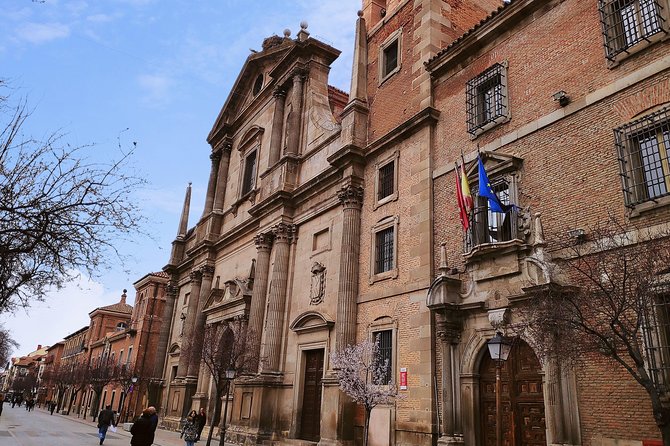
After the major institutional stop, the route takes you along Calle Mayor, a commercial street with older roots. The tour explains that its origin connects to the city’s old Jewish aljama area around the 12th century, built along a path that aligned with the Roman road through the region (the Caesar Augusta route passing through Complutum).
So yes, it’s a street you can walk. But it’s also a shortcut through time. You see how the city’s power and everyday life were organized around travel routes and trade movement.
The practical value here: it helps you stop thinking of Cervantes locations as separate postcards. You start to see how the urban map links them—where people walked, bought things, and moved through the city.
Museo Casa Natal de Cervantes: the birthplace debate, now turned into a museum
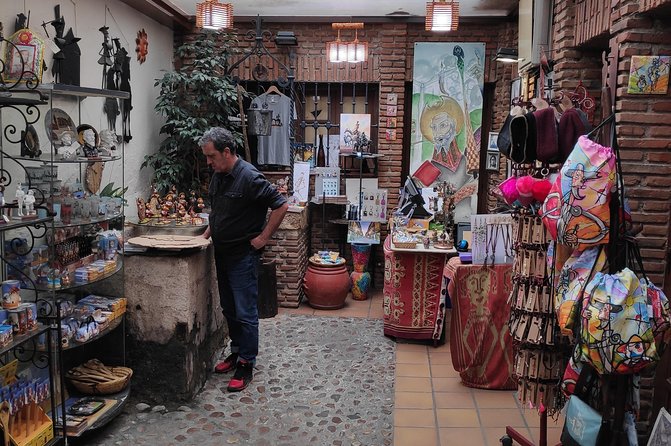
This is the stop with the biggest emotional punch for many people, and it’s included with admission. The Museo Casa Natal de Cervantes is tied to the idea that Cervantes’s birth house is known, even though the location was debated for a long time.
According to the tour information, the museum story turns on a key point: in 1948, historian Luis Astrana Marin proclaimed this particular building as Cervantes’s birthplace. The process behind that matters, because it’s not just a label slapped on a wall. It’s a reconstruction of evidence and local history, which the museum and guide help you understand.
The house sits in the old city near the Hospital de Antezana, where Cervantes’s father, Rodrigo de Cervantes, worked. That connection gives the museum a wider family context, so you’re not only picturing a single moment in 1547—you’re seeing how the family ties into the city’s social institutions.
In reviews connected to this tour, the house was repeatedly described as memorable, with people loving the atmosphere and the way objects and details bring the period forward. One guide named Maria Jesus also got specific praise for friendliness and strong explanations, which often makes a museum visit feel less like reading labels and more like getting oriented inside a real world.
Cathedral de Alcala de Henares: a concentric-town center and early martyrs
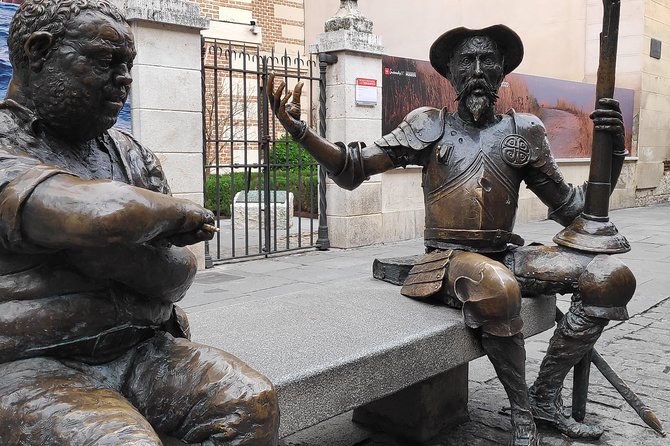
Next comes the Catedral de Alcala de Henares, dedicated to Saints Justo and Pastor. The tour frames it as the town’s center through the Middle Ages, placed where multiple streets meet within a concentric layout for the walled enclosure.
The cathedral’s origins are tied to the martyrdom story of Justo and Pastor, described as taking place in the early 4th century. The tour notes that the cathedral stands on the site where, according to tradition, the martyrs were beheaded and buried.
If you’re short on time, this stop still works because the guide links the building to how civic power functioned. It wasn’t just a religious setting. The tour explains that the cathedral area was also where political and social life concentrated, with council houses located in nearby plazas (the tour references Plaza de Abajo and Picota).
Practical note: cathedral entry is not included, so your time here may be more about seeing the setting and understanding the story than doing a long inside visit. If you’re especially eager to go inside, keep that in mind so you aren’t expecting ticketed access.
How the guides shape the day (and why it matters)
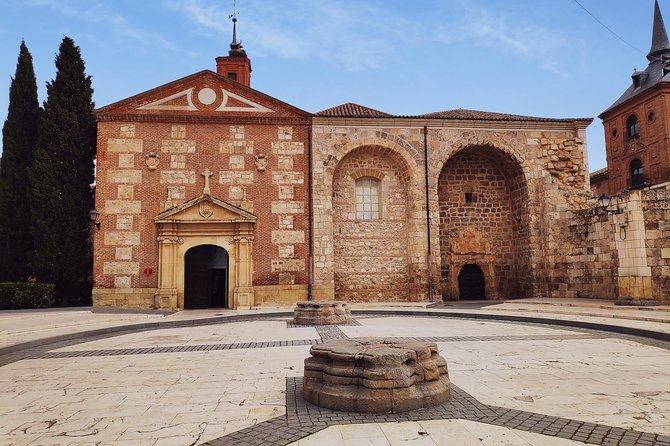
On a half-day trip, the guide isn’t just narration. The guide sets your level of understanding. When you’re moving from a university building to a birthplace house, you need someone who can keep the storyline coherent.
In reviews, guides were singled out by name. Vicky was praised for being interesting and for knowing the subject matter well, with people saying they learned facts they hadn’t picked up even after many trips to Spain. David also earned strong comments for being friendly and for having deep knowledge, and Maria Jesus was praised for a warm, clear approach.
So if you want a Cervantes day that feels like it’s about meaning—not just footsteps—this tour’s guide quality is one of its real advantages.
Price and value: what $54.57 buys you in real terms
At $54.57 per person, you’re paying for more than a bus ride. The value comes from the mix of included entry tickets and guided structure:
- Official guide plus a guided walking tour
- Admission to the College of San Ildefonso
- Admission to the Cervantes Museum and Library
- Air-conditioned round-trip transportation
Food and drinks are not included, which is normal for a half-day cultural tour, but it does mean you should budget for water and a snack. If you get hungry, there’s no meal stop included in the provided details, so having a plan keeps the day smooth.
Compared with doing this on your own, you’re also paying for time savings and interpretation. You don’t have to sort out where to go in what order, or how to connect the sites to the larger Cervantes and university themes. That can be a big deal on a day when you want fewer decisions and more understanding.
Best fit: who this tour suits and who might want a different plan
You’ll likely love this tour if:
- You want Cervantes in context, not just a single museum stop
- You enjoy guided walking through historic city areas
- You like university and learning themes (the Cisneros and University of Alcala thread is central)
It may be less ideal if:
- You hate walking or dislike timeboxed days
- You expect cathedral access to be included (it’s listed as not included)
- You need a fully flexible, choose-your-own-pace itinerary
Also, if your schedule includes another big day trip, this one is a nice mid-point: compact enough to keep energy, focused enough to leave you with a real take-away.
Should you book Alcala de Henares and the Cervantes tour from Madrid?
If you want a day that feels focused—Cervantes plus the university world that shaped learned culture—this is an easy yes. The big reasons are included museum and university entry, a structured route that explains what you’re looking at, and transport that prevents logistics from eating your time.
I’d book it if you care about understanding the connections: why a university town matters for Cervantes, how a city street connects to older communities and routes, and how a house museum helps turn a debated birthplace into something visitable.
I’d think twice if you’re hoping for long cathedral time indoors or a fully unstructured wandering day. For that, you’d probably want a more open plan.
Overall, for a half-day outing from Madrid, this is a solid use of time—equal parts city charm and literature context, with enough included access to make the price feel fair.
FAQ
How long is the Alcala de Henares and Cervantes tour?
The tour is listed at about 5 hours.
Is round-trip transportation from Madrid included?
Yes. You travel by air-conditioned bus with round-trip transportation included.
What entry tickets are included?
Admission is included for the College of San Ildefonso (University of Alcala de Henares) and for the Museo Casa Natal de Cervantes (Museum and Library).
Are food and drinks included?
No. Food and drinks are not included.
Do I need a face mask?
Yes. Face masks are mandatory during the tour. If you forget one, you can buy a mask for 1€.
How big is the group?
The tour has a maximum of 50 travelers.
What if I need to cancel?
You can cancel for a full refund up to 24 hours in advance of the experience start time. If you cancel less than 24 hours before, the amount paid is not refunded.
Easier With a Local Guide
- Madrid: Royal Palace Expert Guided Tour with Skip-the-Line
★ 4.7 · 8,407 reviews - From Madrid: Guided Day Trip to Toledo by Bus
★ 4.1 · 5,280 reviews - From Madrid: Toledo Guided Day Trip
★ 4.3 · 3,501 reviews - Madrid: Las Ventas Bullring Tour with Audio Guide
★ 4.6 · 3,154 reviews - Madrid: Royal Palace Skip-the-line Guided Tour
★ 4.9 · 3,146 reviews - Madrid Welcome Tour with Local Guide in Eco Tuk Tuk Private
★ 5.0 · 2,936 reviews
More Tours in Madrid
- Madrid: Tour Bernabéu Entry Ticket
★ 4.5 · 21,573 reviews - Madrid: Panoramic Route City Tour
★ 4.1 · 12,259 reviews - Avila & Segovia Tour with Tickets to Monuments from Madrid
★ 5.0 · 9,762 reviews - Madrid: Royal Palace Expert Guided Tour with Skip-the-Line
★ 4.7 · 8,407 reviews - Madrid: Segovia and Toledo Tour, Alcazar, and Cathedral
★ 4.7 · 7,797 reviews - Toledo Tour from Madrid: Cathedral, Synagogue & St. Tome’s Church
★ 5.0 · 6,784 reviews
More Tour Reviews in Madrid
- Madrid: Tour Bernabéu Entry Ticket
★ 4.5 · 21,573 reviews - Madrid: Prado Museum Entry Ticket
★ 4.6 · 20,699 reviews - Madrid: “Emociones” Live Flamenco Performance
★ 4.8 · 12,866 reviews - Madrid: Panoramic Route City Tour
★ 4.1 · 12,259 reviews - Madrid: Live Flamenco Show with Food and Drinks Options
★ 4.5 · 9,901 reviews - Avila & Segovia Tour with Tickets to Monuments from Madrid
★ 5.0 · 9,762 reviews
Just Added: New Madrid Tour Reviews


Guided, compared.
 ★ 4.1From Madrid: Guided Day Trip to Toledo by BusFrom $405,280 reviews
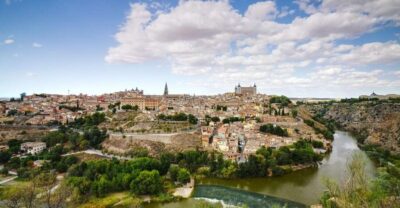 ★ 4.3From Madrid: Toledo Guided Day TripFrom $323,501 reviews
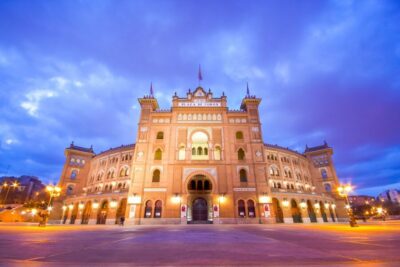 ★ 4.6Las Ventas Bullring Tour with Audio GuideFrom $183,154 reviews
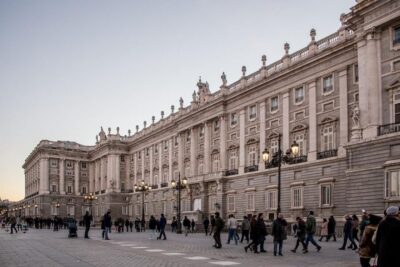 ★ 4.9Royal Palace Skip-the-line Guided TourFrom $423,146 reviews
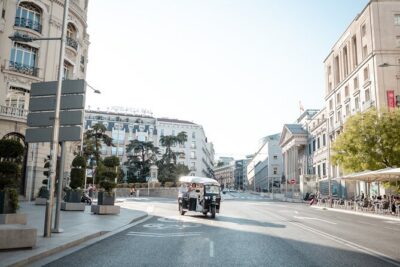 ★ 5.0Madrid Welcome Tour with Local Guide in Eco Tuk Tuk PrivateFrom $282,936 reviews
 ★ 4.8Tapas & Wine Tasting Tour with Local GuideFrom $912,171 reviews
★ 4.5Royal Palace Skip-the-Line Guided TourFrom $412,140 reviews
★ 4.8Tapas & Wine Tasting Tour with Local GuideFrom $912,171 reviews
★ 4.5Royal Palace Skip-the-Line Guided TourFrom $412,140 reviews
 ★ 5.0Madrid Tapas & Wine Tour with Rooftop Views and Local GuideFrom $1132,047 reviews