
REVIEW · 2-HOUR EXPERIENCES
Tour Madrid in 2 hours! Electric Tuk – Fast, Fun, and Exclusive
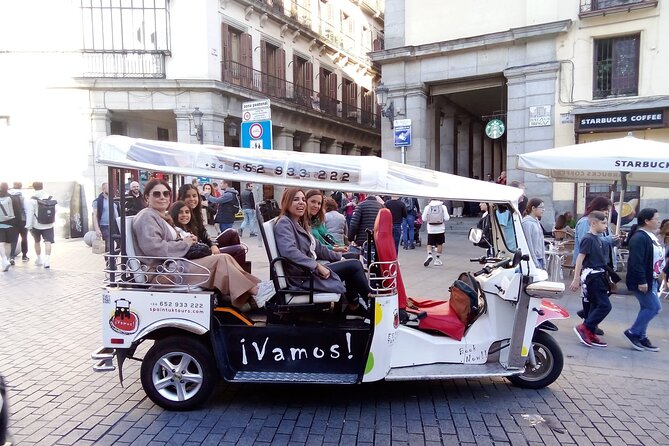
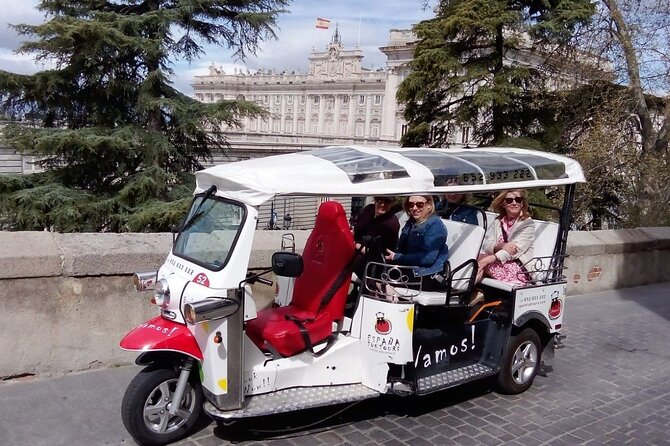
Madrid is big. This tour cuts it fast. You’ll get a private electric tuk-tuk ride that strings together major landmarks in about 2 hours, with a guide who helps you frame photos and point out the story behind what you’re seeing. I especially like how the route hits both grand royal Madrid and everyday city Madrid, and I also like that it’s set up for a small group of up to 4. One thing to watch: if you need a specific language, double-check at booking, since there have been cases where the spoken language didn’t match the request.
If you want a first-day Madrid win, this is it: you start near Retiro, then you move through central squares, church stops, classic fountains, and even the sports skyline. You’re not doing long museum marathons here. You’re getting your bearings fast, plus a bunch of iconic photo angles.
In This Review
- Key Highlights You’ll Feel in Real Life
- Electric Tuk-Tuk in Madrid: How You Actually Benefit From a 2-Hour Loop
- Starting at Plaza de la Lealtad: A Good Launch Point for Central Madrid
- Plaza de Santa Ana and the Royal Palace Area: Big Names, Short Stops, Smart Views
- Almudena Cathedral Museum and Sabatini Gardens: Religious Madrid Plus a Breath of Green
- Plaza Mayor and Mercado San Miguel: Where Old Madrid Still Shows Up
- Debod Temple and the Writers’ Madrid Stops: Different Side of the City
- Plaza de las Cortes, Neptune Fountain, and Cibeles: Architecture With Story, Not Just Photo Spots
- Puerta de Alcalá to Las Ventas: From Triumph Arch to Madrid’s Bullfighting Icon
- Barrio de Salamanca and Gran Vía: Where Madrid Turns Elegant
- Santiago Bernabéu and Paseo Castellana: Modern Madrid at Full Scale
- Plaza Colón, the National Library of Spain, and the Banco de España Exterior: Big Institutions, Quick Context
- Price and Value: Does $215.07 for Up to 4 Make Sense?
- Who Should Book This Electric Tuk-Tuk Tour, and Who Might Want Something Else?
- Should You Book It?
- FAQ
- How long is the Madrid electric tuk-tuk tour?
- What does it cost, and how many people are in a group?
- Is the Royal Palace admission included?
- What languages is the tour offered in?
- Where do we meet for the tour?
- What is the cancellation policy for a full refund?
Key Highlights You’ll Feel in Real Life
- Private electric tuk-tuk pace: quick hops that keep the whole circuit fun instead of exhausting
- Photo-friendly guide time: you’re given help with picture spots, not just a list of dates
- A mix of Madrid eras: royal power, Golden Age writers, and modern-city landmarks in one loop
- Many stops are free: Plaza Mayor, Almudena Cathedral Museum, gardens, fountains, and more
- Sports stops included: Las Ventas bullring and Santiago Bernabéu show Madrid’s other side
- Small-group value math: $215.07 per group (up to 4) can work out very reasonable per person
Set these beside it before you book anything in Madrid
- Madrid: 2-Hour Sightseeing Segway Tour★ 4.7 · 217 reviews
- 2-Hour Tour of the Madrid of Mysteries★ 4.5 · 75 reviews
- Majestic Madrid 2-hour Walking Tour★ 4.2 · 74 reviews
- Madrid Segway: 2h Casa Campo Off Road Tour★ 5.0 · 34 reviews
Electric Tuk-Tuk in Madrid: How You Actually Benefit From a 2-Hour Loop
This is the kind of tour that makes sense when your calendar is tight. A two-hour schedule means you won’t linger, but it also means you don’t waste the day either. The electric tuk-tuk keeps things light and quick, so you can cover a lot of ground without arriving at each stop already drained.
The experience is private for your group (up to 4), which is a big deal. In a small group, you’re more likely to get practical attention from your guide, including where to stand for photos and what to notice at street level. And yes, some guides go the extra mile on pictures, so if that matters to you, you’ll appreciate the setup.
The one real catch is that speed can’t magically replace time. This tour is built for snapshots and context, not for deep museum sessions or long lines. If your goal is sitting for hours, you’ll want a different plan alongside this.
Starting at Plaza de la Lealtad: A Good Launch Point for Central Madrid
The meet-up is at Pl. de la Lealtad, 1, in Retiro. From there, the route quickly feeds you into the Centro core, where Madrid’s major squares and showpiece buildings are packed close together.
Because you’re on a tuk-tuk, you’re not doing the typical walk-only “stair and pavement grind” that can turn sightseeing into a chore. You’re also near public transportation, which helps if your day changes and you need a quick reset.
You’ll also get a mobile ticket, which is handy when you’re hopping between neighborhoods and don’t want to fumble with paperwork.
Plaza de Santa Ana and the Royal Palace Area: Big Names, Short Stops, Smart Views
You kick off at Plaza de Santa Ana, a classic open square in the Cortes neighborhood. It’s one of those places that feels like a Madrid living room—easy to orient yourself, easy to snap a first photo, and good for getting the “this is where the action starts” feeling.
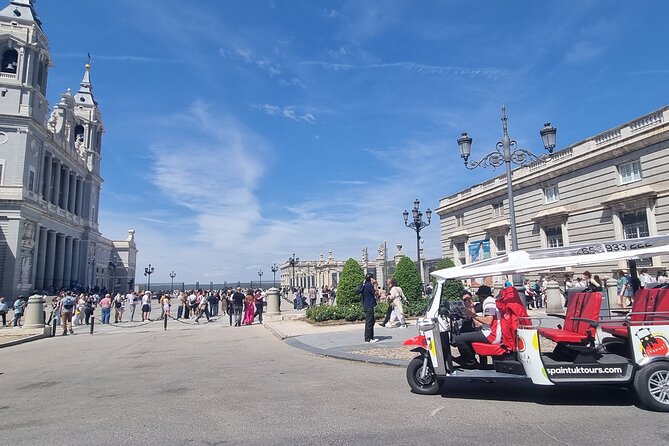
Next comes the Royal Palace area, known as the Palacio de Oriente. Construction began in 1738 and took 17 years, and Carlos III made it his habitual residence in 1764. Today, kings live at the Palacio de la Zarzuela, so the Royal Palace is used mainly for receptions, ceremonies, and official events.
Important practical note: the stop is short, and Palacio Real admission is not included. That’s actually a blessing if you’re on a tight timeline—you get the exterior impact and the historical context without losing half a day inside.
Almudena Cathedral Museum and Sabatini Gardens: Religious Madrid Plus a Breath of Green
Almudena Cathedral is Madrid’s main church, consecrated on June 15, 1993 by Pope John Paul II. The cathedral museum gathers objects that tell the story of the diocese of Madrid, and it’s divided into rooms that include mosaics, episcopal shields, and decorative pieces.
You also get a look at Jardines de Sabatini, right in front of the north facade of the Royal Palace. These gardens cover about 2.66 hectares, so even with a quick stop you get an actual palette change from stone and crowds.
This combo works well because it breaks the sightseeing rhythm. One moment you’re in monumental architecture; the next you’re in open garden space where your eyes can rest.




Plaza Mayor and Mercado San Miguel: Where Old Madrid Still Shows Up

From the Royal Palace zone, the tour flows into the heart of old Madrid: Plaza Mayor. It started on the site of the old Plaza del Arrabal, where Madrid’s popular market operated at the end of the 15th century. Later, when Philip II moved the court to Madrid, this square became more central to civic life, with major architects like Juan Gómez de Mora commissioned in 1617 to bring uniformity to the buildings.
What you’ll feel here is how Madrid’s past still shapes everyday movement. Think streets and passages that once belonged to a smaller city map—now wrapping around one of the most recognizable plazas in Spain.
Right after, you pass Mercado San Miguel, a covered market dating to around 1916. It’s focused on local food and delicatessen, and it also runs events in that elegant indoor setting. Even if you don’t buy much, the market is a strong “taste of Madrid” moment.
Debod Temple and the Writers’ Madrid Stops: Different Side of the City
You’ll also see Templo de Debod nearby Plaza de España. This is the famous ancient Egypt temple that exists in Madrid today, and it’s an atmospheric change from the palace-and-church rhythm. Since the stop is brief, treat it like a viewpoint moment: look for the setting and the contrast, then move on.
The itinerary also includes literary Madrid with stops connected to Miguel de Cervantes and Lope de Vega. You’ll reach the former residence of Cervantes, author of Don Quijote, and the House of Lope de Vega on Cervantes Street. This is Golden Age Madrid made physical—proof that Madrid wasn’t only about politics and religion.
The tour also includes a stop near San Francisco el Grande (officially the Basilica of Our Lady of the Angels). If churches are your thing, this is one more historical anchor.
Plaza de las Cortes, Neptune Fountain, and Cibeles: Architecture With Story, Not Just Photo Spots
A highlight for architecture lovers is Plaza de las Cortes. The Palace of the Spanish Courts sits where a former convent (used as the Congress seat between 1834 and 1841) once stood. The facade has a neoclassical portico with six columns, and the pediment is decorated with reliefs.
Here’s a detail worth paying attention to: the lions flanking the entrance were sculpted by Ponciano Ponzano and cast using iron from cannons captured during the war in Africa. That’s the kind of odd, specific fact that makes a short stop feel meaningful.
Then you’ll reach Neptune Fountain at the roundabout called Plaza de Cánovas del Castillo. It was proposed in 1777, construction began in 1782, and it was completed in 1786—classic “old Madrid engineering” wrapped in sculpture.
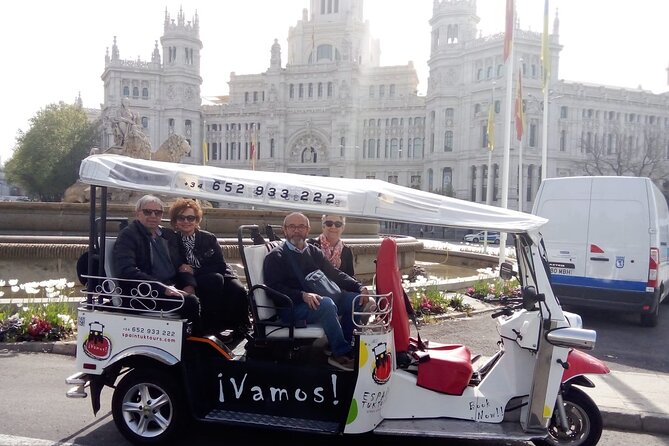
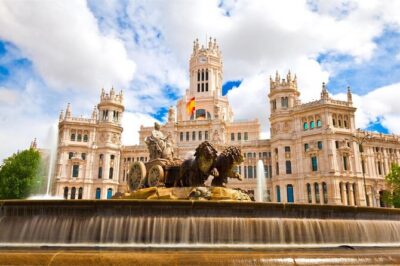
After that, Cibeles Fountain is another must. It represents the Roman goddess Cibeles, linked to land, agriculture, and fertility, with a car pulled by two lions. It’s also a fan icon for Real Madrid celebrations, and it’s framed by major city buildings around the square.
Puerta de Alcalá to Las Ventas: From Triumph Arch to Madrid’s Bullfighting Icon
Puerta de Alcalá is the monumental gateway built by Carlos III, inaugurated in 1778. It was designed by Francesco Sabatini and is a neoclassical arc of triumph. It’s even described as a precursor to later triumph arches across Europe, like Paris’s Arc de Triomphe and Berlin’s Brandenburg Gate. It has five openings instead of the usual three, and the two facades have different levels of decoration.
From there, you transition to sports and spectacle with Las Ventas bullring. It’s the biggest bullfighting venue in Spain, with 23,798 spectators. Its ring diameter is listed at 61.5 m, making it one of the largest in the world by diameter.
This stretch is a good reminder that Madrid isn’t one-note. You can spend half a day in royal palaces and grand plazas, and then still end up facing a major cultural tradition that’s part of how the city marks big moments.
Barrio de Salamanca and Gran Vía: Where Madrid Turns Elegant
You’ll pass through Barrio de Salamanca, including main streets like Velázquez, Ortega y Gasset, and Serrano. This is where Madrid feels more polished and designer-friendly, so it’s a useful counterpoint after the older cores.
The route also touches Gran Vía, one of Madrid’s main streets. It runs from Calle de Alcalá to Plaza de España and became a major milestone in the early 20th century for commerce, tourism, and leisure. For many first-time visitors, Gran Vía is where the city’s “modern Madrid” identity becomes obvious fast.
If you like switching vibes—old stone to wide avenue—this middle-to-late part of the route hits the tone changes well.
Santiago Bernabéu and Paseo Castellana: Modern Madrid at Full Scale
Next comes the Santiago Bernabéu Stadium. It opened December 14, 1947, and it currently holds about 81,044 spectators. Even if you’re not a die-hard fan, seeing a stadium on this scale helps you understand why Madrid carries global sports weight.
The tour continues along the Paseo de la Castellana financial district. This is a strong “Madrid today” section—wide boulevards, major buildings, and a different kind of city rhythm than what you saw near Plaza Mayor.
Plaza Colón, the National Library of Spain, and the Banco de España Exterior: Big Institutions, Quick Context
You end up around Plaza de Colón, anchored by the Columbus monument. The white marble sculpture is neo-Gothic, built in 1885 by Jerónimo Suñol, and it’s tied to the wedding celebration of Alfonso XII and María de las Mercedes de Orleans.
The square includes the Gardens of Discovery, opened in 1970, with sculptures you can admire on foot. The Cultural Center of the Villa Fernán Gómez is also referenced as being in the basement, so this area has layers beyond the monument itself.
The route also includes the National Library of Spain (BNE). It’s described as responsible for collecting and preserving Spain’s bibliographic and documentary heritage, with custody of around 30 million publications from the start of the 18th century—books, magazines, maps, prints, drawings, scores, and brochures.
Finally, you’ll see a stop connected to the National Bank building (Banco de España). The interior is noted as restricted: accessible only by groups from educational centers and universities, and exceptionally by nonprofit cultural or associative entities. That’s helpful to know so you’re not expecting a spontaneous public visit.
Price and Value: Does $215.07 for Up to 4 Make Sense?
At $215.07 per group (up to 4) for about 2 hours, the math can look good—especially if you split it. In the best case, that’s around $54 per person, before any separate entry tickets you choose on your own.
The value is strongest because you’re not paying for “one landmark.” You’re paying for a private ride that passes a large list of iconic stops: royal-palace area, major squares, fountains, a bullring, Bernabéu, and major city zones like Salamanca and the Castellana.
Just be honest with what’s not included. Palacio Real admission is not included, and a short tour means most stops are about seeing from outside or in quick proximity rather than doing long visits. Still, many listed stops have free admission, which helps you keep your budget under control.
If you’re the kind of traveler who wants a first-day overview with context and a photo-friendly guide, this price is easier to swallow.
Who Should Book This Electric Tuk-Tuk Tour, and Who Might Want Something Else?
This works best if:
- You’re in Madrid for a short stay and want quick bearings
- You like seeing lots of highlights without committing to a full-day on foot
- You want a private guide feel, not a big group schedule
- You care about photo positioning and getting smart context fast
You might want a different plan if:
- You want to spend serious time inside major sites (this schedule is short)
- You have strict needs around language. The tour is offered in English, but there has been at least one case where the spoken language didn’t match a requested one, so confirmation matters.
Also, if you’re sensitive to timing, keep a little buffer in your day. Electric tuk-tuk tours depend on pickup timing and smooth meeting at the start.
Should You Book It?
Yes, if your goal is a high-efficiency Madrid sampler with great city context and photo help. The best outcome is what this tour is designed for: short, well-chosen stops across both classic landmarks and modern Madrid beats.
If you have the patience for longer site visits, pair this with one or two separate ticketed experiences later in your trip. But for getting oriented fast and seeing Madrid’s “greatest hits” in a fun, small-group format, this is a strong choice.
FAQ
How long is the Madrid electric tuk-tuk tour?
The tour lasts about 2 hours.
What does it cost, and how many people are in a group?
It costs $215.07 per group, up to 4 people.
Is the Royal Palace admission included?
No. Palacio Real admission is not included.
What languages is the tour offered in?
The tour is offered in English.
Where do we meet for the tour?
The meeting point is Pl. de la Lealtad, 1, Retiro, 28014 Madrid, Spain.
What is the cancellation policy for a full refund?
You can cancel for a full refund up to 24 hours in advance of the experience’s start time.
More 2-Hour Experiences in Madrid
- Madrid: 2-Hour Sightseeing Segway Tour
★ 4.7 · 217 reviews - 2-Hour Tour of the Madrid of Mysteries
★ 4.5 · 75 reviews - Majestic Madrid 2-hour Walking Tour
★ 4.2 · 74 reviews - Axe Throwing 2 Hour Session
★ 5.0 · 49 reviews - Madrid Segway: 2h Casa Campo Off Road Tour
★ 5.0 · 34 reviews - 2-Hour Madrid – Prado Museum Private Tour
★ 4.6 · 31 reviews
More Tours in Madrid
- Madrid: Tour Bernabéu Entry Ticket
★ 4.5 · 21,573 reviews - Madrid: Panoramic Route City Tour
★ 4.1 · 12,259 reviews - Avila & Segovia Tour with Tickets to Monuments from Madrid
★ 5.0 · 9,762 reviews - Madrid: Royal Palace Expert Guided Tour with Skip-the-Line
★ 4.7 · 8,407 reviews - Madrid: Segovia and Toledo Tour, Alcazar, and Cathedral
★ 4.7 · 7,797 reviews - Toledo Tour from Madrid: Cathedral, Synagogue & St. Tome’s Church
★ 5.0 · 6,784 reviews
More Tour Reviews in Madrid
- Madrid: Tour Bernabéu Entry Ticket
★ 4.5 · 21,573 reviews - Madrid: Prado Museum Entry Ticket
★ 4.6 · 20,699 reviews - Madrid: “Emociones” Live Flamenco Performance
★ 4.8 · 12,866 reviews - Madrid: Panoramic Route City Tour
★ 4.1 · 12,259 reviews - Madrid: Live Flamenco Show with Food and Drinks Options
★ 4.5 · 9,901 reviews - Avila & Segovia Tour with Tickets to Monuments from Madrid
★ 5.0 · 9,762 reviews
Just Added: New Madrid Tour Reviews




2-Hour Experiences, compared.
 ★ 4.72-Hour Sightseeing Segway TourFrom $50217 reviews
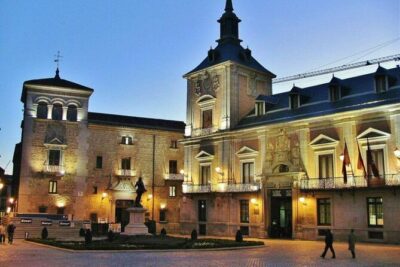 ★ 4.52-Hour Tour of the Madrid of MysteriesFrom $1475 reviews
Majestic Madrid 2-hour Walking TourFrom $3174 reviews
★ 4.52-Hour Tour of the Madrid of MysteriesFrom $1475 reviews
Majestic Madrid 2-hour Walking TourFrom $3174 reviews
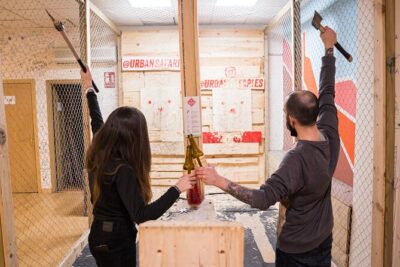 ★ 5.0Axe Throwing 2 Hour SessionFrom $3349 reviews
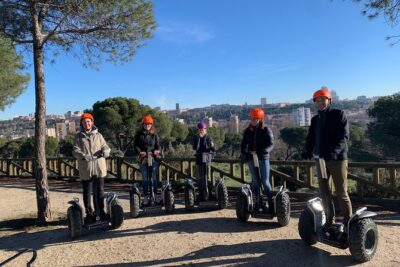 ★ 5.0Madrid Segway: 2h Casa Campo Off Road TourFrom $7234 reviews
 ★ 4.62-Hour Madrid – Prado Museum Private TourFrom $30631 reviews
 ★ 5.0Ax Throw – 2h – PREMIUMFrom $3325 reviews
 ★ 4.62-Hour Private City Tour Off the Beaten TrackFrom $8922 reviews
Browse the lists this tour appears in