REVIEW · MADRID
Architour through Lavapiés and Rastro with an architect
A good architecture tour does one thing fast: it gives you eyes. In Lavapiés and along the Rastro, I love how Emilio turns street corners into a real story, linking architecture to history and politics as you walk. You’ll also get a practical feel for Madrid’s everyday life, not just landmark photos.
My favorite part is the mix of styles in tight walking distance—medieval and baroque leftovers, rationalist 1930s details, and then Jean Nouvel’s modern Reina Sofía extension. One watch-out: this is a 3-hour walk, and you’ll cover cobblestones and alleyways, so wear comfortable shoes and plan for decent weather since the route depends on it.
In This Review
- Key highlights you’ll actually feel on the walk
- Why Lavapiés and the Rastro are great with an architect guide
- Plaza de Tirso de Molina: the neighborhood intro that sets the rules
- Carcel de la Inquisición: the eerie architecture under a corrala
- El Rastro market streets: how design shopping changes on Sundays
- El Pavón Teatro Kamikaze facade and its art-deco clock
- Imprenta Municipal: the rationalist 1930s building you’ll remember
- Plaza de Lavapiés: why the square is more than a landmark
- Museo Reina Sofía extension by Jean Nouvel: modern ideas and the 1999 contest
- Mercado San Fernando: tapas plans plus local advice
- La Tabacalera de Lavapiés: the industrial shell with an active creative scene
- Teatro Figaro and the modern movement idea
- Price and value: what $210.12 buys you on this route
- Logistics you should plan for: walk time, weather, and comfort
- Who should book this tour (and who might not love it)
- Should you book Architour through Lavapiés and Rastro?
- FAQ
- How long is the Architour through Lavapiés and Rastro?
- What language is the tour offered in?
- What is included in the price?
- Are drinks included at Mercado San Fernando?
- Is this tour private?
- Where does the tour start and end?
Key highlights you’ll actually feel on the walk
- Emilio’s architect lens: you connect buildings to how Madrid grew, politically and socially
- Rastro timing: you’ll hit the market street on Sundays, while other days focus more on the surrounding shops
- Rationalist magic at Imprenta Municipal: a 1930 municipal printing press with real design character
- Jean Nouvel’s Reina Sofía extension: a guided look at the ideas behind the building
- Lavapies as a living neighborhood: you’ll see the mix of cultures and daily street life around Plaza de Lavapiés
- Stops that end with food plans: tapas at Mercado San Fernando, with a friendly discussion to help you finish your Madrid days
Still deciding? Here are other Madrid tours to weigh up first.
- Madrid: Tour Bernabéu Entry Ticket★ 4.5 · 21,573 reviews
- Madrid: Prado Museum Entry Ticket★ 4.6 · 20,699 reviews
- Madrid: “Emociones” Live Flamenco Performance★ 4.8 · 12,866 reviews
- Madrid: Panoramic Route City Tour★ 4.1 · 12,259 reviews
Why Lavapiés and the Rastro are great with an architect guide
Lavapiés is one of those Madrid neighborhoods where the city’s layers stack up fast. You get old streets, changes from different eras, and constant cultural mixing in the same block. That’s exactly why an architect-led tour works here: buildings aren’t just scenery. They’re the evidence.
With Emilio, the walk feels like he’s teaching you how to read the place. You learn what to look for—facades, courtyards, design shifts, and how institutions and everyday life shaped the streets. And because the tour is structured around specific stops, you don’t wander aimlessly. You know why each corner matters.
It also helps that the route isn’t only museum time. You mix architecture with public spaces—markets, plazas, theaters, and a neighborhood market where you can plan your next steps in Madrid.
Plaza de Tirso de Molina: the neighborhood intro that sets the rules
You start at Plaza de Tirso de Molina, right in the Centro area. Emilio opens with the neighborhood’s background and how Madrid’s urban fabric evolved here. This matters because Lavapiés can look like one big “now” from a distance—cafés, people, noise, movement. The introduction gives you context so you can spot the older structure under the surface.
This isn’t a long lecture. The stop is about 15 minutes, just enough to get your bearings. If you’ve only got one morning in this part of town, this first grounding makes the rest of the route easier to follow.
Carcel de la Inquisición: the eerie architecture under a corrala
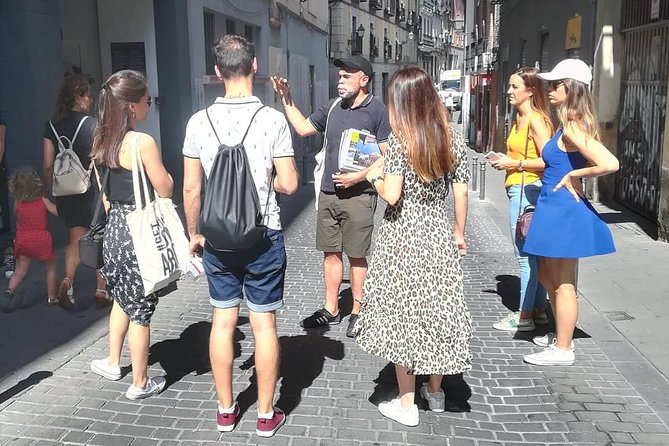
Next is the Inquisition Jail (Carcel de la Inquisicion), described as an Inquisition prison under a corrala. Even with a short visit, it gives you a jolt: the building layout and its tucked-in nature show how power worked in older Madrid—controlled, hidden, and wrapped into residential-style structures.
This stop is about 10 minutes. The value here isn’t just the fact of what it was—it’s seeing how Madrid reused spaces and how “history” can hide in ordinary-looking urban forms.
El Rastro market streets: how design shopping changes on Sundays
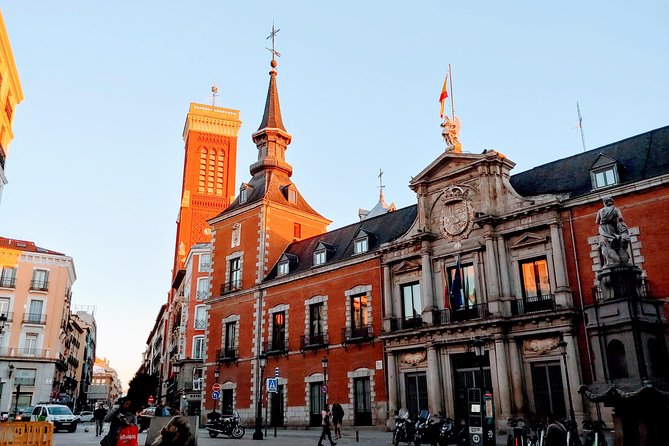
Then you head to El Rastro, the famous street market. Timing is the key detail. If you do this tour on a Sunday, you’re visiting the street market in full swing. If it’s not Sunday, the tour still gives you the route logic, but the focus shifts: you’ll likely see where the market energy lives and how the area’s vintage furniture shops operate during the rest of the week.
This works well for two types of visitors:
- If you love shopping, you’re in the right place at the right time.
- If you’re not shopping, you still get the urban rhythm—streets that function like a market even when they’re not packed.
Expect a 15-minute stop. Quick, but enough to notice what makes El Rastro a Madrid institution rather than just a flea market.




El Pavón Teatro Kamikaze facade and its art-deco clock
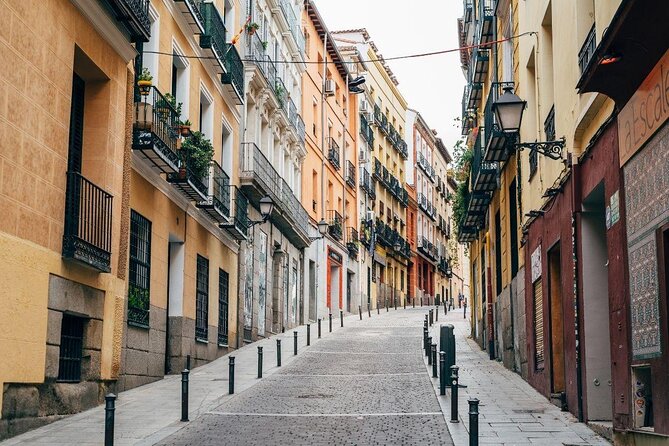
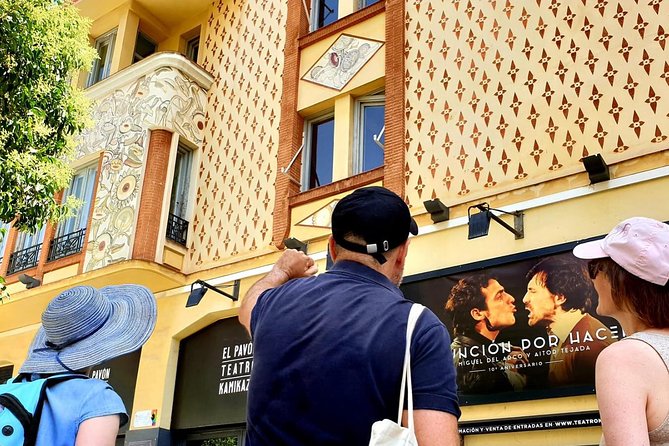
At El Pavón Teatro Kamikaze, you pause for the facade and the standout art-deco clock. This is one of those “stop for five minutes, but pay attention for an hour” moments. Emilio points out what makes art deco read as modern optimism in a city that’s otherwise built on layers.
There’s also an optional café moment. If you want, you can take a break with a coffee in the café in the middle of the architour. That matters because it gives you a chance to reset your legs and ask questions while the architecture is still fresh in your mind.
This stop is about 5 minutes, and it’s free to enjoy the exterior.
Imprenta Municipal: the rationalist 1930s building you’ll remember
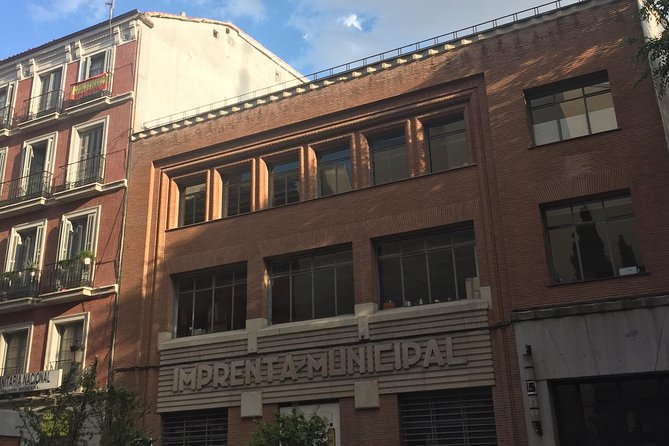
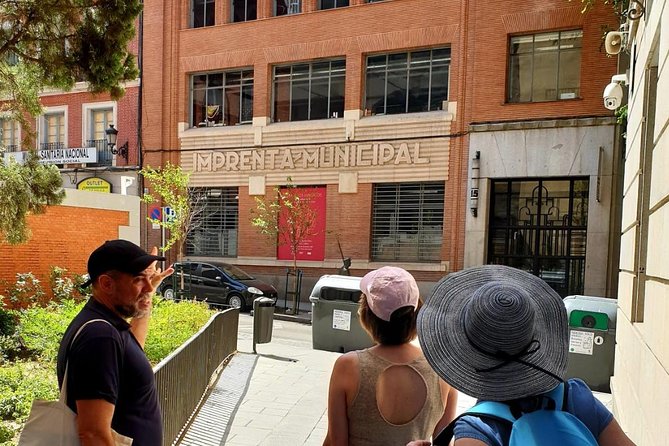
One of the most satisfying stops is Imprenta Municipal, described as a hidden jewel of Madrid rationalist architecture from 1930. You’ll spend around 15 minutes here, and the admission is included.
Rationalist buildings can feel plain if you’re not looking for the design choices. On this walk, Emilio frames it so you see the logic: clean lines, functional form, and the way institutions expressed modern thinking through architecture. This is also where his architect background really shows—he’s not just naming styles. He’s teaching you how the style connects to the moment it was built.
If you enjoy design history, this is a highlight stop.
Plaza de Lavapiés: why the square is more than a landmark
At Plaza de Lavapiés, you get the neighborhood viewpoint. This square is where the neighborhood gets its name, and you see the area’s daily mix—different cultures, different communities, neighbors who have lived there longer, and newer residents changing the vibe over the past few years.
The stop is short (about 5 minutes), but it’s a useful shift. Up to now you’ve been studying building types and facades. Here, you switch to people and place—who uses the space and how the neighborhood feels in real time.
For me, that balance is a big part of why this tour works. It doesn’t treat architecture like frozen art. It treats it like a backdrop to real life.
Museo Reina Sofía extension by Jean Nouvel: modern ideas and the 1999 contest
Next you visit the Museo Nacional Centro de Arte Reina Sofía extension designed by Jean Nouvel. This stop is about 10 minutes, and it’s focused on understanding the building’s thinking rather than rushing through rooms.
You’ll stop at the restaurant, the library, and the covered patio, and Emilio explains the contest proposals from 1999 that shaped different ideas for the space. Even if you don’t know modern museum design ahead of time, this is a friendly way to learn what architects were trying to solve—how the building creates movement, light, and flexible public space.
This is the moment where the tour jumps from “old Madrid layers” into “Madrid as a design-forward capital.” It gives you a contrast that makes the entire route click.
Mercado San Fernando: tapas plans plus local advice
You end the museum-styled part of the walk at Mercado San Fernando, a neighborhood market where you’ll take tapas and drink something. This is a practical stop. Emilio uses the food setting to discuss what you’ve seen so far and to share suggestions for your stay in Madrid.
Important: the market tapas and drinks are not included. You’ll decide what you want to order. That said, this stop is still great value because you’re getting:
- a break at the perfect time (about 15 minutes),
- a chance to eat something real, not just a snack,
- and a guided wrap-up that helps you turn the architecture lessons into travel choices.
If you like getting recommendations that are actually connected to where you walked, this stop is worth it.
La Tabacalera de Lavapiés: the industrial shell with an active creative scene
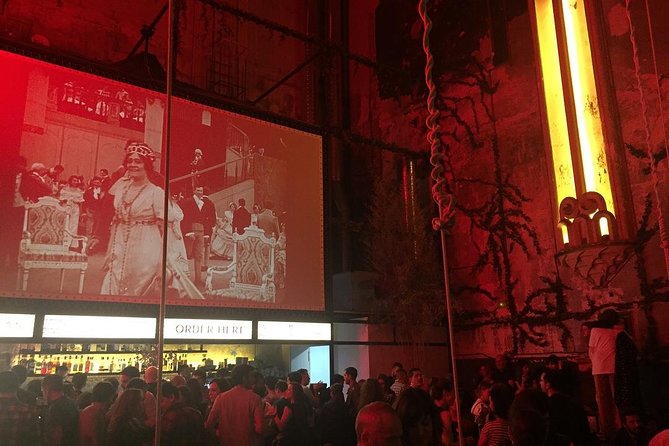
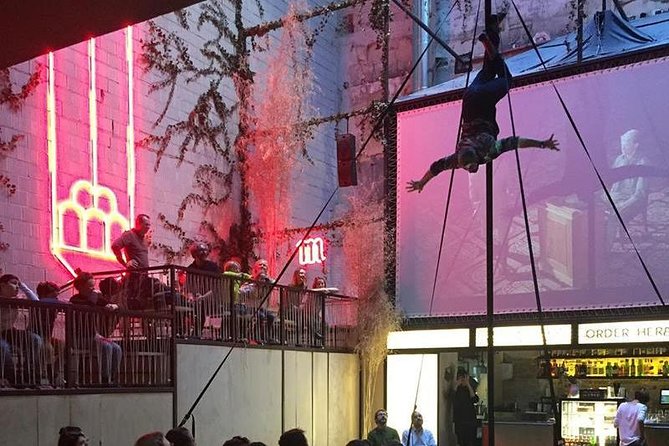
After San Fernando, you head to La Tabacalera de Lavapiés, an abandoned industrial building now used for exhibitions and a self-managed area by neighbors. On its walls, you’ll see works from top urban artists.
This is one of the most “Madrid right now” stops on the route. Industrial architecture was built for work; creative communities often bring it back to life with a different kind of purpose. Even with a 15-minute visit, you’ll understand the transformation: from production to expression.
One practical consideration: La Tabacalera is closed for works starting July 25. If you’re traveling around that time, you’ll want to check whether the visit is replaced or skipped.
Teatro Figaro and the modern movement idea
Finally, you visit Teatro Figaro, described as the first theater built in Spain using the criteria of the modern movement. You’ll spend about 5 minutes looking at it, which fits the overall pacing of the tour.
This last stop is like a closing argument. You go from old power spaces, to markets, to rationalist public architecture, to museum modern design, and then to a theater shaped by modern principles. By the end, you can see a pattern: Madrid keeps changing its identity through design choices, not just by adding new buildings.
Price and value: what $210.12 buys you on this route
At $210.12 per person for about 3 hours, the price isn’t trying to be a bargain walking tour. It’s paying for a guide with an architect’s skill set and a route that hits multiple meaningful sites in a small area.
Here’s where the value comes from:
- You’re not only seeing places. You’re getting explanations that connect architecture, social history, and politics.
- You get building access included, and at least one key building admission (Imprenta Municipal) is explicitly included.
- The tour ends with a market stop where you’re set up to eat and ask questions about the rest of your trip.
Also note the format: it’s a private tour/activity, so only your group participates. That makes a difference if you want to ask follow-up questions about details you care about—facade styles, urban planning, or why certain design eras left specific traces.
Logistics you should plan for: walk time, weather, and comfort
This is a walking tour. Even if the stops are short, the time adds up across alleys, plazas, and streets. You’ll enjoy it more if you start with shoes you can handle for hours.
It’s also stated that the experience requires good weather. If Madrid is in a heavy rain pattern, expect it to be rescheduled or refunded, but the bigger point for you is simple: don’t plan this on your only “maybe-weather” morning.
Finally, if you’re traveling around July 25, plan extra flexibility because La Tabacalera is closed for works from that date.
Who should book this tour (and who might not love it)
Book it if you:
- want an architecture-and-city-history walk, not a “here’s a photo stop” tour
- like understanding how politics and neighborhoods shape the built environment
- enjoy markets and public spaces, not only museums
- want a guide who can answer detail questions in plain language
You might skip it if:
- you hate walking or have limited mobility on foot (this is not described as a low-walking route)
- you’re only interested in famous museum halls and want fewer stops
- your dates fall near July 25 and you strongly want to see La Tabacalera (closure is a real factor)
Should you book Architour through Lavapiés and Rastro?
Yes—if you like your Madrid travel with real context. This tour is built around places that most people pass without understanding. With Emilio’s architect approach, the route turns into a way to see the city instead of just watch it.
I’d book it if you want one solid morning (or day) that mixes design thinking with neighborhood life—starting in Plaza de Tirso de Molina, moving through market and theater streets, and landing at Mercado San Fernando with tapas plans and smart follow-up advice. Just come prepared for walking, and double-check timing for La Tabacalera after July 25.
FAQ
How long is the Architour through Lavapiés and Rastro?
It’s about 3 hours (approx.).
What language is the tour offered in?
The tour is offered in English.
What is included in the price?
Access to all buildings is included, and Imprenta Municipal is listed as admission included. The other listed stops have free admission.
Are drinks included at Mercado San Fernando?
No. You’ll take tapas and drink something at the market, but drinks are not included.
Is this tour private?
Yes. It’s a private tour/activity, with only your group participating.
Where does the tour start and end?
It starts at Plaza de Tirso de Molina and ends at Mercado de San Fernando (C. de Embajadores, 41, Centro, 28012 Madrid, Spain).
More Tour Reviews in Madrid
- Madrid: Tour Bernabéu Entry Ticket
★ 4.5 · 21,573 reviews - Madrid: Prado Museum Entry Ticket
★ 4.6 · 20,699 reviews - Madrid: “Emociones” Live Flamenco Performance
★ 4.8 · 12,866 reviews - Madrid: Panoramic Route City Tour
★ 4.1 · 12,259 reviews - Madrid: Live Flamenco Show with Food and Drinks Options
★ 4.5 · 9,901 reviews - Avila & Segovia Tour with Tickets to Monuments from Madrid
★ 5.0 · 9,762 reviews