REVIEW · MADRID
Andalusia: Cordoba, Seville & Granada from Madrid – 4 Nights
Some tours just list sights. This one strings them into a real route through Andalusia. You’ll hit Cordoba’s Mezquita and Granada’s Alhambra with guided access, then get structured time in Seville’s historic center. Two things I really like: the guided walking in the key neighborhoods (Jewish Quarter in Cordoba and Santa Cruz in Seville), and the fact that entrance tickets for the big hitters are handled for you. One consideration: the pace is packed, and language support can be inconsistent, so bring comfy shoes and a flexible mindset.
This is a practical way to see a lot without planning. You’ll travel by air-conditioned coach, sleep four nights in 4-star hotels (Spanish hotel star ratings can feel different than elsewhere), and follow a guided rhythm with occasional free time. Still, it’s not a slow “wander at will” trip—expect walking, some waiting in busy areas, and optional add-ons that can change how the day feels.
In This Review
- Key Highlights That Make This Tour Work
- Day 1 From Madrid to Cordoba, Then On to Seville
- Mezquita-Catedral and the Jewish Quarter: Why This Stop Lands
- Day 2 Seville: Cathedral Views, Santa Cruz, and the Plaza de España Factor
- Optional Flamenco and Add-Ons: How to Choose Without Regret
- Day 3 Granada: Alhambra Day and the Shift From Streets to Palaces
- Granada’s Second Day: Free Time That Matters More Than You Think
- Day 5 Toledo: A Short Guided Walk Through Three Cultures
- Hotels, Meals, and the Coach Reality Check
- The Guide and Group Factor: What You Can Expect From the Human Side
- Value: Is $949.11 a Good Deal for This Route?
- Who This Tour Fits Best (and Who Should Skip It)
- Should You Book This Andalusia Tour?
- FAQ
- What’s included in the ticket price?
- What’s not included?
- Where do you meet in Madrid, and what time does it start?
- Do I need my passport for this tour?
- Is there a bathroom on the coach?
- How big is the group?
- Is the tour suitable for most people?
Key Highlights That Make This Tour Work
- Guided access to the big three: Mezquita (Cordoba), Seville Cathedral, Alhambra + Generalife (Granada)
- Seville’s “postcard core” built in: Santa Cruz, Parque de María Luisa, Plaza de España
- A real stop in Toledo: a short guided walk through an old town shaped by Christians, Muslims, and Jews
- Small group feel: maximum 40 people, and several reviews praise smooth organization
- You’re not stuck planning logistics: coach, entrance fees, and select meals are handled
- Optional choices you can tailor: flamenco add-ons and a possible Granada neighborhood visit to complement Alhambra
Still deciding? Here are other Madrid tours to weigh up first.
- Madrid: Tour Bernabéu Entry Ticket★ 4.5 · 21,573 reviews
- Madrid: Prado Museum Entry Ticket★ 4.6 · 20,699 reviews
- Madrid: “Emociones” Live Flamenco Performance★ 4.8 · 12,866 reviews
- Madrid: Panoramic Route City Tour★ 4.1 · 12,259 reviews
Day 1 From Madrid to Cordoba, Then On to Seville
Day 1 starts with a morning departure from Madrid at 8:00 am from the Meliá Castilla (C. del Poeta Joan Maragall, 43, Tetuán). After that, you’re headed south through La Mancha—Don Quixote country—with a quick stop in Puerto Lápice. It’s not a long detour, just enough to break the drive.
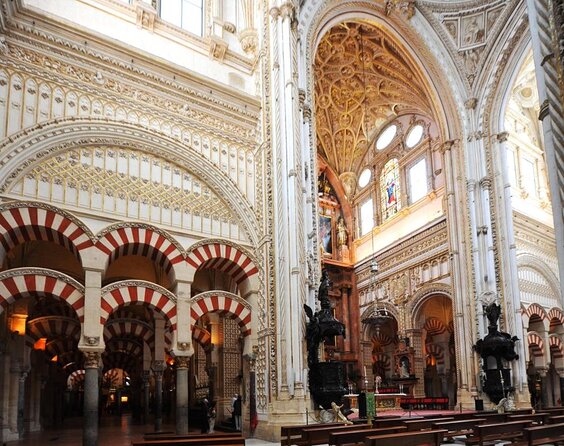
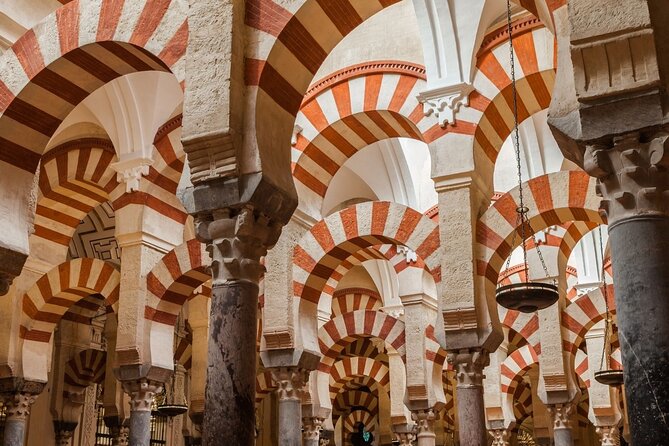
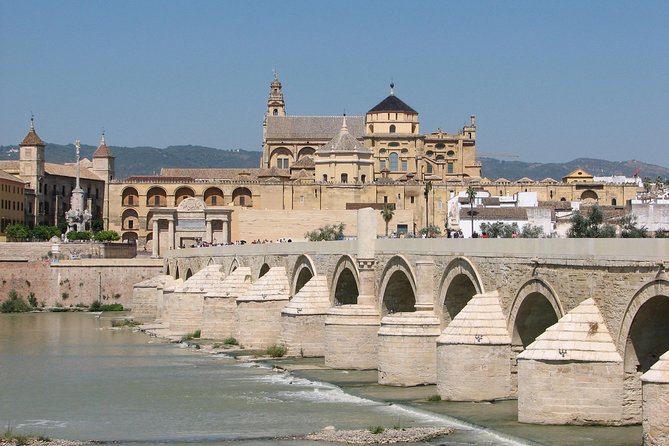
Then comes Cordoba, and the day is built around the Mezquita-Catedral. You’ll get a guided visit there, plus time moving through the narrow streets of Cordoba’s Jewish Quarter. This is one of the best ways to understand the city fast: the Mezquita isn’t just a landmark; it’s a physical record of changing powers and faiths. Even if you’ve read about it, seeing how the architecture “holds” different eras makes it click.
After Cordoba, you continue to Seville in the afternoon. It’s a long day, but the benefit is simple: you don’t waste your time sitting around in transit for multiple days. You arrive with enough energy to settle in and still have a guided plan for the next morning.
Practical note: there’s no bathroom on the coach. You’ll want to build your own hydration rhythm and use any planned breaks.
Mezquita-Catedral and the Jewish Quarter: Why This Stop Lands
If you only do one guided component well on a packed tour, make it this one. The Mezquita is huge in scale, but the guided element helps you see it with a purpose—where to look, what changes to notice, and how the different layers of worship and design connect.
Cordoba’s Jewish Quarter is also one of those places where time slows down on foot. Even on a guided route, you’ll have the feel of older streets and courtyards. If you like atmospheric neighborhoods—cobblestones, close buildings, sudden open squares—that part of the day is the payoff.
One thing to watch: some departures can feel rushed in the middle of the walking. If you’re sensitive to pace or you prefer a slower “stop and stare,” you may want to compensate by adding a bit of your own time during free slots (when offered) or by planning a separate return someday.
Day 2 Seville: Cathedral Views, Santa Cruz, and the Plaza de España Factor
Seville day is where the tour turns into full-on city sightseeing. You’ll start with the Cathedral of Seville. The tour includes the exterior visit, with entrance ticket included for the Cathedral. The key detail is that the exterior-first approach helps you orient before the inside. The Cathedral is second only in Catholic scale to St. Peter’s in Rome, so even its “outside” impact is real.
Next you move into Barrio Santa Cruz. This is the part of Seville that’s most often tied to stories—like Carmen vibes and Don Juan lore—and it’s worth visiting because it’s not just photogenic. It’s atmospheric: narrow lanes, small plazas, and a layout that rewards slow steps.
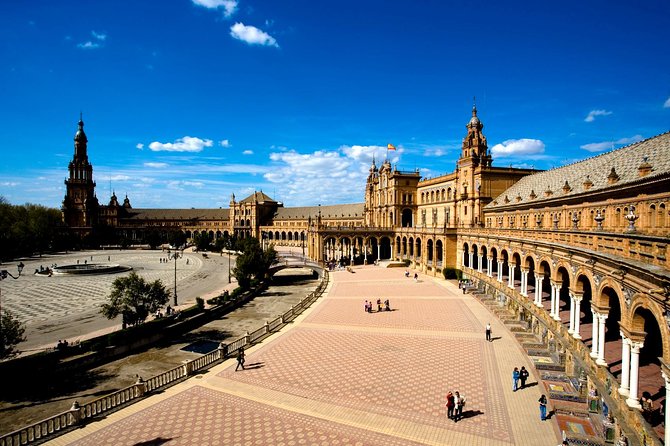
After that, you’ll pass through Parque de María Luisa and then see Plaza de España. These spaces are famous for a reason. They give your eyes a break from constant close-up street scenery. Plaza de España also gives you a chance to pick out angles for your own photos before you head into the historic core.
The afternoon is where the tour does something useful: it gives you time to explore on your own. Optional flamenco is also offered here. In several accounts, the flamenco add-on is the most consistently satisfying extra—especially compared to other add-ons that don’t always seem worth the time cost.
Reality check: Seville is easy to love, and a few departures can feel like you’re skating through. If you’re a “must-see everything” person, you may want to protect your energy for your own top priorities.
Optional Flamenco and Add-Ons: How to Choose Without Regret
There’s one clear theme in the experience: optional events can make or break your day. Flamenco tends to land well. Other add-ons, like a boat cruise option in Seville or certain “gypsy show” pairings in Granada, are more hit-or-miss depending on what you expect.
Here’s how I’d decide in plain terms:
- If flamenco is a core reason you’re going, pick a reputable show and treat it as entertainment, not a history lesson.
- If you’re picky about timing and prefer museum-level sites, you might skip weaker add-ons and use that time for another hour in a neighborhood or a second round at a main site.
Also: some optional side trips are easier if you have euros on hand. One common piece of advice from the group experience is that cash can be helpful for add-ons if payment methods aren’t consistent.




Day 3 Granada: Alhambra Day and the Shift From Streets to Palaces
By Day 3 you’ll head east from Seville to Granada. The route includes a drive through olive country—endless olive trees—before you reach the city and the monumental Moorish legacy that shaped Granada up to 1492.
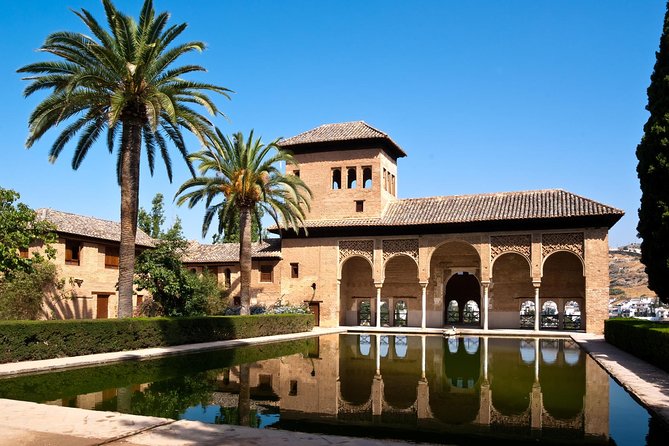
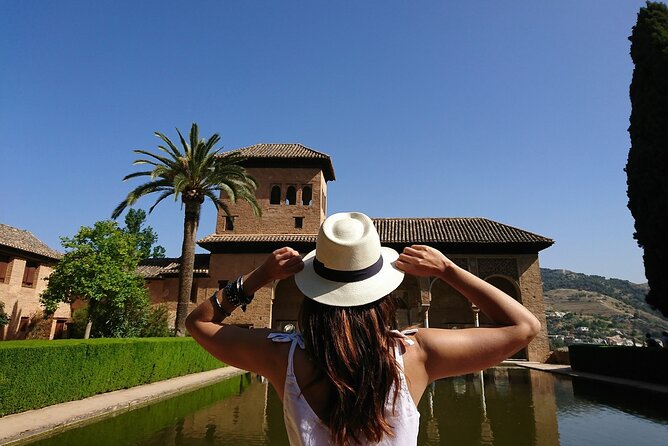
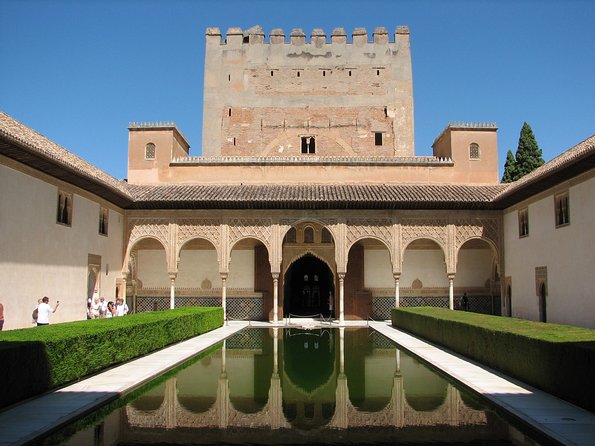
Then it’s Alhambra time. The tour includes entrance to the Alhambra complex and the Generalife Gardens. This is the moment you came for. You’re not just looking at rooms; you’re reading a design language: water, shade, geometry, and detailed surface work. Even if you only get a portion of the site in a group schedule, the experience is built to show the logic behind the beauty.
One crucial instruction: you must present your passport on the day you visit the Alhambra complex. Don’t leave it in your hotel safe “for later.” Bring it.
You may also have the option of a flamenco show in the Sacromonte quarter. Whether it’s worth it depends on what you want. If you love the performance side, it can be a great pairing with the evening vibe of Granada. If you mainly want architecture and neighborhoods, you might keep your energy for the next day’s free exploring.
Granada’s Second Day: Free Time That Matters More Than You Think

Day 4 is a free day in Granada, with an option to join a tour around El Albaicín. That’s a World Heritage site and it’s a smart complement to Alhambra. Alhambra is palace and gardens. Albaicín is living-in-the-slopes—older mosques converted to churches, old palaces, and the kind of street network that helps you understand how people actually moved and lived.
This is also where the “fast tour” model gives you a chance to slow down a little. You can focus on Granada beyond the ticketed highlight.
One tip: Granada is more than one complex. If you only care about Alhambra, you’ll feel full by noon. If you want the city feel, use the free day to find small viewpoints, sit down, and let the city breathe for a bit.
Day 5 Toledo: A Short Guided Walk Through Three Cultures

The final day takes you north to Toledo, an “imperial city” sitting above the Tagus River. Toledo’s story is often told as three cultures living side by side: Christians, Muslims, and Jews. On this tour, you’ll get a short guided tour through narrow old streets to help you understand the town layout and what to look for.
The time is tight, so it’s best approached like this:
- Use the guided walk to get the big orientation.
- Then decide if you want to linger on your own if time allows (on this type of route, the ability to linger can vary).
After Toledo, you drive back to Madrid. The tour ends back at the same meeting point where you started.
Hotels, Meals, and the Coach Reality Check
The tour includes four nights of accommodation in 4-star hotels, but Spanish hotel standards can feel different than what you’re used to elsewhere. A few departures seem to work great—clean rooms, solid comfort, and good breakfast experiences. Other departures have had complaints about buffet dinners or limited vegetarian options, especially in Granada.
So what should you do? Don’t assume every meal will be a feast. Treat included breakfasts as a dependable anchor, and plan to find your own lunch or dinner options nearby when you can.
On the logistics side:
- Air-conditioned coach is included.
- Group size caps at 40.
- There’s no bathroom on the coach, so planned breaks matter.
The Guide and Group Factor: What You Can Expect From the Human Side
This tour’s quality often comes down to your guide. Some named guides show up as highlights: Grace (on several accounts) is praised for storytelling and organization, and local Granada guiding is noted as strong through Sergio. Another guide name that appears is Josep, with positive remarks about keeping the group upbeat.
That said, a big potential drawback is language handling. Even when the tour is advertised in English, some departures can run Spanish first and then English later. If you strongly need constant English-only narration, this is the biggest “read the room” risk.
The pace can also vary by group and guide. Some people felt the walking speed was easy; others struggled and felt left behind during explanations. If you’re 60+ or you don’t move quickly, you’ll want to be honest with yourself about your tolerance for steady group walking.
A small practical fix: bring good shoes and keep your eye on where the group is heading during photo stops. These tours move as a unit.
Value: Is $949.11 a Good Deal for This Route?
For $949.11 per person, you’re paying for four nights, coach transportation, guided visits, and included entrance fees for the Mezquita, Seville Cathedral, Alhambra, and Generalife. You’re also getting select meals (breakfasts are included for four days, and some other meals may be part of the package as specified).
If you tried to DIY this at the same speed, you’d likely pay separately for:
- Guided tickets/access (especially Alhambra)
- Entrance fees in all three cities
- Intercity transport across multiple days
That’s why many people call this a value-for-limited-time option. You’re not buying a lazy vacation. You’re buying an efficient route where the key “must-book” items are already built in.
The catch is that the tour value depends on what you care about. If you want deep time in Seville or Cordoba—think 2–3 days each—this package will feel rushed. Some add-ons can also dilute value if you choose the wrong ones, like lower-quality optional events.
My honest take: this is good value if you’re methodical and time-limited, and you’re willing to pick one or two optional extras rather than stacking everything.
Who This Tour Fits Best (and Who Should Skip It)
This tour fits you best if:
- You want a guided path through Cordoba, Seville, and Granada with the main ticketed sites included
- You like historic neighborhoods and architecture more than lounging
- You travel with flexible expectations and can handle lots of walking
It might not fit you as well if:
- You need strict English-only narration at all times
- You can’t manage steady group pace or you dislike long walking days
- You plan to rely on optional add-ons as your main highlights (some aren’t worth the time cost)
If you’re an “I want to see everything slowly” traveler, you’ll probably enjoy a slower land-based plan with one or two bases instead of hopping cities.
Should You Book This Andalusia Tour?
I’d book it if your goal is a high-impact circuit with guides, transport, and major entrances handled. The combination of Cordoba’s Mezquita, Seville’s Cathedral + Santa Cruz, and Granada’s Alhambra makes this a strong one-week-adjacent experience even though it’s shorter.
I’d hesitate if English narration consistency matters more than schedule efficiency. In that case, you might prefer an itinerary where English-only guiding is guaranteed, or you might plan a DIY approach and hire local guides for just the top sites.
Finally, go in prepared: pack a passport for Alhambra, wear shoes made for uneven stone, and treat optional side trips as choices—not necessities.
FAQ
What’s included in the ticket price?
The tour includes guided visits in Seville, Cordoba, Granada, and Toledo; four nights of accommodation; air-conditioned coach transport; travel insurance; entrance to the Mosque of Cordoba, Seville Cathedral, Alhambra, and Generalife Gardens; and breakfast for four days.
What’s not included?
Food and drinks beyond what’s specified, and hotel pickup/drop-off in Madrid (you meet at the listed starting point instead).
Where do you meet in Madrid, and what time does it start?
You meet at Meliá Castilla on C. del Poeta Joan Maragall, 43, Tetuán, Madrid, and the start time is 8:00 am. The tour ends back at the same meeting point.
Do I need my passport for this tour?
Yes. It’s mandatory to present your passport on the day you visit the Alhambra complex.
Is there a bathroom on the coach?
No, there is no bathroom on the coach.
How big is the group?
The tour has a maximum of 40 travelers.
Is the tour suitable for most people?
The tour notes that most travelers can participate, but it’s still a walking-heavy itinerary, so comfort with paced walking matters.
More Tour Reviews in Madrid
- Madrid: Tour Bernabéu Entry Ticket
★ 4.5 · 21,573 reviews - Madrid: Prado Museum Entry Ticket
★ 4.6 · 20,699 reviews - Madrid: “Emociones” Live Flamenco Performance
★ 4.8 · 12,866 reviews - Madrid: Panoramic Route City Tour
★ 4.1 · 12,259 reviews - Madrid: Live Flamenco Show with Food and Drinks Options
★ 4.5 · 9,901 reviews - Avila & Segovia Tour with Tickets to Monuments from Madrid
★ 5.0 · 9,762 reviews